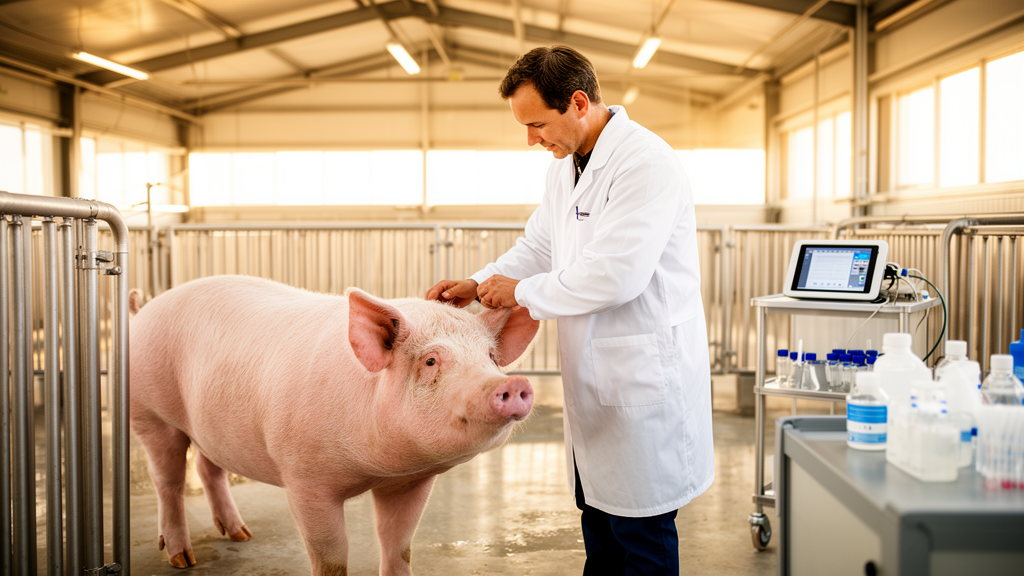
A large-scale empirical evaluation of commercial pig populations has revealed that variation in autosomal crossover count inherited from sires does not produce statistically significant changes in sire additive genetic variance for major reproduction and production traits. Meiotic recombination, which facilitates the reciprocal exchange of chromosomal material between homologous pairs during gamete formation, has long been hypothesized to release cryptic genetic variation by breaking linkage disequilibrium between adjacent genomic loci. In an investigation analyzing tens of thousands of phenotypic records across two distinct commercial lines, researchers found that while crossover counts varied substantially, the estimated sire additive genetic variance across discrete crossover intervals did not deviate significantly from baseline population estimates.
The study sought to resolve whether selecting or stratifying animals according to their autosomal crossover count could act as an effective mechanism to accelerate genetic gain. In livestock breeding programs, the additive genetic variance of a trait is the fundamental driver determining response to artificial selection. Previous theoretical investigations and simulation studies postulated that substantially elevating the frequency of meiotic recombination could unlock favorable allele combinations and generate more extreme haplotypes, thereby enlarging genetic variance. Nevertheless, earlier modeling suggested that achieving measurable increases in genetic gain might require a tenfold to twentyfold elevation in crossover rates, an increase that could introduce severe biological constraints. The current investigation provided an empirical test of whether existing, naturally occurring variation in crossover transmission within commercial populations generates measurable shifts in additive genetic variance.
To obtain reliable estimates of meiotic crossovers, the investigators utilized extensive genomic datasets supplied by the commercial breeding company Topigs Norsvin, covering two specialized genetic lines with distinct selective histories. The first line was a Large White sow line selected primarily for maternal reproductive performance, comprising an initial set of 246,630 animals. Both populations were genotyped using an Illumina Geneseek custom 25K single nucleotide polymorphism array mapped to the Sscrofa11.1 swine reference genome. Stringent pedigree and quality filters were applied to ensure haplotype phasing accuracy, requiring every informative family to include an individual with at least five offspring, two genotyped parents, and four genotyped grandparents. Following the removal of sex chromosomes, Mendelian inconsistencies, and map positioning errors, the refined pedigree structures retained 8,265 families comprising 78,446 individuals in the sow line and 5,642 families with 47,549 individuals in the boar line.
The estimation of crossover events was conducted using the rule-based phasing and recombination detection software LINKPHASE3. By tracking inheritance patterns across validated parent-offspring pairs, the software determined the parental origin of phased haplotypes and quantified the number of autosomal crossover events transmitted during gametogenesis. Paternal and maternal crossovers are generated through independent meiotic events and were treated as distinct biological observations. Because breeding sires are typically mated to multiple dams and generate large progeny cohorts, each sire contributes repeated crossover transmissions across offspring. To enhance phasing reliability, records were restricted to parent-offspring pairs with at least one genotyped maternal grandparent and one genotyped paternal grandparent. This filtering protocol yielded 144,912 estimated crossover transmissions in the sow line and 87,984 in the boar line. The primary quantitative models focused specifically on paternal autosomal crossover counts, incorporating 72,456 informative sire-offspring pairs from the maternal line and 43,992 pairs from the terminal sire line.
The researchers coupled these genomic transmission metrics with comprehensive phenotypic datasets covering five core breeding goal traits. For the Large White maternal line, the analysis examined three reproductive traits: total number of piglets born, number of piglets born alive, and number of stillborn piglets, totaling an initial pool of over 437,000 raw litter records from more than 128,000 unique sows. Following standard data cleaning protocols, including four-standard-deviation filtering and Box-Cox transformation for stillborn counts to correct for residual skewness, more than 50,000 validated farrowing observations were paired with paternal crossover data. The team also evaluated the total number of teats recorded at one day of age in nearly 15,000 sows, representing an anatomically stable trait with high heritability. For the production perspective, standardized lifetime daily gain, measuring growth from birth to the conclusion of post-lactation testing at approximately 180 to 200 days, was analyzed using 39,753 records from the sow line and 35,168 records from the boar line.
To evaluate whether additive genetic variance fluctuated across recombination rates, the authors grouped the phenotypic observations into five discrete bins based on paternal autosomal crossover count, ensuring non-overlapping ranges and comparable sample sizes per bin. Univariate mixed linear sire models were initially fitted using ASReml to estimate additive sire variance both across the pooled population and within each individual bin. Fixed effects, such as herd-year-season of farrowing or birth, and random effects, including permanent environmental and maternal influences, were parameterized according to the biological structure of each trait. Across all five traits, the 95% confidence intervals of the overall sire additive genetic variance overlapped with the estimates calculated within each crossover bin.
Despite the absence of formal statistical significance, the empirical estimates revealed distinct, trait-specific numerical tendencies across the crossover bins. For the reproduction traits of total piglets born and piglets born alive, as well as teat count, sire additive genetic variance was numerically maximized at intermediate ranges of paternal crossover counts. Conversely, standardized lifetime daily gain in both the maternal and terminal lines showed numerical elevations in additive genetic variance toward higher crossover ranges. For the Box-Cox transformed stillborn piglet trait, variance was highest within the lowest crossover bin. When comparing the bin with the lowest estimated variance to the bin with the highest estimated variance within each trait, the observed values differed by an unadjusted average of 57%, indicating that although random sampling uncertainty was broad, the biological trends displayed marked diversity depending on the genetic architecture of the phenotype under selection.
To investigate cross-bin covariance and evaluate whether different crossover classes behaved as genetically correlated traits, the authors implemented pairwise bivariate sire models across all ten combinations of the five bins. Bivariate analyses achieved stable numerical convergence across all combinations for piglets born alive, and across nine of ten models for total born and stillborn counts, whereas models for teat count and daily gain suffered from convergence limitations due to overparameterization. Genetic correlations between bins for litter size traits were consistently high, ranging between 0.79 and 0.99, indicating substantial genetic stability across the recombination gradient. An exception appeared in the stillborn trait, where genetic correlations between the lowest crossover bin and all subsequent bins dropped to between 0.75 and 0.80, suggesting possible architectural heterogeneity or heightened sensitivity to segregation errors when recombination rates are depressed.
Complementary analyses using random regression models with Legendre polynomials were implemented to trace the continuous trajectory of additive genetic variance across the full spectrum of paternal crossovers. For total piglets born and piglets born alive, statistical model comparisons favored a fourth-order Legendre polynomial over simpler functions. However, the resulting continuous trajectories produced sharp, biologically implausible variance increases at the extreme tails of the crossover distribution, where observations represented less than 1.7% of the dataset. For teat count, stillborn piglets, and daily gain, zero-order polynomials were favored, reflecting an essentially flat variance response across the covariate. The authors noted that random regression models can suffer from artifactual boundary inflation and potential confounding between additive genotype effects and crossover inheritance, leading them to place higher confidence in the discrete, independent estimates generated by the univariate and bivariate models.
The study also assessed the biological implications of sex differences in recombination landscapes and heterochiasmy. When parallel univariate models were fitted using maternal crossover transmissions, NBA and TNB maintained similar intermediate optimization patterns, but the remaining traits exhibited marked divergence between parental sexes. Paternal and maternal crossover transmissions within identical offspring were found to be uncorrelated, with paternal counts ranging from 5 to 34 crossovers and maternal counts spanning 8 to 47. The authors concluded that while autosomal crossover counts do not demonstrate significant empirical utility for altering additive genetic variance under current commercial distribution ranges, future breeding strategies should monitor crossover distributions and intrachromosomal shuffling metrics rather than assuming gross crossover frequency alone can unlock additive genetic gains.
Subject of Research: Evaluation of autosomal crossover count and sire additive genetic variance in pig breeding
Article Title: Potential of autosomal crossover count to enhance additive genetic variance in pig breeding programs
Article References: Katz, O., Wientjes, Y. C. J., Jansen, A. C. M., & Calus, M. P. L. (2026). Potential of autosomal crossover count to enhance additive genetic variance in pig breeding programs. Genetics Selection Evolution, 58(1), Article 85. https://doi.org/10.1186/s12711-026-01114-0
Image Credits: AI Generated
DOI: 10.1186/s12711-026-01114-0
Keywords: animal breeding, porcine genetics, autosomal crossover count, additive genetic variance, meiotic recombination, reproduction traits, production traits, sire models, random regression, Legendre polynomials, Large White pigs, synthetic boar line, LINKPHASE3, single nucleotide polymorphisms, total number born, number born alive, number of stillborn piglets, standardized daily gain
News Source: Juliet Wilcox. (November 12, 2026). Pig Breeding Study Finds Autosomal Crossover Counts Do Not Significantly Boost Genetic Variance. Scienmag.