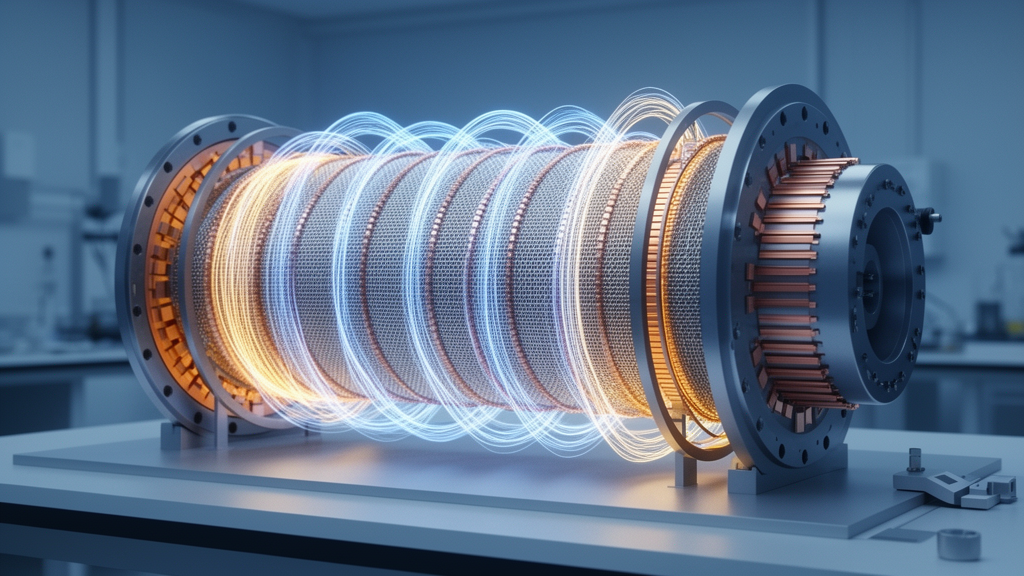
Deep inside the ATLAS experiment at CERN, a set of particle detectors called the New Small Wheels has been quietly doing a job that most visitors never think about: surviving torrents of highly ionizing particles without erupting into destructive electrical sparks. The New Small Wheels, an upgrade of the ATLAS Muon Spectrometer built in view of the High-Luminosity LHC, combine two detector technologies, resistive Micromegas and sTGC, arranged into sixteen sectors in each wheel. The Micromegas detectors have already been installed and operate in the experimental cavern, and their ability to suppress sparks relies on a subtle electrodynamic phenomenon that has now been mapped in detail by a team of researchers working on the project.
In a study published in EPJ Techniques and Instrumentation, T. Alexopoulos, S. Maltezos, K. Patrinos and G. Koutelieris, together with G. Iakovidis, describe analytically how electric charge deposited on a resistive strip spreads across its surface and how that spreading charge creates a transient electric field that suppresses sparking in the detector’s amplification region. The work provides a spatial and temporal map of the perpendicular component of this field, calculated with both an approximate two-layer geometric model and a more accurate three-layer treatment that accounts for the real thickness of the resistive film.
To understand why this matters, it helps to look at how the New Small Wheel Micromegas are built. Each detector consists of two main regions, a conversion and drift region and an amplification region, separated by a grounded metallic grid called the Micromesh. Both regions are filled with a gas mixture that is nominally argon with 5 percent carbon dioxide and 2 percent isobutane for the New Small Wheel application. The Micromesh itself is a woven configuration of metallic wires 30 micrometers in diameter, spaced 70 micrometers apart with a pitch of 100 micrometers. Constant voltages applied to the cathode plane and the resistive strips create a low-strength electric field in the drift region and a high-strength one in the amplification region. The Micromesh plays three roles at once: it separates the two regions, it remains transparent to incident electrons produced in the drift region, and it collects the positive ions generated during the avalanche.
The spark suppression mechanism rests on the resistive design. In the resistive Micromegas of the New Small Wheels, an adequate suppression of the spark rate is achieved because the deposited charge develops an electric field pointing in the opposite direction to the constant electric field in the amplification region. This results in an instantaneous drop in the overall electric field during spark formation, and in that way the gas gain is sufficiently reduced. The authors note that resistive Micromegas detectors can therefore be characterized as spark-insensitive. Even so, the highly ionizing particles produced in LHC collisions still lead to an increasing probability of spark occurrence, which is why a quantitative understanding of the transient field matters for the detector’s operation.
The physical picture the team analyzes is as follows. Electron avalanches form in the amplification region, and an electric point charge is deposited almost instantaneously on a resistive strip, while a signal is induced on the readout strips basically due to the motion of that charge. In the argon-based gas mixture used, about 50 electrons are liberated in the 5 millimeter drift gap, and the signal formed spreads over roughly 100 to 200 nanoseconds as ions drift toward the cathode. Between the resistive strips and the readout strips, which are 17 micrometer thick copper structures, there is an insulator 64 micrometers thick. Each resistive strip is a thin resistive film about 15 micrometers thick, characterized by a surface resistivity measured in ohms per square that depends only on the material and its thickness.
The electrical layout is more elaborate than a single strip. Each New Small Wheel Micromegas printed circuit board carries 1024 resistive strips printed in parallel, interconnected at one end through a conducting silver line connected to the positive high-voltage electrode, while the other end of each strip is left floating. The readout strips are grounded through the electronics, specifically through charge-sensitive amplifiers, and the Micromesh is grounded as well. The whole system extends over areas of the order of square meters per module. Despite this segmented structure, the authors argue that under a macroscopic view the potential is well defined on the grounded layers, so the electrode system can be treated, in good approximation, as an infinitely extended geometry. They estimate that a strip width of 300 micrometers over the 64 micrometer insulator thickness gives a ratio close to 4.7, allowing an infinite-geometry treatment with accuracy better than 5 percent, and even better near the middle of the amplification region where the field is of greatest interest.
The first stage of the analysis uses a two-layer approximation in which the resistive layer is treated as infinitely thin with a constant given surface resistivity. Solving the Laplace equation in cylindrical coordinates with the grounded Micromesh plane and the grounded readout strip plane as boundary conditions, the team derives an expression for the potential and then for the perpendicular electric field component, which decays in time with a characteristic decay time that depends on the surface resistivity, the permittivities and the geometric parameters. Because an infinitely thin resistive layer would drive the expressions toward infinity, the authors employ a mathematical trick from earlier work, replacing a product in the integrand with a finite representative value, which makes the calculations remarkably simpler and informative about the impact of the associated parameters, even though such an infinitely thin layer is unachievable experimentally.
That limitation motivates the second, more accurate stage: a three-layer geometry that includes the resistive film in the middle with its actual thickness of 15 micrometers. The grounded Micromesh is placed at 128 micrometers and the relative permittivity of the insulator layer is taken as 3.55. The calculation is based on formulating a six-equation linear system whose determinant encodes the boundary conditions at every interface; the constants in the field solution are computed numerically and the inverse Laplace transformation is performed using the Mathematica framework. The authors report that the two methodologies are precisely consistent at thickness values down to 1 nanometer, confirming that the simplified model captures the physics in its limiting case while the three-layer treatment is the one that reflects reality.
With the accurate method in hand, the researchers studied how the electric field depends on the resistive layer thickness across a realistic range from 1 to 30 micrometers. Two scenarios were considered. In the first, the surface resistivity was held fixed at 0.24 megaohms, corresponding to a production choice in which the resistive material is selected to satisfy the relation between resistivity, surface resistivity and thickness. In the second, the volume resistivity was held fixed at 3.6 ohm-meters, corresponding to selecting a layer thickness and then calculating the resulting surface resistivity for experimental confirmation. In the fixed-resistivity case, the field at the time slice of 1 nanosecond shows a minimum at a thickness of 3.6 micrometers, a feature the authors note can help counterbalance the uncertainty of the thickness during deposition. In the fixed surface resistivity case, smaller thicknesses produce a smaller slope of the curve, with asymptotic behavior toward 1 nanometer and beyond.
The conclusions carry practical weight for detector design. The team found that the resistive layer thickness, studied at its realistic scale, affects significantly the decay rate of the transient electric field. They also showed that the overall electric field in the amplification region develops a transient radial valley, roughly equal in width to the resistive strip, even within a time slice of 1.1 nanoseconds, and that a smaller deposited point charge produces a correspondingly shallower valley. The transient field component at all times is increased mostly above the mid-plane of the amplification region at 64 micrometers. The insulator width matters as well: increasing it by 50 percent increases the electric field by 14 percent. Because the mapped field governs the onset, spatial development and probability of sparks, the authors emphasize that the three-layer methodology, which respects the actual resistive layer thickness, is not only the accurate approach but also a useful design tool for future detectors based on resistive strips. The study is purely analytical and computational, grounded in the as-built geometry of the installed New Small Wheel detectors, and its mapped fields are intended to feed further studies of the spark mechanism rather than to report new operational measurements from the cavern itself.
Subject of Research: Analytical mapping of the transient electric field responsible for spark suppression in resistive strip Micromegas detectors of the ATLAS New Small Wheels
Article Title: Mapping of the transient electric field causing spark suppression in Micromegas of the ATLAS New Small Wheels
Article References: Alexopoulos, T., Maltezos, S., Patrinos, K., Iakovidis, G., & Koutelieris, G. (2025). Mapping of the transient electric field causing spark suppression in Micromegas of the ATLAS New Small Wheels. EPJ Techniques and Instrumentation, 12(1), Article 2. https://doi.org/10.1140/epjti/s40485-025-00115-5
Image Credits: AI Generated
DOI: 10.1140/epjti/s40485-025-00115-5
Keywords: ATLAS, New Small Wheel, Micromegas, spark suppression, transient electric field, resistive strips, CERN, HL-LHC, charge spreading, detector instrumentation, electric field mapping, Laplace equation
News Source: Denise Maddox. (October 29, 2026). Physicists Map the Transient Electric Field That Keeps ATLAS Micromegas Detectors From Sparking. Scienmag.