

• HOME
  • NEWS
  • EXPLORE
    • CAREER
      • Companies
      • Jobs
    • EVENTS
    • iGEM
      • News
      • Team
    • PHOTOS
    • VIDEO
    • WIKI
  • BLOG
  • COMMUNITY
    • FACEBOOK
    • INSTAGRAM
    • TWITTER
Monday, December 29, 2025
BIOENGINEER.ORG
No Result
View All Result
  • Login
  • HOME
  • NEWS
  • EXPLORE
    • CAREER
      • Companies
      • Jobs
        • Lecturer
        • PhD Studentship
        • Postdoc
        • Research Assistant
    • EVENTS
    • iGEM
      • News
      • Team
    • PHOTOS
    • VIDEO
    • WIKI
  • BLOG
  • COMMUNITY
    • FACEBOOK
    • INSTAGRAM
    • TWITTER
  • HOME
  • NEWS
  • EXPLORE
    • CAREER
      • Companies
      • Jobs
        • Lecturer
        • PhD Studentship
        • Postdoc
        • Research Assistant
    • EVENTS
    • iGEM
      • News
      • Team
    • PHOTOS
    • VIDEO
    • WIKI
  • BLOG
  • COMMUNITY
    • FACEBOOK
    • INSTAGRAM
    • TWITTER
No Result
View All Result
Bioengineer.org
No Result
View All Result
Home NEWS Science News Biology

Physicists gain new insights into nanosystems with spherical confinement

Bioengineer by Bioengineer
July 26, 2017
in Biology
Reading Time: 2 mins read
0
Share on FacebookShare on TwitterShare on LinkedinShare on RedditShare on Telegram
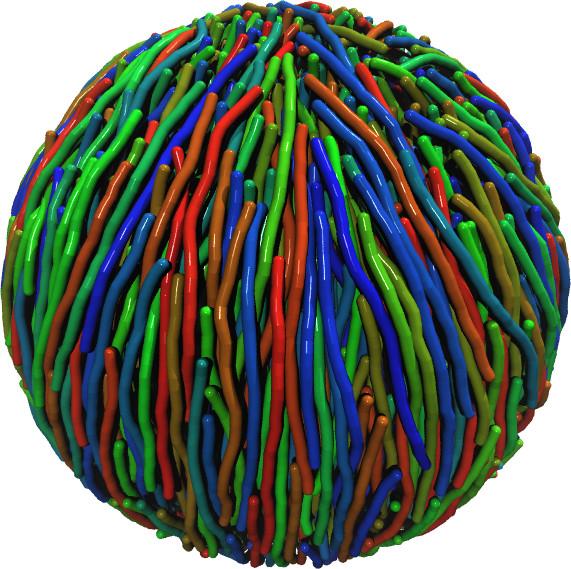
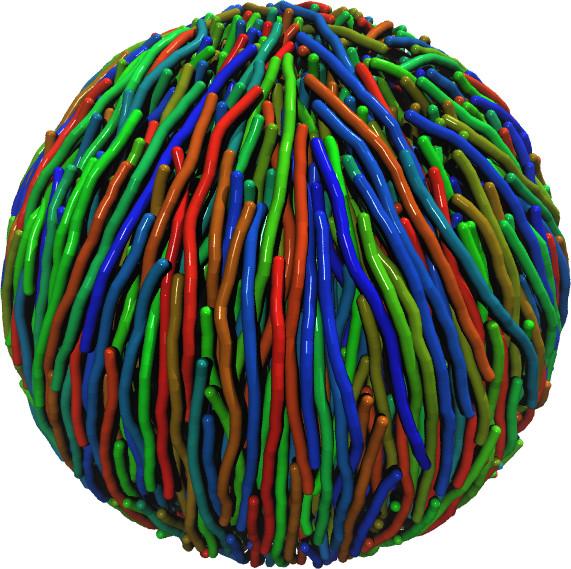
IMAGE

Credit: Ill./©: Arash Nikoubashman, Mainz University

Theoretical physicists led by Professor Kurt Binder and Dr. Arash Nikoubashman at Johannes Gutenberg University Mainz (JGU) in Germany have used computer simulations to study the arrangement of stiff polymers in spherical cavities. These confined systems play an important role for a wide range of applications, such as the fabrication of nanoparticles for targeted drug delivery and for tailored nanomaterials. Furthermore, the investigated systems can give crucial insights into the inner workings of biological problems where confinement effects are crucial, such as the packaging of double-stranded DNA in bacteriophage capsids and the self-assembly of actin filaments in cells.

The simulations have demonstrated that fully flexible chains are homogeneously distributed inside the spherical cavity, with an unstructured surface at the confining sphere. However, when the stiffness of the chains was increased, the polymers aligned in a parallel fashion with the chain ends ordered on a common equatorial plane. At the same time, complex structures emerged on the sphere surface. At low densities and intermediate stiffness, the chains formed bipolar patterns (see Figure 1), as they are known from onions and globes. As the density and stiffness was increased further, the texture changed to a tennis ball-like structure with four distinct poles (see Figure 2).

These highly unusual states originate from the complex interplay between the packing and bending of the individual polymer chains. On the one hand, it is entropically favorable for stiff polymer chains to align parallel to each other. This so-called nematic phase is, for instance, crucial for the functionality of liquid crystal displays. On the other hand, the spherical confinement impedes such an order throughout the whole system so that the chains close to the sphere surface have to bend, which is energetically unfavorable. The resulting structures are then the compromise out of these constraints.

These simulations provided the first opportunity to observe and study the self-assembly of stiff polymers in spherical cavities. The researchers around Dr. Arash Nikoubashman and Professor Kurt Binder are confident that their work will help to elucidate the behavior of both naturally occurring and synthetic soft systems in confinement.

###

Media Contact

Dr. Arash Nikoubashman
[email protected]
49-613-139-27254
@uni_mainz_eng

Startseite der JGU

Original Source

http://www.uni-mainz.de/presse/aktuell/1988_ENG_HTML.php http://dx.doi.org/10.1103/PhysRevLett.118.217803


Share12Tweet7Share2ShareShareShare1

Related Posts

Thousands of Lytic Phages Found in Bacterial Genomes

Thousands of Lytic Phages Found in Bacterial Genomes

December 29, 2025
Persistent Virulent Phages Found Across Bacterial Isolates

Persistent Virulent Phages Found Across Bacterial Isolates

December 29, 2025

Metabolomic Insights into Eriocheir sinensis Infection Response

December 29, 2025

Microbial Collagenase Drives Oral-Gut Shift in Liver Disease

December 29, 2025
Please login to join discussion

POPULAR NEWS

  • Robotic Waist Tether for Research Into Metabolic Cost of Walking

    NSF funds machine-learning research at UNO and UNL to study energy requirements of walking in older adults

    71 shares
    Share 28 Tweet 18
  • Exploring Audiology Accessibility in Johannesburg, South Africa

    51 shares
    Share 20 Tweet 13
  • Nurses’ Views on Online Learning: Effects on Performance

    70 shares
    Share 28 Tweet 18
  • SARS-CoV-2 Subvariants Affect Outcomes in Elderly Hip Fractures

    44 shares
    Share 18 Tweet 11

About

We bring you the latest biotechnology news from best research centers and universities around the world. Check our website.

Follow us

Recent News

Clinician Insights on Adolescent Eating Disorder Program Change

Thousands of Lytic Phages Found in Bacterial Genomes

Blocking Prolyl Endopeptidase Boosts Bone Regeneration

Subscribe to Blog via Email

Enter your email address to subscribe to this blog and receive notifications of new posts by email.

Join 71 other subscribers
  • Contact Us

Bioengineer.org © Copyright 2023 All Rights Reserved.

Welcome Back!

Login to your account below

Forgotten Password?

Retrieve your password

Please enter your username or email address to reset your password.

Log In
No Result
View All Result
  • Homepages
    • Home Page 1
    • Home Page 2
  • News
  • National
  • Business
  • Health
  • Lifestyle
  • Science

Bioengineer.org © Copyright 2023 All Rights Reserved.
