For decades, the understanding that our universe is expanding has been a cornerstone of cosmology. The measurement of this expansion rate, known as the Hubble constant, plays a vital role in unraveling the universe’s history and fate. Traditionally, scientists have relied on electromagnetic observations, particularly using the light from supernovae, to gauge this expansion. More recently, the advent of gravitational-wave astronomy has introduced revolutionary tools and methodologies to refine our measurements of the Hubble constant. Yet, despite the variety of methods grounded in consistent physics, a puzzling discrepancy remains: early-universe data and late-universe observations yield conflicting values—a conundrum dubbed the “Hubble tension.” Resolving this tension is one of the most pressing challenges facing modern cosmology.
In an exciting development, researchers from The Grainger College of Engineering at the University of Illinois Urbana-Champaign, in collaboration with the University of Chicago, have pioneered a novel and promising approach to measure the Hubble constant using gravitational waves. These ripples in the fabric of spacetime, originating from cataclysmic cosmic events such as colliding black holes, offer an entirely independent and physics-based measurement paradigm. By harnessing data from gravitational waves more effectively, the new method enhances the precision of the Hubble constant beyond what previous gravitational-wave techniques could achieve.
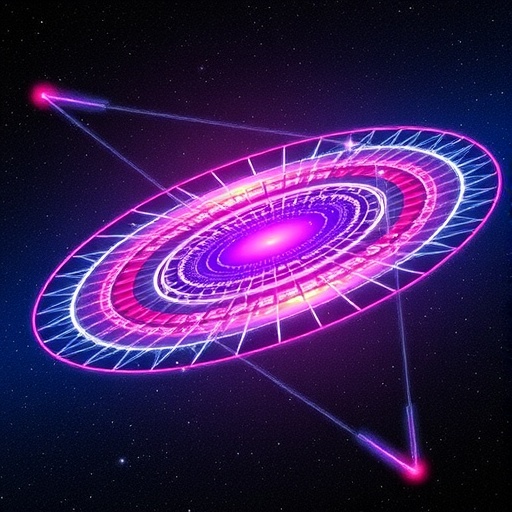
This breakthrough centers around what the team calls the “stochastic siren” method, a clever exploitation of the gravitational-wave background—a cumulative, faint hum produced by innumerable unresolved black hole mergers throughout the universe. Unlike traditional gravitational-wave events that require identifying each individual merger and its host galaxy, this background signal encodes information about the collective population and distribution of these mergers. By analyzing the strength and characteristics of this background, researchers can infer critical cosmological parameters, including constraints on the Hubble constant.
Illinois Physics Professor Nicolás Yunes, a key figure in the study, emphasizes the significance of this independent measurement. He explains that resolving the Hubble tension requires fresh, corroborative measurements, free from biases inherent to electromagnetic observations. Their stochastic siren approach leverages the underlying physics of gravitational waves, offering a complementary and innovative pathway to better understand our universe’s expansion.
At the University of Chicago, Professor Daniel Holz echoed the excitement of the discovery, highlighting how tapping into the gravitational-wave background opens unprecedented avenues in cosmology. Unlike typical gravitational-wave detections focused on individual events, this background hum from distant black holes offers a new lens through which to study universal expansion. Holz foresees this method becoming indispensable as gravitational-wave observatories reach greater sensitivities.
The foundational premise of the stochastic siren approach lies in the interplay between expansion rate and spatial volume. A lower Hubble constant implies a smaller cosmic volume that contributes to gravitational-wave events, increasing their density and thus strengthening the background signal. Conversely, the absence of a detectable gravitational-wave background can rule out slower rates of expansion, effectively setting lower bounds on the Hubble constant.
This technique was tested using data from the LIGO-Virgo-KAGRA (LVK) Collaboration, an international network responsible for gravitational-wave observations. Applying the stochastic siren model to current observational limits, the team demonstrated, as a proof of concept, that the non-detection of the gravitational-wave background already excludes certain low-expansion scenarios. By integrating this with measurements from individual black hole mergers, they refined the Hubble constant with improved accuracy.
A central challenge in traditional gravitational-wave cosmology is measuring the recessional velocity of black hole mergers, fundamentally required to calculate the Hubble constant via the classic “standard siren” method. This velocity is typically obtained by identifying electromagnetic counterparts or host galaxies, which are often elusive. The stochastic siren circumvents this problem by statistically analyzing the aggregated background signal, thereby broadening the scope of usable gravitational-wave data.
Looking ahead, the method’s potential will grow as gravitational-wave detectors become more sensitive. Projections suggest that the gravitational-wave background should become detectable within the next six years. Until then, incremental improvements in detector sensitivity will tighten the constraints on the expansion rate by refining upper limits on the background’s strength.
The implications are profound: with the stochastic siren method, cosmologists anticipate not only achieving a more precise measurement of the Hubble constant but also gaining new insight into the fundamental physics that govern the universe’s evolution. This could ultimately illuminate the nature of dark energy, dark matter interactions, or even reveal heretofore unknown physics from the universe’s infancy.
Gravitational-wave astronomy continues to be a transformative field. By integrating the stochastic siren technique with existing observational paradigms, scientists now have a powerful new tool to confront the Hubble tension head-on, potentially steering cosmology into a new era of precision and discovery. This achievement exemplifies the marriage of theoretical innovation and cutting-edge observational technology driving modern astrophysics forward.
This research was conducted on the Illinois Campus Cluster, supported by the Illinois Campus Cluster Program and the National Center for Supercomputing Applications, highlighting the importance of advanced computational resources in contemporary astronomical research. The work also benefits from generous support from multiple foundations and funding agencies, reflecting the collaborative and resource-intensive nature of frontier scientific inquiry.
As the next generation of gravitational-wave observatories comes online, including upgrades to the LVK network and future projects, the stochastic siren method promises to be a cornerstone for cosmological measurements. Researchers are eagerly preparing to apply this method to forthcoming datasets, shining new light on the cosmic expansion rate and advancing our quest to understand the universe’s deepest mysteries.
Subject of Research: Cosmology, Gravitational Waves, Hubble Constant Measurement
Article Title: Stochastic Siren: Astrophysical gravitational-wave background measurements of the Hubble constant
News Publication Date: 11-Mar-2026
Web References:
Full article on arXiv
Physical Review Letters DOI
University of Illinois Physics – Nicolás Yunes
UChicago Holz Lab
LIGO-Virgo-KAGRA Collaboration
Illinois Center for Advanced Studies of the Universe (ICASU)
Image Credits: The Grainger College of Engineering at the University of Illinois Urbana-Champaign
Keywords
Astrophysics, Cosmology, Gravitational Waves, Hubble Constant, Black Hole Mergers, Cosmic Expansion, Gravitational-Wave Background, Stochastic Sirens, LIGO-Virgo-KAGRA Collaboration
Tags: colliding black holes gravitational wavescosmic spacetime ripples analysisearly vs late universe expansion ratesgravitational-wave astronomy innovationsHubble constant determination methodsindependent Hubble constant measurementsnew gravitational-wave based cosmological toolsprecision cosmology using gravitational wavesresolving Hubble tension in cosmologysupernovae electromagnetic observationsuniverse expansion measurement techniquesUniversity of Illinois and UChicago astrophysics research