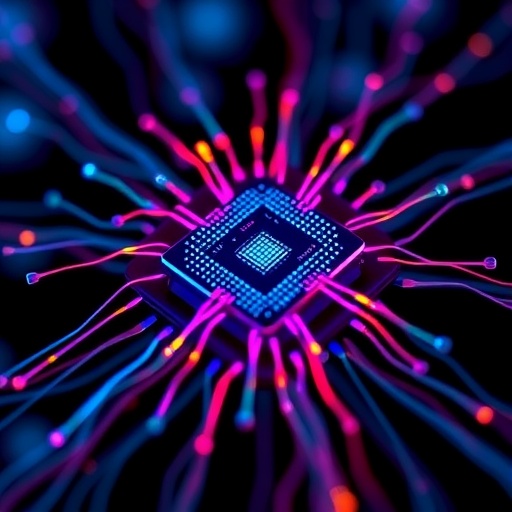
In a groundbreaking advancement that promises to revolutionize the field of neuromorphic computing, a team of researchers from Xidian University in China has unveiled a novel photonic computing system capable of performing complex neural network operations solely using light. This pioneering system, detailed in the latest issue of the highly regarded journal Optica, transcends the limitations of traditional photonic spiking neural networks by facilitating both linear and nonlinear computation entirely within the optical domain, thus eliminating the energy and latency penalties associated with electronic signal conversion.
Traditional photonic spiking neural systems, though promising for their high-speed, low-energy operation via optical pulses, have long been hindered by their inability to fully exploit nonlinear processing in photonics. These nonlinear mechanisms are critical for enabling learning and decision-making functions intrinsic to artificial intelligence. Until now, these essential nonlinear computations required conversion back into electronic signals, negating many benefits of photonics by introducing additional delays and power consumption. The newly developed system ingeniously bypasses this bottleneck, leveraging a dual-chip design that supports all-optical processing, which could drastically accelerate applications ranging from autonomous driving to real-time robotic cognition.
The core architecture comprises a 16-channel photonic neuromorphic chip equipped with 272 trainable parameters, working in concert with a complementary chip featuring a state-of-the-art distributed feedback laser array integrated with saturable absorbers. This hardware combination enables the system to handle multiple streams of optical data simultaneously while dynamically adjusting synaptic weights through optical learning processes. The sophisticated use of Mach-Zehnder interferometer meshes within the chips allows precise manipulation of spiking signals, closely mimicking the functionality of biological neural networks but at unprecedented speeds measured in picoseconds.
To validate the system, the researchers implemented a comprehensive hardware-software collaborative training framework. Initial global training occurred via conventional software algorithms, after which the neural models were transferred onto the photonic chips for further refinement. This hybrid strategy allowed compensation for any manufacturing variances and ensured the photonic neural network’s operational fidelity matched the software’s performance with remarkable accuracy. The capacity for on-chip learning and inference is a breakthrough that substantially reduces latency and power consumption compared to purely electronic solutions.
Demonstrating the practical capability of the new neuromorphic system, the team successfully deployed the photonic chips in classic reinforcement learning scenarios such as the CartPole and Pendulum tasks. These benchmark problems require fast, adaptive decision-making to stabilize a balancing pole or swing a pendulum upright. Impressively, the photonic hardware’s decision accuracy was only marginally lower than purely software-based implementations, with a mere 1.5% and 2% reduction in performance respectively. This equivalency underscores the system’s proficiency in replicating complex neural behaviors in real time using light alone.
Beyond task execution, the system boasts extraordinary energy efficiency, delivering 1.39 tera operations per second per watt (TOPS/W) for linear photonic computations, comfortably competing with current GPU technology. Nonlinear processing metrics are equally impressive, achieving close to 988 giga operations per second per watt (GOPS/W), marking a significant leap in operational density and energy economy in neuromorphic photonics. Fabrication innovations, including optimized low-threshold nonlinear spiking components, contribute to these superior performance metrics.
On top of energy efficiency, the photonic neuromorphic chip impresses with its compute density, estimated at 0.13 TOPS per square millimeter for linear operations and 533.33 GOPS per square millimeter for nonlinear tasks, placing it squarely within the performance envelope of top-tier GPUs and application-specific integrated circuits. Its ultra-low latency—only 320 picoseconds for on-chip computation—further cements its potential as a game-changing technology for applications requiring ultra-fast, real-time processing capabilities at the hardware edge.
Looking forward, the research team envisions scaling their design to a 128-channel fully integrated photonic spiking neural network chip. Such an advancement would empower the hardware to tackle even more complex, dynamic reinforcement learning problems such as neuromorphic autonomous navigation, which demands rapid sensorimotor coordination and adaptation. Achieving this level of integration and complexity will require overcoming engineering challenges related to hybrid photonic integration, fabrication yield, and system-level optimization.
This research heralds a new era of neuromorphic computing hardware, where energy-efficient, ultra-fast, and fully programmable photonic processors offer a viable alternative to conventional electronic neural networks. By demonstrating the feasibility of large-scale photonic spiking neurons with hardware-in-the-loop training and inference, this work opens horizons for next-generation AI that can learn directly from environmental interactions with minimal energy footprint and unprecedented speed.
The potential applications of these photonic neuromorphic chips extend far beyond autonomous vehicles and robotics. High-speed optical neural networks could impact data centers, telecommunications, sensor networks, and edge computing devices, accelerating processing while significantly reducing cooling and power requirements. The integration of nonlinear photonic components also suggests future possibilities for on-chip optical memory and real-time cognitive processing in compact, robust form factors.
In summary, this breakthrough in photonic spiking reinforcement learning signifies a monumental step toward neuromorphic hardware that leverages the unmatched properties of optics for artificial intelligence. The synthesis of advanced laser arrays, interferometric meshes, and saturable absorbers into a coherent, scalable architecture exemplifies the fusion of photonics and machine learning. Such technology promises to reshape the landscape of computing with systems that learn fast, operate efficiently, and respond instantaneously—all within the realm of light.
Subject of Research: Photonic Neuromorphic Computing and Reinforcement Learning
Article Title: Nonlinear Photonic Neuromorphic Chips for Spiking Reinforcement Learning
Web References: https://opg.optica.org/optica/abstract.cfm?doi=10.1364/OPTICA.578687
References: S. Xiang, Y. Chen, H. Zhao, S. Shi, X. Zeng, Y. Zhang, X. Guo, Y. Han, Y. Shi, Y. Hao, “Nonlinear Photonic Neuromorphic Chips for Spiking Reinforcement Learning” 13, (2025).
Image Credits: Shuiying Xiang, Xidian University
Keywords
Neural networks, Autonomous vehicles, Robots, Photonics, Applied optics
Tags: all-optical neural network processingautonomous driving AI technologydual-chip photonic designenergy-efficient AI hardwarelow-latency optical neural chipsneuromorphic photonic systemsnonlinear photonic computationoptical domain neural operationsphotonic neuromorphic computingreal-time learning spiking neural networksreal-time robotic cognitiontrainable photonic parameters