An international research team led by scientists from the University of Osaka has demonstrated that modifying the local electrolyte environment around a copper electrode significantly accelerates the catalytic electrochemical reduction of nitrate while doubling its selectivity toward ammonia. In an experimental investigation published in the Journal of the American Chemical Society, the researchers discovered that performing nitrate electrolysis in a neutral phosphate buffer allows phosphate ions adsorbed onto the copper surface to act as molecular proton shuttles. This mechanism addresses a longstanding chemical barrier that typically stalls nitrate reduction at the nitrite intermediate stage under non-acidic conditions.
Nitrate contamination in freshwater and groundwater represents a severe ecological hazard and a growing threat to public health. Agricultural runoff, industrial fertilizer use, intensive livestock operations, and municipal wastewater discharge frequently release vast quantities of nitrate into natural water systems. Among the potential end products, ammonia is particularly sought after as an essential chemical feedstock for synthetic fertilizers and a viable zero-carbon hydrogen energy carrier.
Despite the promise of electrochemical conversion, controlling the product distribution on metallic surfaces such as copper has remained notoriously difficult. Most contaminated industrial and agricultural waste streams are neutral or alkaline. Under these pH regimes, copper catalysts exhibit relatively high reaction rates for initial electron transfer, breaking down nitrate into nitrite. However, transforming nitrite into ammonia requires the sustained addition of protons.
Prior engineering strategies have largely focused on synthesizing intricate catalyst materials or altering electrode compositions to overcome this limitation. In this study, the authors adopted an alternative strategy by intentionally tailoring the chemical microenvironment surrounding the working electrode. Because nitrate-rich industrial feedstocks and agricultural wastewater often naturally contain dissolved anions such as phosphate and carbonate, the team tested whether an electrolyte buffer could actively participate in the catalytic cycle rather than serving merely as a passive conductive medium.
Electrochemical evaluations revealed substantial performance gains when introducing a neutral phosphate buffer into the reaction cell. At a fixed electrochemical driving force, the catalytic reaction rate on copper was approximately ten times higher than the rate observed in a standard alkaline solution at pH 13. Furthermore, the conversion selectivity toward ammonia more than doubled under identical operating potentials.
To uncover the physical mechanism driving this enhancement, the researchers characterized the electrode-electrolyte interface using a combination of local pH sensing, operando infrared spectroscopy, and theoretical computational modeling. In bulk phosphate buffer maintained at pH 7, the local pH directly at the copper electrode surface rose sharply during continuous nitrate reduction, matching the strongly alkaline conditions observed in the reference bulk pH 13 solution. Because the interfacial alkalinity was practically identical in both configurations, the dramatic increase in reaction velocity and ammonia yield could not be attributed to differences in local proton concentration alone.
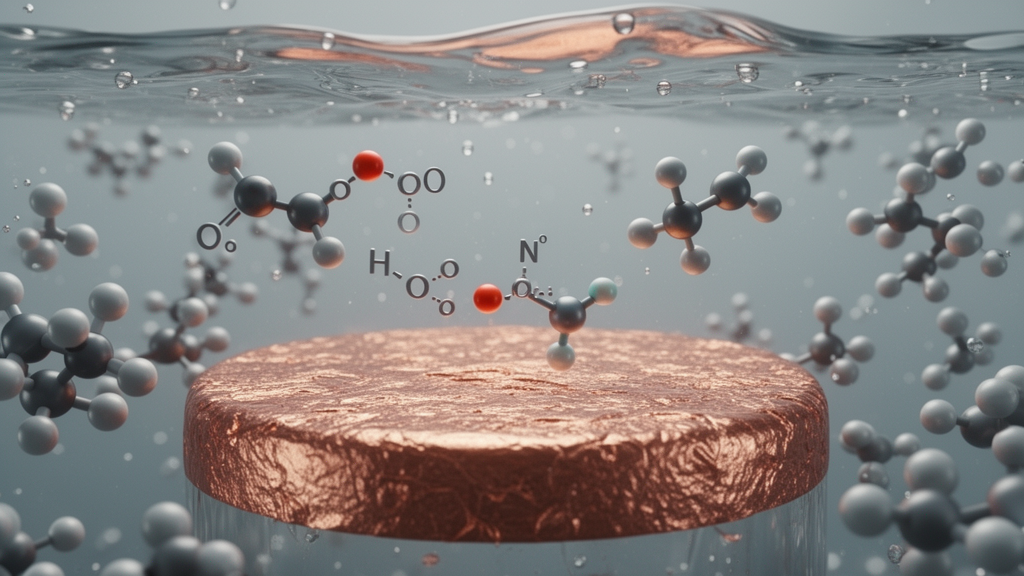
Instead, spectroscopic and theoretical data demonstrated that phosphate species specifically adsorb directly onto the copper electrode surface during electrolysis. Once anchored to the metallic copper, the adsorbed phosphate molecules effectively operate as proton shuttles, extracting protons from adjacent water molecules and transferring them directly to co-adsorbed reaction intermediates, including nitrite.
The findings illustrate that the microenvironment directly adjacent to an electrocatalyst can influence reaction pathways and catalytic efficiency just as profoundly as the intrinsic chemical identity of the electrode material itself.
Subject of Research: Electrochemical nitrate reduction to ammonia using phosphate-mediated proton shuttling on copper catalysts
Article Title: Local action: microenvironments boost catalyst activity ten-fold
Article References: Local action: microenvironments boost catalyst activity ten-fold. Original publication (Bibliographic details unavailable.)
Image Credits: AI Generated
DOI: Not provided
Keywords: nitrate reduction, electrochemical reduction, copper catalyst, ammonia synthesis, phosphate buffer, proton shuttle, catalysis microenvironment, water remediation, nitrite intermediate, operando spectroscopy, electrode interface, Osaka University, environmental chemistry, green ammonia, electrolysis, local pH
News Source: Bethany Barker. (November 25, 2026). Phosphate Buffer Boosts Nitrate Reduction Rate and Ammonia Selectivity on Copper. Scienmag.