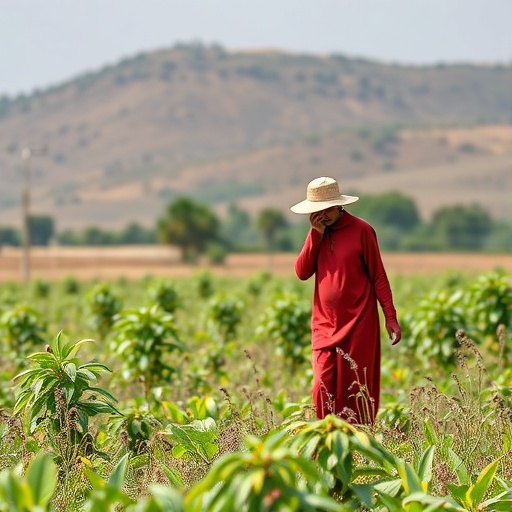
In the expansive agricultural landscape of Northwest Ethiopia, where farming is not only a livelihood but a way of life, the use of pesticides remains an indispensable practice. However, the improper handling and non-compliance with safety precautions by pesticide users continue to pose significant health risks. A groundbreaking study by Workineh, Belay, and Molla, published in Scientific Reports in 2026, casts new light on this critical issue, employing the Health Belief Model (HBM) to unravel the complexities surrounding safety precaution compliance among farmers in the Dera district.
The research dives deeply into behavioral health theories to explore the myriad factors influencing whether farmers adopt safety measures when using pesticides. The Health Belief Model, a well-established psychological framework, examines how personal beliefs about health conditions predict health-related behaviors. By applying this model, the researchers elucidate how perceptions, such as susceptibility to pesticide-related illnesses and the perceived severity of potential health outcomes, govern compliance rates. This nuanced approach marks a significant advance in understanding the motivations behind unsafe pesticide practices in rural Ethiopia.
Pesticide exposure is a global public health concern, but farmers in developing regions face disproportionately higher risks due to minimal regulatory oversight, lack of training, and insufficient access to protective equipment. In the Dera district, these challenges are exacerbated by social and economic constraints. The study meticulously documents how these multifaceted barriers contribute to poor adherence to safety protocols, potentially leading to acute poisoning incidents, chronic health conditions, and environmental contamination.
The methodology of the study combined quantitative surveys with qualitative interviews to gather comprehensive data from pesticide-using farmers. This mixed-method approach allowed the researchers to capture the depth of knowledge, attitudes, and practices related to pesticide safety. They meticulously measured constructs such as perceived benefits and barriers of safety precautions, cues to action (like advice from agricultural extension workers), and self-efficacy – the confidence farmers have in their ability to implement safety measures effectively.
Findings reveal a troubling yet insightful pattern: despite awareness of the harmful effects of pesticides, many farmers underestimate their personal vulnerability or dismiss the severity of potential health hazards. This cognitive disconnect often stems from entrenched cultural beliefs and economic necessity, where safety measures are viewed as secondary to the immediate demands of crop production and income generation. The study highlights that this gap between knowledge and practice is a critical target for interventions.
Moreover, the research identifies gender dynamics as a pivotal factor influencing safety compliance. Female farmers, who play a substantial role in Ethiopian agriculture, often had lower compliance rates due to limited access to resources and educational opportunities. The study emphasizes that gender-sensitive strategies are essential to effectively promote pesticide safety and reduce health disparities within farming communities.
Another compelling revelation concerns the role of social influence and community norms. Farmers who received regular guidance from agricultural extension officers or from peer networks were significantly more likely to adhere to precautionary measures. This underscores the potential of leveraging community-based approaches and credible information sources to foster behavioral change in rural settings where formal health infrastructure is limited.
Economic barriers also play a formidable role. The cost of protective gear—such as gloves, masks, and specialized clothing—is prohibitively high for many in Dera district, leading to sporadic or non-use. The study suggests that subsidizing safety equipment or integrating cost-effective local alternatives could dramatically improve compliance rates. Economic empowerment coupled with education could thus serve as a dual strategy to safeguard farmers’ health.
Importantly, the study critiques the prevailing pesticide risk communication strategies deployed by governmental and non-governmental organizations. It points out that campaigns often fail to resonate with farmers’ lived realities and lack follow-through. The authors advocate for culturally tailored messaging that aligns with farmers’ beliefs, languages, and daily challenges, thereby enhancing the perceived relevance and urgency of safety behaviors.
The application of the Health Belief Model allowed the researchers to construct an explanatory framework linking psychosocial factors with actual safety behavior. It provides a predictive tool for stakeholders designing interventions, highlighting the need to strengthen perceived benefits and self-efficacy while minimizing perceived barriers. This evidence-based framework paves the way for more targeted, effective health promotion strategies.
Environmental implications of pesticide misuse also permeate the study. Unsafe disposal practices and runoff lead to soil and water contamination, adversely affecting broader ecosystems. The researchers call for integrated pest management programs that not only reduce health risks but also protect environmental integrity. Such sustainability-focused approaches resonate with emerging global agricultural policies promoting safer and greener farming practices.
This research underscores the urgency of systemic policy reforms. It recommends that Ethiopian agricultural and health authorities enhance training programs, provide subsidized protective equipment, and implement routine monitoring of pesticide use. Institutional collaboration along these lines could substantially reduce pesticide-related morbidity and mortality rates among farmers.
In summation, the study by Workineh, Belay, and Molla stands as a pioneering inquiry into the health behaviors of pesticide-using farmers in Ethiopia. By marrying behavioral theory with rigorous field research, it offers actionable insights and a lucid blueprint for improving occupational health in rural agriculture. As climate change and food security pressures escalate, safeguarding the health of farmers through informed pesticide management is a global imperative.
The findings reverberate beyond Ethiopia, addressing common challenges in many low-income agricultural settings worldwide. They signal a call to action for integrating health psychology, education, and policy innovation to foster a culture of safety and sustainability in pesticide use. This multidisciplinary approach embodies the future of agricultural health research—one where science meets social context to protect the most vulnerable populations.
As the world grapples with balancing agricultural productivity and human health, this seminal study delivers a stark yet hopeful message: change is possible through understanding the beliefs driving behavior. Empowering farmers with knowledge, resources, and community support can transform perilous pesticide practices into safer, sustainable agriculture that thrives alongside human well-being.
Subject of Research:
Safety precaution compliance and behavioral factors among pesticide-using farmers
Article Title:
Safety precaution compliance and associated factors among pesticide user farmers in Dera district, Northwest Ethiopia, 2024: a health belief model approach
Article References:
Workineh, E.A., Belay, E. & Molla, E. Safety precaution compliance and associated factors among pesticide user farmers in Dera district, Northwest Ethiopia, 2024: a health belief model approach. Sci Rep (2026). https://doi.org/10.1038/s41598-026-44420-9
Image Credits: AI Generated
DOI:
https://doi.org/10.1038/s41598-026-44420-9
Keywords:
Pesticide safety, Health Belief Model, farmer compliance, occupational health, Ethiopia, agricultural health risks
Tags: agricultural pesticide exposure preventionagricultural pesticide handling practicesbehavioral health theories in farmingfactors influencing pesticide safety compliancefarmer health risk perceptionfarmer health risks from pesticidesHealth Belief Model and pesticide useHealth Belief Model in agriculturepesticide exposure in developing countriespesticide handling practices in developing countriespesticide regulation challenges Ethiopiapesticide regulation challenges in agriculturepesticide safety compliance in Ethiopiapesticide safety training for farmerspesticide safety training programspesticide-related illness preventionpesticide-related illnesses in rural Ethiopiaprotective equipment for pesticide usersprotective equipment use in agriculturepublic health and pesticide userural farmer health educationsafety precaution adherence among farmers