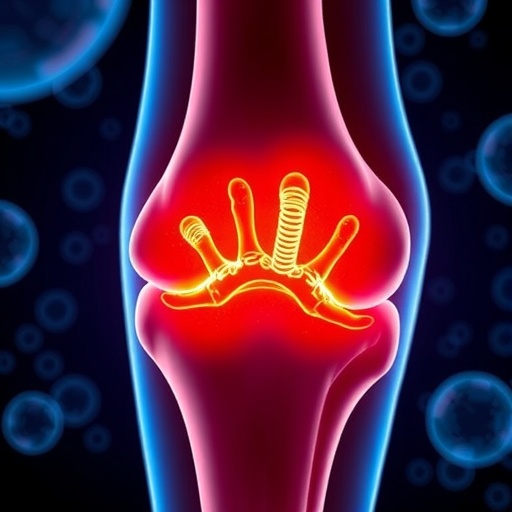
In a groundbreaking study that could change the landscape of orthopedic surgery, researchers have discovered the critical role of persistent synovial inflammation following what is deemed successful eradication of infection in total joint replacements. The research led by Manasherob, Warren, Flanagan, and their colleagues indicates that this inflammation is not merely a remnant of a past infection, but rather a harbinger of future complications that could affect the longevity and effectiveness of joint prosthetics.
Total joint replacements, widely regarded as one of the most successful procedures in modern medicine, are not without their risks. Infection remains a significant concern, often requiring prolonged antibiotic treatment or even resulting in revision surgery. The study opens up a new understanding of how dormant infections can exist alongside what is considered clinical cure. This discrepancy, rooted in persistent synovial inflammation, unveils a ‘dormant state’ of infection that challenges the conventional understanding of postoperative care.
Synovial fluid, a viscous substance found in joint cavities, plays an instrumental role in joint health. It acts as a lubricant, providing the necessary environment for smooth movement and delivering important nutrients to cartilage. However, when inflammation occurs due to an infection or other factors, the dynamic within the joint can begin to shift. The study illustrates that even after standard treatments aimed at eradicating an infection succeed in eliminating visible pathogens, the inflammatory markers can remain, suggesting that infection may not be fully eradicated.
Furthermore, the research highlights the importance of monitoring synovitis after surgery. The presence of inflammatory cells and cytokines in synovial fluid could serve as predictors for long-term infection-free survival in patients with total joint replacements. Traditional endpoints of infection-free status often rely solely on clinical assessments and microbial culture results, which may overlook the subtle signs of ongoing inflammation that indicate a lingering risk.
The methodology employed in this research was meticulous. By assessing patients at regular intervals following their joint replacement surgery, the team could track changes in synovial fluid composition and markers of inflammation. Advanced analytic techniques and imaging modalities helped define the relationship between inflammatory responses and the risk of subsequent infections. The findings also suggest that biomarker profiling of synovial fluid could lead to the development of tailored treatment plans, personalized to each individual’s inflammatory profile.
In addition to practical applications in clinical settings, the implications of this study stretch into the realm of public health and patient education. Understanding that eradication of infection does not equate to freedom from all inflammatory risks means that patients should be counseled accordingly. Awareness campaigns may be necessary to inform patients about the signs of potential complications, enabling early intervention and management.
The research also invites further exploration into treatment avenues that could specifically target residual inflammation. Current strategies might include anti-inflammatory steroids or biologics that have emerged in the realm of chronic inflammatory diseases. Imagine a future where joint replacement surgery is paired with a preventive regimen that not only ensures the eradication of infection but addresses the inflammatory state, significantly improving patient outcomes.
Moreover, this new mastery of synovial dynamics could potentially generalize across other medical fields such as rheumatology and infectious disease, where persistent inflammation alongside resolved infection is observed. The biological pathways elucidated through this study could serve as a valuable framework for understanding conditions characterized by chronic inflammation, such as rheumatoid arthritis or even post-viral syndromes.
While the findings of this research are promising, they do require careful consideration. Additional studies with larger cohorts and diverse populations could solidify the predictability of the inflammatory markers regarding various types of joint replacements, such as hips versus knees, and their respective outcomes. Furthermore, understanding the etiology of persistent synovial inflammation may also require interdisciplinary collaboration, merge insights from immunology, microbiology, and orthopedic research.
In conclusion, the work conducted by Manasherob, Warren, Flanagan, and their team marks a pivotal moment in the field of orthopedics, revealing the hidden complexities surrounding persistent inflammation following joint surgery. By shedding light on the dormant states of infection and their implications for patient management, this research underscores the need for an evolution in how we perceive and treat infections post-surgery. The findings not only aim to improve clinical outcomes but also to enhance the overall quality of life for patients undergoing total joint replacements.
As the healthcare community continues to grapple with the implications of this study, one thing is crystal clear: the era of simply monitoring traditional infection markers is quickly becoming outdated. The future will demand a more nuanced approach that includes the assessment of inflammation and its effects on recovery, paving the way for innovations in both therapy and patient care.
This fascinating intersection of inflammation research and orthopedic surgery promises to open new doors in personalized medicine, highlighting the complexity of bodily responses to infection and treatment. As researchers delve deeper into the role of synovial fluid and persistent inflammation, the hope is to achieve a future where joint replacements are more effective, durable, and free from the threat of infection.
Subject of Research: Persistent Synovial Inflammation in Total Joint Replacements
Article Title: The presence of persistent synovial inflammation after “Eradication” unmasks the “Unseen” dormant state of infection allowing the prediction of infection free survival in total joint replacements.
Article References:
Manasherob, R., Warren, S.I., Flanagan, C.M. et al. The presence of persistent synovial inflammation after “Eradication” unmasks the “Unseen” dormant state of infection allowing the prediction of infection free survival in total joint replacements. J Transl Med 23, 1392 (2025). https://doi.org/10.1186/s12967-025-07425-y
Image Credits: AI Generated
DOI: https://doi.org/10.1186/s12967-025-07425-y
Keywords: synovial inflammation, total joint replacements, infection, biomarker profiling, patient management
Tags: antibiotic treatment for joint infectionsdormant infections in joint prostheticshidden infection risks in surgeryimplications of joint inflammationinflammation and infection interplay in orthopedicsorthopedic surgery advancementspersistent synovial inflammationpostoperative care challengesrevision surgery riskssynovial fluid role in joint healthtotal joint replacements complicationsunderstanding joint prosthetic longevity