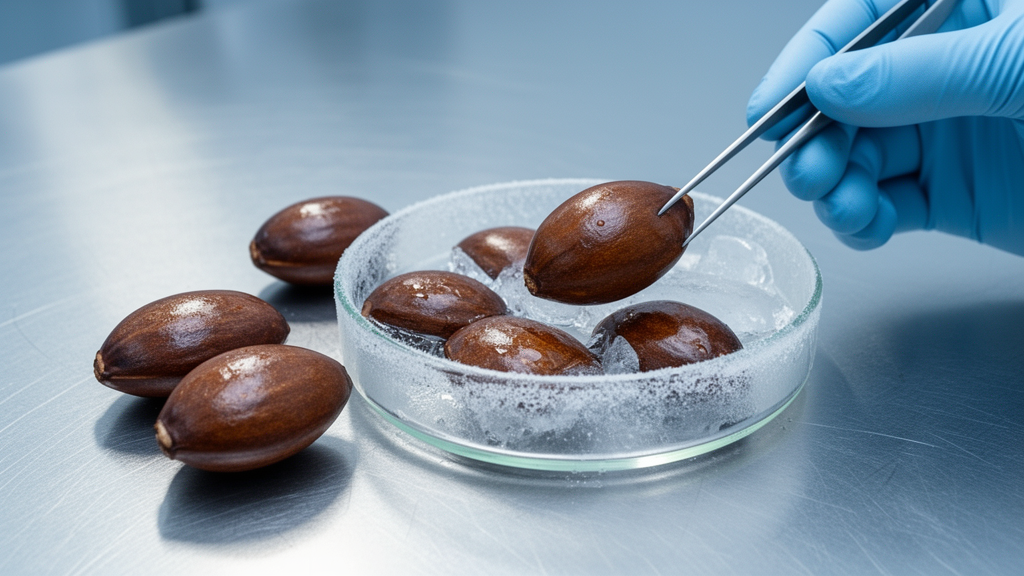
Seeds of the Amazonian tree species Pentaclethra macroloba display intermediate storage behavior, tolerating moderate desiccation but suffering rapid loss of viability during prolonged storage and complete failure after freezing, according to a study published in Plant Biosystems. The investigation examined how dehydration and temperature affect seed germination and seedling vigor, while also monitoring the stability of seed oil yield and fatty acid composition. Researchers determined that while the oil profile remains stable under varying storage regimes, the physiological viability of the seeds declines steeply within months, establishing vital empirical limits for conserving this economically and ecologically significant tropical tree.
Pentaclethra macroloba is an ecologically prominent species native to the Amazon basin, frequently utilized in regional ecological restoration initiatives and widely recognized for its oil-rich seeds. These seeds provide valuable raw materials for traditional medicine, cosmetic formulations, and pharmaceutical applications. To determine optimal handling protocols for conservation and sustainable utilization, investigators collected seeds in the state of Pará, Brazil. The experimental design subjected the collected seeds to progressive drying protocols and evaluated their performance across multiple temperature environments over storage periods lasting up to 12 months.
Desiccation trials revealed that the seeds could withstand drying down to approximately 10 to 12 percent moisture content without an immediate total loss of viability. When seeds reached a moisture content of 9.62 percent, laboratory assays recorded a germination rate of 79 percent. However, dehydration beyond this threshold resulted in substantial declines in both germination capacity and subsequent seedling vigor. The experimental data identified a safe moisture content threshold of up to 18.71 percent, while critical and lethal moisture thresholds occurred below 16.75 percent and 6.82 percent, respectively.
The study demonstrated that the species is particularly vulnerable to sub-zero temperatures, confirming an intolerance to standard cold-banking methods. Seeds that were dried to a 5 percent moisture content and subsequently stored at −18 degrees Celsius failed to germinate entirely.
Prolonged storage trials further documented a rapid deterioration in seed physiological quality across all tested thermal conditions. Even under the most favorable storage environment evaluated in the trials, which was maintained at 15 degrees Celsius, seed germination plummeted to less than 15 percent after only three months.
In contrast to the rapid physiological decline observed in seed viability, the chemical characteristics of the seed oil demonstrated notable resilience. Gas chromatography-mass spectrometry (GC/MS) analyses showed that oil yield and overall fatty acid composition remained relatively stable throughout the storage trials. This compositional stability persisted regardless of the specific temperature conditions applied or whether the seed coat remained intact, with oleic acid consistently identified as the predominant fatty acid in the analyzed samples.
Collectively, the experimental measurements confirm that Pentaclethra macroloba seeds exhibit intermediate storage behavior rather than orthodox or recalcitrant characteristics. These baseline thresholds provide practical parameters to guide short-term seed handling, conservation planning, and sustainable resource management across the Amazon region.
Subject of Research: Intermediate seed storage behavior and seed oil stability of Pentaclethra macroloba
Article Title: Storage behavior and seed oil chemical composition of Pentaclethra macroloba (Leguminosae, Caesalpinioideae)
Article References: Ribeiro, O. D., Carvalho, J. D. S., Oliveira, A. L. M. C., Correia, Z. A., da Silva, L. R. R., de Oliveira, M. S., Andrade, E. H. D. A., Jardim, M. A. G., & Gurgel, E. S. C. (2026). Storage behavior and seed oil chemical composition of Pentaclethra macroloba (Leguminosae, Caesalpinioideae). Plant Biosystems, 160(6), Article 312. https://doi.org/10.1007/s44473-026-00295-2
Image Credits: AI Generated
DOI: 10.1007/s44473-026-00295-2
Keywords: Pentaclethra macroloba, seed storage behavior, intermediate seeds, desiccation tolerance, freezing sensitivity, seed germination, seedling vigor, seed oil yield, fatty acid composition, oleic acid, GC-MS analysis, Pará Brazil, Amazonian tree species, ecological restoration, safe moisture content, critical moisture threshold, seed conservation
News Source: Drew Townsend. (November 12, 2026). Pentaclethra Macroloba Seeds Show Intermediate Storage Behavior and Freezing Sensitivity. Scienmag.