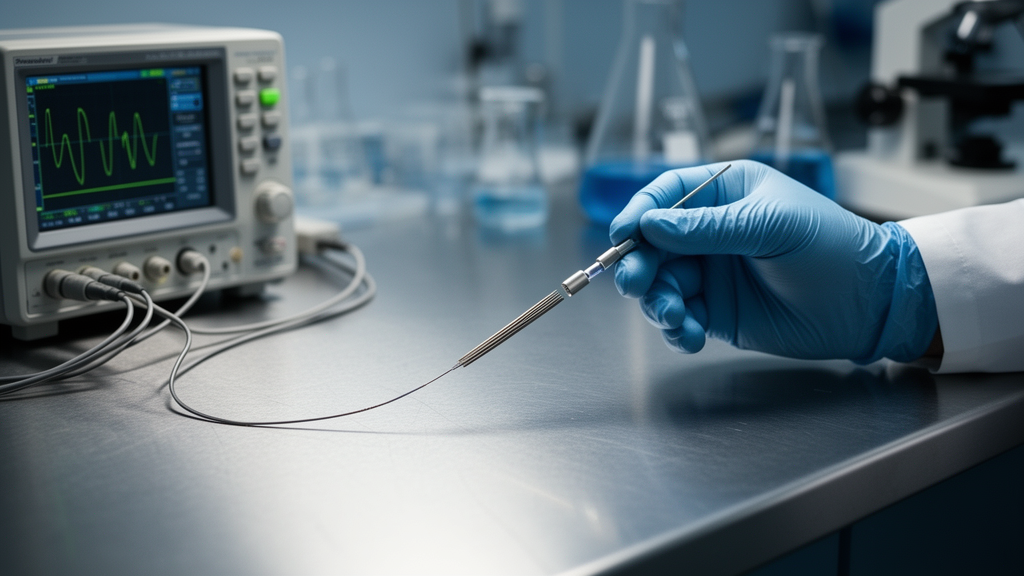
Researchers developing a new kind of hearing prosthesis have reported that the device’s penetrating microelectrodes survived a battery of preclinical bench tests designed to mimic more than a year of use inside the body. The device, called an Auditory Nerve Implant, or ANI, pairs a slanted microelectrode array that is inserted directly into the auditory nerve with a commercially available cochlear stimulator. According to the study published in Bioelectronic Medicine, every electrode met the impedance criteria at the end of a thermal accelerated aging soak equivalent to 1.5 years, and nearly all electrodes survived 6.3 billion stimulation pulses, including a high-intensity condition twelve times the current planned for the clinic.
The motivation behind the device lies in a long-standing limitation of cochlear implants. Although cochlear implants have treated more than one million patients with severe to profound sensorineural hearing loss and are the most successful neural interface technology to date, performance on difficult tasks such as understanding speech in noise, appreciating music, and localizing sound has improved little in more than two decades. The authors attribute this ceiling partly to geometry: cochlear implant electrodes sit in the fluid-filled scala tympani inside the bony cochlea, so current must cross the low-conductivity bony wall to reach the spiral ganglion neurons. That distance and the conductive milieu reduce the specificity of neural activation and raise threshold currents, which is why contemporary implants with 12 to 24 electrodes deliver only about 4 to 8 independently distinguishable percepts.
The ANI approach instead places electrodes into the nerve itself. The Auditory Nerve Utah Slant Array, or AN-USA, is a 3 by 5 shank variant of the Utah Slant Array, derived from the Blackrock Neurotech NeuroPort cortical electrode that holds 510(k) FDA clearance. Twelve of its fifteen electrodes are electrically connected. Shank lengths range from 0.5 to 0.9 millimeters across an array face of roughly 1.2 by 2.0 square millimeters, with a slanted geometry intended to stimulate localized populations across the cross-section of a peripheral nerve. The human auditory nerve is about 1.25 millimeters in diameter in normal hearing and closer to 1.0 millimeter in hearing impairment, dimensions that shaped the array’s design. The array connects through a helically wound gold wire lead to an FDA-approved MEDEL SYNCHRONY2 cochlear stimulator, allowing the team to reuse established stimulator hardware and processes.
Earlier work supports the underlying concept. Intraneural stimulation with Utah arrays in animal studies has produced more frequency-specific and localized activation of auditory pathways than cochlear implants, with lower thresholds, greater dynamic ranges, and faster temporal coding. In human volunteers, 10 by 10 Utah arrays placed in the median and radial nerves recruited cutaneous percepts with small receptive fields and thresholds in the low tens of microamps. Prior feline studies using the AN-USA or Utah arrays evoked auditory percepts at similarly low thresholds. The team acknowledges trade-offs: the translabyrinthine surgical approach used for the first subjects ablates the vestibular canals, restricting the initial trial population to people with vestibular comorbidities, and the penetrating array is less reversible than a cochlear implant and can cause some nerve trauma, although large animal studies found the devices well tolerated without impairment.
The bench testing had two arms. The first was thermal accelerated aging, in which three fully integrated ANI devices were submerged in phosphate-buffered saline and held at 67 degrees Celsius for 10 days and 77 degrees Celsius for 33 days. Using an Arrhenius-based acceleration factor relative to body temperature, this schedule corresponds to an equivalent in-dwelling period of 1.5 years, matching the planned duration of the clinical study. Impedances were measured daily through the stimulator’s telemetry, with a failure threshold of 70 kilo-ohms, the highest impedance that still permits delivery of the 100-microamp current limit set for the clinical investigation. At the endpoint, all electrodes remained below the failure criterion, with impedances around 2 kilo-ohms measured at the elevated test temperature. Three electrodes transiently exceeded 70 kilo-ohms during the study, including two on one device and one on another, before settling at passing values near 24 to 37 kilo-ohms. The impedance spikes coincided with handling of the devices for microscopy, though the team could not determine whether handling or imaging caused them.
Microscopy told a more nuanced story. Optical and backscattered scanning electron microscopy of every electrode before and after soaking revealed that the aging cohort had arrived with statistically worse initial tip-metal quality than the devices later used for stimulation testing, with buckled iridium oxide films and chipped tips predominating. On one device, six of fifteen electrodes showed delamination of the buckled iridium oxide during the soak, exposing the underlying platinum-silicide contact layer and, in places, the silicon shank. Despite that visible damage, impedances largely held steady, suggesting the contact layer itself provides reasonable electrical characteristics. The authors describe the aging cohort as a worst-case test and note that a small change in the device integration process has since eliminated the buckled metallization.
The second arm tested stimulation stability. Six devices delivered 6.3 billion biphasic, charge-balanced cathodic-leading pulses at 100 microamps, the maximum current planned for the clinical study, at 1600 pulses per second with 200-microsecond phases. The team estimated this delivers the same total charge, about 252 coulombs, as a year of clinical stimulation, compressed into roughly 1.5 months through accelerated pulse rate and continuous operation. Four electrodes per device were stimulated, four served as unstimulated controls, and four were discarded. No electrode showed the abrupt voltage increase that defines electrical failure, impedances dropped, often by more than 10 kilo-ohms, to typical endpoint values of 2 to 3 kilo-ohms, and microscopy found no stimulation-induced changes to electrode materials or morphology.
A high-intensity arm pushed the device well beyond clinical parameters. Five devices, four of them reused from the 100-microamp test, delivered the same 6.3 billion pulses at 1200 microamps, a cumulative charge of 3024 coulombs and a charge density of 6.52 millicoulombs per square centimeter per phase. Voltage transients measured at this current exceeded the water window of the iridium oxide electrode material, meaning the interface potential crossed into regimes where electrochemical reactions become possible. One stimulated electrode failed with an abrupt voltage increase a little after 4 billion pulses, but voltage-matrix analysis showed no stimulation artifact on adjacent electrodes, pointing to a broken lead wire or bond pad rather than electrode damage. Microscopy revealed degradation on three of twenty stimulated electrodes, all on devices that already had chipped or delaminated tips as received, with corrosion of exposed silicon and partial iridium oxide delamination. The authors argue that the slow degradation rate even under these extreme conditions suggests the electrodes will likely tolerate the planned year of clinical stimulation.
Baseline electrochemical characterization anchored the results. The electrodes averaged a geometrical surface area of 3.68 by 10 to the minus 5 square centimeters, a 1-kilohertz impedance of 4.86 plus or minus 1.81 kilo-ohms, a cathodic charge storage capacity of 25.83 plus or minus 3.62 millicoulombs per square centimeter, and a charge injection capacity of 1.70 plus or minus 0.25 millicoulombs per square centimeter, all consistent with published Utah array data. The charge injection capacity exceeds the maximum per-phase charge density planned for the clinic, though the authors caution that injection capacity falls substantially in vivo. Trace-metal analysis of the soak solution by inductively coupled plasma mass spectrometry proved disappointing: iridium and gold concentrations fell below detection limits, platinum was measurable at 0.54 to 2.26 parts per billion, and the large saline volume required for testing whole integrated devices made the method far less sensitive than electron microscopy for detecting tip-metal loss.
The authors conclude that the electrodes exhibit a high degree of integrity and impedance stability and that the device can plausibly tolerate the 1.5-year in-dwelling period needed for a one-year perceptual study, clearing a key milestone toward initiating the first-in-human investigation. They also stress the limits of bench testing: impedances run higher and charge injection capacity lower in living tissue than in saline, the in vivo environment is more complex, and outcomes in the body are often worse than bench predictions, which they argue makes better accelerated aging tests for microelectrode devices a continuing need. Whether direct intraneural stimulation translates into the speech-in-noise and music perception gains that cochlear implants have not delivered remains a question only the planned psychophysical study in human subjects can answer.
Subject of Research: Preclinical bench testing of electrode stability for a penetrating auditory nerve implant intended for a first-in-human clinical study
Article Title: Stimulation-stability and preclinical bench testing of a new auditory nerve interface
Article References: Stump, T., Strahl, S., Crew, J., Leber, M., Hübner, K., Negi, S., Vankirk, J., Adams, M. E., Lenarz, T., Solzbacher, F., Lim, H. H., & Rieth, L. (2026). Stimulation-stability and preclinical bench testing of a new auditory nerve interface. Bioelectronic Medicine, 12(1), Article 21. https://doi.org/10.1186/s42234-026-00215-x
Image Credits: AI Generated
DOI: 10.1186/s42234-026-00215-x
Keywords: auditory nerve implant, cochlear implants, microelectrodes, Utah slant array, accelerated aging, stimulation stability, hearing loss, neural prosthesis, electrode impedance, first-in-human study, bioelectronic medicine, IrOx electrodes
News Source: Denise Maddox. (October 28, 2026). Penetrating auditory nerve implant passes bench tests for first-in-human trial. Scienmag.