Observed the pattern of change in place cells in animal experiments using cue-poor and cue-rich spatial environments. Suggesting new directions in the treatment of brain disorders like Alzheimer’s and amnesia, and advancement in the AI
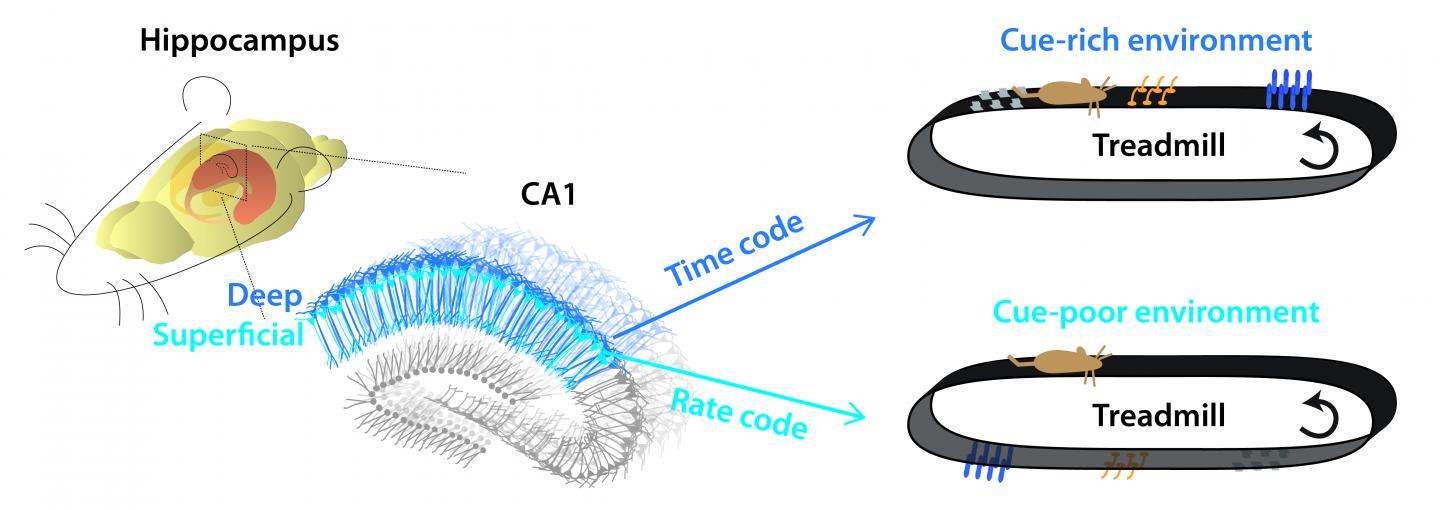
Credit: Korea Institute of Science and Technology(KIST)
We find routes to destination and remember special places because there is an area somewhere in the brain that functions like a GPS and navigation system. When taking a new path for the first time, we pay attention to the landmarks along the way. Owing to such navigation system, it becomes easier to find destinations along the path after having already used the path. Over the years, scientists have learned, based on a variety of animal experiments, that cells in the brain region called hippocampus are responsible for spatial perception and are activated in discrete positions of the environment, which which reason they are called “place cells”. However, how place cells store long-term memories of locations and encode particular positions in the environment is still not understood.
The Korea Institute of Science and Technology (KIST) announced that the research team led by Sebastien Royer at KIST Brain Science Institute (BSI), in collaboration with a research team at New York University (NYU), uncovered that place cells in the hippocampus encode spatial information using interchangeably two distinct information processing mechanisms referred to as a rate code and a phase code, somewhat analogue to the number and spatial arrangement of bars in bar codes. In addition, the research team found that parallel neural circuits and information processing mechanisms are used depending on the complexity of the landmarks along the path.
The KIST and NYU research teams identified fundamental principles of information processing in the hippocampus by conducting two types of spatial exploration experiments. In the first type of experiment, the researchers used a treadmill with a long belt, a well controlled spatial environment for mice, and trained the animals to run on the belt sequentially through a section cleared of any objects and another section furnished with small objects. The second type of experiment was carried with rats foraging in a circular arena that was either completely empty or filled with objects. To analyze neural activity, they implanted silicon probe electrodes in CA1, the subregion generating the main output of the hippocampus, and in CA3, a subregion of the hippocampus suspected of playing an important role in spatial memory formation.
Results of the two experiments were consistent. It was found that the hippocampus uses different neural circuits and information processing strategies depending on the environmental conditions. In the object-free environments, a group of cells located in the superficial region of CA1 tends to be active and uses a rate code since the animal position is best predicted by changes in the frequency of action potentials discharged by single neurons. In contrast, in a complex, object-strewn environment, a group of cells in the deep region of CA1 tend to be active and uses a phase code since the animal position is best predicted by the timing of a neuron action potentials relative to the ensemble of active neurons.
These findings suggest that the circuit using the rate code is more strongly associated with providing information about overall positioning and spatial perception, whereas the circuit using the phase code is more strongly associated with remembering the precise location of an object and spatial relationships. Aside from this, the respective contribution of inputs from CA3 and the entorhinal cortex was also analysed. It is known that CA1 receive information from both the CA3 region and the entorhinal cortex. In this study, based on differences in fast network oscillations called “gamma”, it was found that superficial CA1 cells receive information primarily from CA3 in the simple environments whereas deep CA1 cells receive information primarily from the entorhinal cortex in the complex environments.
Sebastien Royer, Principal investigator at KIST said “this study improves our understanding on how the hippocampus processes information, which is a critical step for understanding the general mechanisms of memory.” He added that “such basic level understanding will eventually help the development of technologies for the diagnosis and treatment of brain disorders related to hippocampal injury such as Alzheimer’s type dementia, amnesia, and cognitive impairment, and might inspire the development of some AI.”
The research team headed by Sebastien Royer, PhD has been gradually expanding the understanding of information storage and processing in memory-related brain areas using diverse approaches. In a study combining mouse experiment and neural network modeling published last year in the journal “Nature Communications”, the same team identified the process by which granule cells in the dentate gyrus region of the hippocampus develop a uniform mapping of the space during spatial learning.
###
The study was conducted as a KIST major project and funded by the Ministry of Science and ICT (MSIT). The study findings were published in the latest issue of the international academic journal, “Neuron.”
Media Contact
Do-Hyun Kim
[email protected]
Related Journal Article
http://dx.