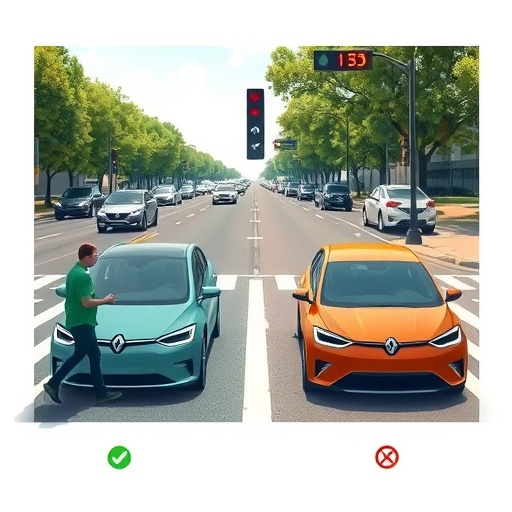
In a rapidly evolving automotive landscape where electric vehicles (EVs) are becoming increasingly prevalent, questions about their safety implications for pedestrians have moved to the forefront of public discourse and scientific inquiry. Researchers at the nexus of transportation technology and urban safety have recently undertaken a rigorous comparison between electric vehicles and traditional internal combustion engine (ICE) vehicles, focusing specifically on the nuances of pedestrian safety. This comprehensive investigation provides groundbreaking insights that could shape future safety regulations and vehicle designs worldwide.
The fundamental premise underlying this research is that while electric vehicles offer numerous environmental benefits, their operational characteristics differ considerably from conventional ICE vehicles. EVs are known for their near-silent operation at low speeds, a factor that has raised concern among safety experts and pedestrians alike. Audible cues from traditional vehicles serve as crucial early-warning signals, helping pedestrians and cyclists detect oncoming traffic and avoid accidents. The absence or significant reduction of these cues in electric vehicles could potentially increase pedestrian vulnerability, especially in busy urban environments or among visually impaired individuals.
Utilizing a multidisciplinary approach, the study combined extensive real-world data collection with sophisticated computational modeling to analyze pedestrian-vehicle interactions under various traffic conditions. Sensor arrays and audio detectors were deployed in urban settings to capture sound profiles, deceleration rates, and pedestrian reaction times when confronted with electric versus internal combustion engine vehicles. By correlating these data streams with recorded pedestrian incidents and near-miss events, the researchers developed a robust framework for assessing relative safety risks.
The sound emission characteristics emerged as a pivotal factor in the analysis. Internal combustion vehicles generate distinct engine and exhaust noises that propagate over a wide frequency range, providing reliable auditory cues for pedestrians. In contrast, electric vehicles, powered by silent electric motors, often emit only artificial sounds or road and tire noise. Despite regulatory efforts mandating the inclusion of artificial alert sounds at low speeds, the study found that these sounds are often less perceptible and less informative regarding vehicle speed and direction, potentially diminishing pedestrian situational awareness.
Beyond auditory elements, the study delved into the kinematic profiles of both vehicle types—acceleration, deceleration, and braking patterns—and their impact on pedestrian safety outcomes. Electric vehicles, due to their electric motor torque delivery, can accelerate more abruptly but also tend to have more sophisticated regenerative braking systems that enable smoother deceleration. This duality complicates pedestrian detection of imminent hazards, as sudden acceleration noises or movements are less predictable in electric vehicles compared to the more familiar engine rumble and deceleration sounds in internal combustion vehicles.
Furthermore, the spatial dynamics of pedestrian interactions with vehicles revealed interesting patterns. Electric vehicles, often equipped with advanced driver-assistance systems (ADAS), demonstrated improved hazard detection and emergency braking capabilities compared to conventional vehicles. These technological advancements resulted in better pedestrian injury mitigation metrics under controlled conditions. However, the absence of robust auditory warnings still poses a non-negligible risk in real-world, variable traffic scenarios where pedestrian behavior is less predictable.
The researchers also examined the implications for vulnerable populations, including visually impaired pedestrians and children, highlighting the importance of auditory and multisensory cues in safely navigating roadways. The study underscored the trade-off between environmental sustainability benefits and the potential increase in pedestrian risk due to quieter vehicle operations. Mitigating this risk necessitates a multi-pronged approach combining vehicle design innovations, enhanced audible warning systems, and targeted public safety campaigns.
One innovative recommendation put forth involves optimizing the frequency, amplitude, and modulation patterns of artificial sounds emitted by electric vehicles to better mimic traditional engine noises while conveying critical information about vehicle speed and acceleration. These soundscapes would function not only as warnings but also as intuitive communicators of vehicle status, fostering safer human-vehicle interactions. Complementary enhancements in urban infrastructure, such as strategically positioned pedestrian alert systems, could further compensate for the diminished natural acoustic cues.
In tandem with auditory modifications, the study advocates for further integration of advanced sensor and communication technologies within electric vehicles. For instance, vehicle-to-pedestrian (V2P) communication systems, enabled by emerging 5G networks and Bluetooth Low Energy (BLE) protocols, could alert pedestrians of approaching vehicles via smartphones or wearable devices. These digital augmentations, in conjunction with improved sound design, promise to substantially elevate pedestrian safety in the era of electrification.
Additionally, the analysis reveals potential regulatory implications, emphasizing the need for evolving international vehicular safety standards that address the unique characteristics of electric vehicles. Policymakers are encouraged to incorporate empirical evidence from studies like this one into frameworks governing vehicle acoustic requirements and pedestrian safety protocols. Such evidence-based policies would ensure that the rapid adoption of electric vehicles does not inadvertently compromise pedestrian welfare.
Experimental components of the study involved behavioral assessments under simulated urban crossing scenarios. Participants were exposed to both silent electric vehicles and audible internal combustion vehicles in controlled environments. Metrics such as pedestrian head-turn frequency, crossing hesitation, and reaction times were captured via eye-tracking and motion capture technologies. Findings suggested increased pedestrian caution and hesitation around electric vehicles, indicating an implicit recognition of decreased auditory cues. This behavioral adaptation, while protective, may induce traffic flow inefficiencies and unintended stress among pedestrians.
The study’s holistic approach also incorporated geographical and environmental variables affecting pedestrian safety. Urban density, ambient noise levels, and traffic composition were analyzed as moderating factors in the effectiveness of auditory warnings. Quieter suburban neighborhoods, for example, revealed greater discrepancies in pedestrian detection between vehicle types compared to bustling city centers where background noise masks subtler vehicle sounds regardless of type.
Technological synergies with autonomous driving were explored, as electric vehicles often serve as platforms for autonomous and semi-autonomous systems. The interaction between autonomous vehicle decision-making algorithms and pedestrian detection mechanisms adds a layer of complexity to safety dynamics. The research highlights the potential for electric autonomous vehicles to dynamically modulate sound emissions in response to pedestrian proximity, optimizing both safety and noise pollution objectives.
Critically, this research reframes the pedestrian safety conversation away from a binary comparison of EVs and ICE vehicles and toward an integrated systems perspective that encompasses vehicle design, environmental context, human behavior, and regulatory environments. This nuanced understanding supports more effective, targeted interventions that leverage electric vehicle capabilities without sacrificing pedestrian well-being.
In summary, the comparative analysis presented in this landmark study not only confirms that electric vehicles present unique challenges to pedestrian safety but also elucidates practical pathways to mitigate these challenges through sound design innovation, technological integration, and policy evolution. As the global transition to electric mobility accelerates, research of this caliber is indispensable in ensuring that advances in transportation do not come at the expense of vulnerable road users.
Going forward, continued multidisciplinary collaboration among engineers, urban planners, policymakers, psychologists, and technologists will be crucial. The insights yielded by this study pave the way for a safer, smarter, and more equitable mobility future—one where the environmental benefits of electric vehicles harmonize seamlessly with the imperatives of pedestrian safety.
Subject of Research: Comparing pedestrian safety between electric vehicles and internal combustion engine vehicles.
Article Title: Comparing pedestrian safety between electric and internal combustion engine vehicles.
Article References:
Wadud, Z. Comparing pedestrian safety between electric and internal combustion engine vehicles. Nat Commun 16, 10824 (2025). https://doi.org/10.1038/s41467-025-66463-8
Image Credits: AI Generated
DOI: https://doi.org/10.1038/s41467-025-66463-8
Tags: electric vehicle safety concernsenvironmental benefits of electric vehiclesimpact of vehicle noise on safetyimplications for visually impaired pedestriansinternal combustion engine vehicle comparisonmultidisciplinary approach to transportation researchpedestrian safety in urban environmentspedestrian vulnerability in trafficpedestrian-vehicle interaction analysisreal-world data collection in traffic studiessafety regulations for electric vehiclessilent operation of electric vehicles