In a comprehensive developmental review published in Development Genes and Evolution, researchers Gee-Way Lin, Chen-yo Chung, Charles E. Cook, Ming-Der Lin, Wen-Chih Lee, and Chun-che Chang synthesize the molecular and morphological mechanisms governing early embryogenesis in the pea aphid, Acyrthosiphon pisum. The pea aphid occupies a pivotal position in insect evolutionary biology as a hemimetabolous species capable of alternating between an asexual, viviparous phase and a sexual, oviparous phase. By analyzing decades of molecular marker investigations, comparative gene expression data, and cytological observations, the authors demonstrate that the evolution of parthenogenetic viviparity in aphids prompted profound developmental reorganizations. Specifically, the authors show that pea aphids have evolved novel adaptations in germline specification and anterior-posterior axis determination, challenging long-standing paradigms regarding embryonic patterning across the Hemimetabola.
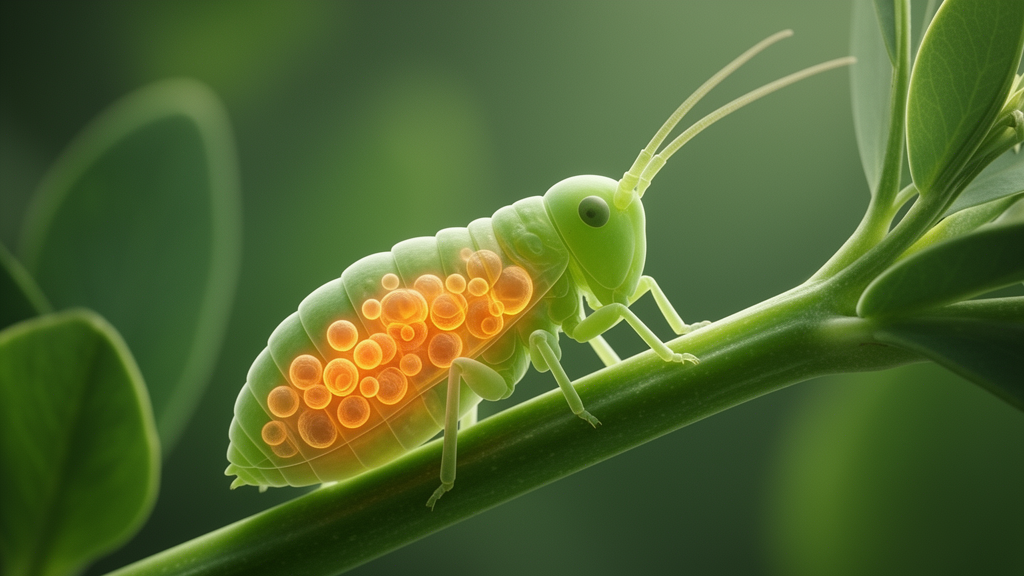
The life cycle of the pea aphid exhibits profound spatiotemporal and physiological divergences between its reproductive morphs, creating distinct developmental constraints for embryonic assembly. Viviparous reproduction, which predominates during favorable ecological periods, allows aphid populations to expand exponentially through an assembly-line structure within telotrophic ovarioles. In these asexual females, oocytes and developing embryos are arranged in connected sequential chains, receiving cytoplasmic nutrients directly from maternal nurse cells situated within anterior germaria. This asexual mode proceeds with astonishing speed: viviparous embryogenesis requires approximately ten days to complete, representing an order of magnitude acceleration compared to the roughly one hundred days required for oviparous embryogenesis. Furthermore, viviparous eggs are nearly fivefold smaller in length than their oviparous counterparts during initial patterning events. This telescoping of generations culminates in a reproductive phenomenon wherein newly hatched first-instar nymphs are already pregnant, carrying late-stage embryos that themselves harbor developing blastoderms. This multi-generational packaging compresses early patterning milestones into drastically shortened developmental windows.
A central breakthrough highlighted in the review concerns how the pea aphid designates its reproductive lineage through a preformed germ plasm containing the conserved RNA helicase Vasa. In animals, primordial germ cells are typically designated either through inductive signals from neighboring tissues or via preformed maternal cytoplasmic determinants termed germ plasm. By tracking the localization of Vasa protein across early embryonic stages, researchers demonstrated that asexual pea aphids assemble a localized, Vasa-positive germ plasm at the posterior pole of syncytial embryos from the very first round of nuclear division. Surprisingly, the authors note that sexual, oviparous pea aphids also assemble a Vasa-positive posterior germ plasm, although its visible emergence is delayed until the completion of five nuclear division cycles when thirty-two nuclei have formed. Western blot analyses and immunostaining confirm that Vasa protein is continuously present in mature oocytes and unfertilized eggs, while significant increases in zygotic Vasa synthesis occur only from gastrulation onward, confirming the maternal origin of this early determinant.
The presence of maternal germ plasm in both viviparous and oviparous pea aphids represents an extraordinary evolutionary anomaly within hemimetabolous insects. In all other thoroughly characterized hemimetabolous model systems, including the cricket Gryllus bimaculatus, the grasshopper Schistocerca gregaria, and the milkweed bug Oncopeltus fasciatus, maternal germ plasm has never been detected. Instead, these insects rely exclusively on signal induction, an ancestral mechanism in which prospective germ cells segregate from somatic lineages much later in development. In Gryllus bimaculatus, for example, germ cells only appear in abdominal segments two through five following complete segmentation, and experimental mesodermal disruption via twist RNA interference abolishes germline formation entirely. Consequently, the discovery that Acyrthosiphon pisum employs preformed germ plasm indicates that aphids independently derived a determinant-driven specification strategy that converges functionally with holometabolous insects while departing from their own hemimetabolous relatives.
Although pea aphids share the use of a preformed maternal germ plasm with the holometabolous fruit fly Drosophila melanogaster, the underlying molecular architectures orchestrating this assembly are entirely distinct. In Drosophila, the assembly of posterior germ plasm requires the maternal gene oskar, whose messenger RNA and protein act as essential molecular anchors that recruit Vasa and other components to the posterior pole. Genomic sequencing has confirmed that the pea aphid genome lacks an orthologue of oskar, proving that aphid germ plasm assembly operates through an oskar-independent mechanism. When researchers ectopically expressed the pea aphid Vasa protein, Ap-Vas1, in Drosophila oocytes, the aphid protein completely failed to localize to the fly germ plasm. Molecular mapping revealed that this incompatibility stems from the HELICc domain of Vasa, where Drosophila Vasa possesses a critical glutamine residue at position 527. This specific amino acid is absent in Ap-Vas1, as well as in Gryllus and Oncopeltus, indicating that aphid germ plasm functions through an uncharacterized anchoring factor.
Following specification, the migratory path taken by pea aphid germ cells reveals a second striking developmental divergence from canonical insect models. In Drosophila, primordial pole cells form at the posterior blastoderm and are rapidly carried into the embryonic interior during early gastrulation through invagination of the posterior midgut primordium. In contrast, pea aphid germ cells remain strictly external to the embryo throughout initial development, resting adjacent to the extending abdomen as the germ band elongates toward the anterior pole. Staining reveals that germ cells remain outside the embryonic body from early blastoderm stages until stage fifteen, when katatrepsis flips the embryo within the egg chamber. Only after katatrepsis brings the abdomen back toward the posterior pole do the germ cells finally invade the interior embryonic cavity to coalesce with the somatic gonadal mesoderm. The authors hypothesize that this prolonged external localization reflects heterochronic constraints imposed by aphid short-germ development, where abdominal segmentation is delayed until just prior to embryonic inversion.
The extracellular journey of migrating germ cells is intimately linked to the maternal obligate endosymbiont Buchnera aphidicola, which colonizes the posterior blastoderm during stage seven. Throughout subsequent developmental stages, Buchnera cells maintain continuous physical proximity with the cluster of migrating germ cells. Specialized maternal host cells known as bacteriocytes directly contact the germ cells, forming an anatomical interface between the symbiont population and the developing germline. The authors suggest that this close association serves dual functions: Buchnera may supply essential metabolic nutrients to sustain germ cells during their extended migration, while bacteriocytes may mediate biochemical guidance cues dispatched from the somatic gonadal mesoderm. Support for this symbiotic coordination comes from studies in Camponotini ants, where endosymbionts regulate germline Vasa expression via the Hox genes Abdominal A and Ultrabithorax. Because both Hox genes are similarly expressed in aphid bacteriocytes, an evolutionary conserved genetic cassette may maintain bacteriocyte integrity to support germline survival and migration.
Axis determination in the pea aphid further highlights how viviparity has restructured early embryonic patterning networks. In long-germ insects such as Drosophila, the anterior-posterior axis is established by the asymmetric localization of maternal bicoid transcript to the anterior pole and nanos transcript to the posterior pole. While pea aphids lack a bicoid orthologue, researchers discovered that maternal transcripts of the zinc-finger transcription factor hunchback, designated Ap-hb, localize specifically to the anterior pole of stage-zero oocytes. This anterior concentration persists through early syncytial divisions, mirroring the spatial distribution of bicoid despite the absence of evolutionary homology. Downstream patterning confirms the functional significance of this anterior polarity: the head specification gene orthodenticle, Ap-otd, is subsequently transcribed in the thickened anterior germ band, while the posterior determinant caudal, Ap-cad, is restricted to the opposite embryonic extremity. This indicates that viviparous aphids specify egg and embryonic anterior poles in identical orientations, resembling long-germ developmental strategies.
In addition to anterior patterning, posterior regulation in viviparous aphids involves the localized accumulation of Vasa and Nanos proteins, which become detectable at the posterior pole once nuclear divisions commence. Intriguingly, Ap-hb displays a dual developmental role that extends beyond early axial determination into direct germline regulation. Although maternal Ap-hb is absent from the preformed germ plasm, zygotic Ap-hb expression appears within germ cells immediately after blastoderm cellularization and continues through gonad coalescence.
Ultimately, the synthesis provided by Lin and colleagues indicates that the evolutionary acquisition of parthenogenetic viviparity drove widespread compensatory modifications across early developmental pathways in the pea aphid. By combining the rapid blastoderm coverage characteristic of long-germ insects with the progressive abdominal segmentation of short-germ embryos, Acyrthosiphon pisum created a novel developmental environment. In this specialized context, the co-option of maternal germ plasm, anterior hunchback localization, and symbiotic integration facilitated rapid embryonic proliferation. The authors emphasize that fully deciphering these regulatory networks will require overcoming significant technical hurdles, notably the perfection of functional genetic tools such as embryonic RNA interference and CRISPR-Cas9 mutagenesis in aphids. Clarifying these unique developmental mechanisms will not only refine broader evolutionary models of insect reproductive transition, but may also uncover highly specific molecular vulnerabilities. Such discoveries could ultimately provide agricultural researchers with precise targets to disrupt aphid embryogenesis and manage destructive crop infestations worldwide.
Subject of Research: Developmental evolution of germline specification and axis determination in pea aphids
Article Title: Germline specification and axis determination in viviparous and oviparous pea aphids: conserved and divergent features
Article References: Lin, G.-W., Chung, C.-Y., Cook, C. E., Lin, M.-D., Lee, W.-C., & Chang, C.-C. (2022). Germline specification and axis determination in viviparous and oviparous pea aphids: conserved and divergent features. Development Genes and Evolution, 232(2-4), 51-65. https://doi.org/10.1007/s00427-022-00690-7
Image Credits: AI Generated
DOI: 10.1007/s00427-022-00690-7
Keywords: Acyrthosiphon pisum, pea aphid, germline specification, axis determination, viviparity, parthenogenesis, Vasa, hunchback, Buchnera aphidicola, bacteriocytes, katatrepsis, preformed germ plasm, hemimetabolous insects, orthodenticle, caudal, embryogenesis, telotrophic ovariole
News Source: Drew Townsend. (November 11, 2026). Pea Aphids Repurpose Maternal Germ Plasm and Hunchback for Rapid Viviparous Development. Scienmag.