• HOME
  • NEWS
  • EXPLORE
    • CAREER
      • Companies
      • Jobs
    • EVENTS
    • iGEM
      • News
      • Team
    • PHOTOS
    • VIDEO
    • WIKI
  • BLOG
  • COMMUNITY
    • FACEBOOK
    • INSTAGRAM
    • TWITTER
Sunday, January 18, 2026
BIOENGINEER.ORG
No Result
View All Result
  • Login
  • HOME
  • NEWS
  • EXPLORE
    • CAREER
      • Companies
      • Jobs
        • Lecturer
        • PhD Studentship
        • Postdoc
        • Research Assistant
    • EVENTS
    • iGEM
      • News
      • Team
    • PHOTOS
    • VIDEO
    • WIKI
  • BLOG
  • COMMUNITY
    • FACEBOOK
    • INSTAGRAM
    • TWITTER
  • HOME
  • NEWS
  • EXPLORE
    • CAREER
      • Companies
      • Jobs
        • Lecturer
        • PhD Studentship
        • Postdoc
        • Research Assistant
    • EVENTS
    • iGEM
      • News
      • Team
    • PHOTOS
    • VIDEO
    • WIKI
  • BLOG
  • COMMUNITY
    • FACEBOOK
    • INSTAGRAM
    • TWITTER
No Result
View All Result
Bioengineer.org
No Result
View All Result
Home NEWS Science News

Paving the way for tunable graphene plasmonic THz amplifiers

Bioengineer by Bioengineer
September 8, 2020
in Science News
Reading Time: 2 mins read
0
IMAGE
Share on FacebookShare on TwitterShare on LinkedinShare on RedditShare on Telegram

IMAGE

Credit: Tohoku University

Tohoku University Professor Taiichi Otsuji has led a team of international researchers in successfully demonstrating a room-temperature coherent amplification of terahertz (THz) radiation in graphene, electrically driven by a dry cell battery.

Roughly 40 years ago, the arrival of plasma wave electronics opened up a wealth of new opportunities. Scientists were fascinated with the possibility that plasma waves could propagate faster than electrons, suggesting that so-called “plasmonic” devices could work at THz frequencies. However, experimental attempts to realize such amplifiers or emitters remained elusive.

“Our study explored THz light-plasmon coupling, light absorption, and amplification using a graphene-based system because of its excellent room-temperature electrical and optical properties,” said Professor Otsuji who is based at the Ultra-Broadband Signal Processing Laboratory at Tohoku University’s Research Institute of Electrical Communication (RIEC).

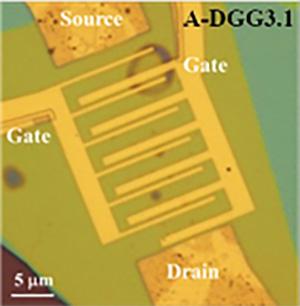
The research team, which consisted of members from Japanese, French, Polish and Russian institutions, designed a series of monolayer-graphene channel transistor structures. These featured an original dual-gathering gate that worked as a highly efficient antenna to couple the THz radiations and graphene plasmons.

Using these devices allowed the researchers to demonstrate tunable resonant plasmon absorption that, with an increase in current, results in THz radiation amplification. The amplification gain of up to 9% was observed in the monolayer graphene–far beyond the well-known landmark level of 2.3% that is the maximum available when photons directly interact with electrons without excitation of graphene plasmons.

To interpret the results, the research team used a dissipative plasmonic crystal model, capturing the main trends and basic physics of the amplification phenomena. Specifically, the model predicts the increase in the channel dc current that drives the system into an amplification regime. This indicates that the plasma waves may transfer the dc energy into the incoming THz electromagnetic waves in a coherent fashion.

“Because all results were obtained at room temperature, our experimental results pave the way toward further THz plasmonic technology with a new generation of all-electronic, resonant, and voltage-controlled THz amplifiers,” added Professor Otsuji.

###

Media Contact
Taiichi Otsuji
[email protected]

Original Source

https://www.tohoku.ac.jp/en/press/tunable_graphene_plasmonic_thzamplifiers.html

Related Journal Article

http://dx.doi.org/10.1103/PhysRevX.10.031004

Tags: Technology/Engineering/Computer Science
Share12Tweet8Share2ShareShareShare2

Related Posts

Immunotherapy in Prostate Cancer: Progress and Outlook

January 18, 2026

Robot Learns from 2D Drawings: A Breakthrough!

January 18, 2026

Analyzing Gaze Synchrony in Autistic Children Through Rhythm

January 18, 2026

Disparities in CGM Prescribing Practices in Primary Care

January 18, 2026
Please login to join discussion

POPULAR NEWS

  • Enhancing Spiritual Care Education in Nursing Programs

    155 shares
    Share 62 Tweet 39
  • PTSD, Depression, Anxiety in Childhood Cancer Survivors, Parents

    148 shares
    Share 59 Tweet 37
  • Robotic Ureteral Reconstruction: A Novel Approach

    78 shares
    Share 31 Tweet 20
  • Study Reveals Lipid Accumulation in ME/CFS Cells

    54 shares
    Share 22 Tweet 14

About

BIOENGINEER.ORG

We bring you the latest biotechnology news from best research centers and universities around the world. Check our website.

Follow us

Recent News

Immunotherapy in Prostate Cancer: Progress and Outlook

Robot Learns from 2D Drawings: A Breakthrough!

Analyzing Gaze Synchrony in Autistic Children Through Rhythm

Subscribe to Blog via Email

Enter your email address to subscribe to this blog and receive notifications of new posts by email.

Join 71 other subscribers
  • Contact Us

Bioengineer.org © Copyright 2023 All Rights Reserved.

Welcome Back!

Login to your account below

Forgotten Password?

Retrieve your password

Please enter your username or email address to reset your password.

Log In
No Result
View All Result
  • Homepages
    • Home Page 1
    • Home Page 2
  • News
  • National
  • Business
  • Health
  • Lifestyle
  • Science

Bioengineer.org © Copyright 2023 All Rights Reserved.