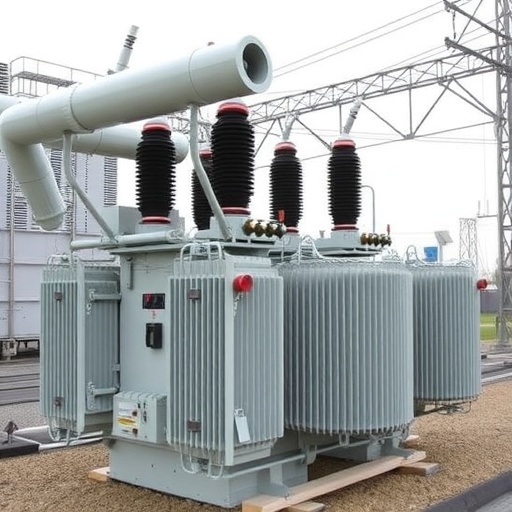
The University of Pittsburgh, in collaboration with North Carolina State University, has embarked on a groundbreaking project funded by the U.S. Department of Energy’s Advanced Research Projects Agency–Energy (ARPA-E). This ambitious initiative, known as the Disruptive DC Converters for Grid Resilient Infrastructure to Deliver Secure Energy (DC-GRIDS), aims to dramatically enhance the capacity and reliability of the power grid by pioneering novel transformer and converter technologies for high-voltage direct current (HVDC) systems.
Leading the University of Pittsburgh’s portion of the project is Paul Ohodnicki, an associate professor of mechanical engineering and materials science at the Swanson School of Engineering. Ohodnicki’s team focuses on the design, modeling, and manufacturing of medium-frequency transformers, critical components for enabling efficient and compact HVDC power systems. Such transformers operate at higher frequencies than traditional grid transformers, allowing for significant reductions in size, weight, and cost, which collectively contribute toward a more manageable and scalable power infrastructure.
HVDC technology is a cornerstone of future energy grids due to its superior efficiency for long-distance and high-power transmission compared to traditional alternating current systems. However, existing HVDC converter stations tend to be large, costly, and complex. The DC-GRIDS project seeks to revolutionize these stations by at least tripling their compactness and reducing associated costs, thanks to innovative semiconductor switch designs developed by subgroups within the project, particularly those at North Carolina State University under the guidance of Subhashish Bhattacharya, Duke Energy Distinguished Professor of Electrical and Computer Engineering.
Central to this effort, Ohodnicki’s contributions hinge on the advanced magnetic components developed through the AMPED consortium (Advanced Magnetics for Power and Energy Development), a collaborative network between universities and industry focusing on soft magnetic materials for power applications. The team’s research addresses the material science and engineering challenges of transformer cores that must function reliably at medium frequencies while minimizing energy losses, thermal challenges, and electromagnetic interference.
The transformative potential of medium-frequency transformer technology lies in its ability to transmit power more efficiently and flexibly across modern grids, incorporating renewable energy sources like wind and solar, and facilitating resilient grid infrastructure capable of withstanding climate disruptions and demand fluctuations. This aligns with broader national energy goals to enhance grid security, increase sustainability, and enable electrification of transportation and industry sectors.
By utilizing next-generation transformer materials and innovative magnetic designs, Ohodnicki’s team engineers devices capable of handling the stress and performance requirements of high-voltage DC transmission. The intricate modeling techniques employed include simulations that capture electromagnetic, thermal, and mechanical behaviors under dynamic grid conditions, enabling iterative optimization that balances cost, durability, and performance.
The collaboration with NCSU extends beyond component design; their semiconductor switch innovations reduce energy losses and improve switching speeds—a fundamental improvement over current technologies. Combining these advancements with Pitt’s tunable magnetic components promises converter stations that are not only physically smaller but also capable of higher efficiency and more adaptive operation under variable grid scenarios.
Pitt’s $600,000 allocation from the total $1.9 million federal grant enhances research capacity by facilitating prototype development and rigorous testing of these medium-frequency transformers. Such tangible outputs bridge theoretical engineering breakthroughs with real-world applicability, accelerating the technology’s readiness for commercialization and grid deployment.
Moreover, the educational dimension of the DC-GRIDS and AMPED projects cannot be overlooked. Ohodnicki highlights how the initiative fosters hands-on research opportunities for students, linking academic training with direct contributions to cutting-edge energy problems. This integrated approach nurtures the next generation of engineers and scientists equipped to steward the nation’s evolving energy infrastructure.
The project is a testament to the power of interdisciplinary and inter-institutional collaboration, strategically combining materials science, electrical engineering, and power systems expertise. It addresses one of the most pressing technical challenges: making the electric grid resilient and adaptive in a future dominated by renewable energy and distributed generation.
Success in this venture entails navigating complex trade-offs, such as balancing transformer efficiency with electromagnetic compatibility and thermal management. The medium frequency operation, while beneficial in scaling down transformer size, introduces unique loss mechanisms—hysteresis and eddy currents in the magnetic core—that demand innovative magnetic alloy formulations and core geometries to mitigate.
The ARPA-E DC-GRIDS project also aligns with emerging trends toward electrification and decarbonization by developing infrastructure capable of handling increasing power loads and integrating diverse energy sources. The scalability of these next-generation transformers and DC converters will play a crucial role in shaping smart grids and microgrids worldwide, enhancing energy security and flexibility.
Ultimately, the work spearheaded by Paul Ohodnicki at the University of Pittsburgh and his collaborators showcases how fundamental research in applied magnetics and advanced materials can drive revolutionary changes in energy systems. The project exemplifies a pathway from visionary research funding through ARPA-E to actual game-changing technological innovations that promise to redefine power transmission and energy distribution for decades to come.
Subject of Research:
Advanced medium-frequency transformer design and high-voltage direct current (HVDC) converter technology for resilient power grid infrastructure.
Article Title:
University of Pittsburgh Leads Cutting-Edge Research to Transform High-Voltage DC Power Grids
News Publication Date:
Not provided
Web References:
https://arpa-e.energy.gov/programs-and-initiatives/view-all-programs/dc-grids
https://www.engineering.pitt.edu/people/faculty/paul-ohodnicki/
https://pittamped.github.io/
Image Credits:
Credit: Tom Altany/University of Pittsburgh
Keywords
Energy infrastructure, Voltage, Electric current, Direct current, High-voltage DC, Transformer design, Medium-frequency magnetics, Power grid resilience, Semiconductor switches, Power conversion, Magnetic materials, Grid modernization
Tags: advanced power transmission systemsARPA-E funded energy projectscompact HVDC converter stationsefficient long-distance power transmissionenergy grid resilience innovationhigh-voltage direct current transformersHVDC power grid technologymechanical engineering in energymedium-frequency transformer designnovel transformer manufacturingscalable power infrastructure developmentUniversity of Pittsburgh energy research