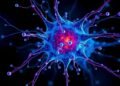
Credit: Salk Institute/Waitt Center
LA JOLLA–(Sept. 14, 2017) Salk Institute scientists have discovered that an interaction between two key proteins helps regulate and maintain the cells that produce neurons. The work, published in Cell Stem Cell on September 14, 2017, offers insight into why an imbalance between these precursor cells and neurons might contribute to mental illness or age-related brain disease.
"Increasingly, we are learning that diseases like schizophrenia, depression and Alzheimer's all have a cellular basis," says Rusty Gage, a professor in Salk's Laboratory of Genetics and senior author of the new work. "So we are eager to understand how specific brain cells develop, what keeps them healthy and why advancing age or other factors can lead to disease."
In 1998, Gage led a research team which discovered that adult brains do produce new neurons, contrary to decades of dogma saying we are born with all the neurons we will ever have. Since then, he has been elucidating various aspects of this neurogenesis as well as what goes wrong in various neurological disorders. (In 2015, for example, his lab identified a cellular basis for bipolar disorder.)
The new work sought to understand how neural precursor cells maintain their own cellular identity as they divide and create neurons or astrocytes. Gage's team already knew that the cell nucleus–the ball-shaped membrane containing the genome–looks very different in the three cell types, with different genes active in each. Another Salk professor and a coauthor on the paper, Martin Hetzer, previously found that proteins in the nuclear membrane influence gene expression in different kinds of cancer cells. The Gage team sought the expertise of the Hetzer lab to explore whether something similar was at play in brain cells.
"Research from my lab has found that the nuclear membrane is a dynamic structure that plays a key role in developmental gene regulation," says Hetzer, Salk's chief science officer and holder of the Jesse and Caryl Philips Foundation Chair. "So we were very interested to see what the Gage lab, working with entirely different cell types, would uncover."
Gage's team conducted screens in cells from mice and rats to see which genes were being transcribed into proteins in precursor cells, immature neurons and astrocytes. In the precursors, they discovered high numbers of a protein called Nup153, which is part of a multiprotein complex that forms a gatekeeping pore in the nuclear membrane, controlling what goes in or out. Immature neurons had an intermediate level of Nup153, and astrocytes had the lowest level. Because all three cell types have roughly the same number of nuclear pores, the team concluded that Nup153 levels influence cell type and that a high level is necessary to maintain cells' precursor status. This was supported by the fact that disrupting Nup153's function in the precursor cells triggered differentiation.
Interestingly, Nup153 levels are also known to be high in cells with elevated levels of a mobile protein called Sox2, a transcription factor that floats around the nucleus and binds to genes and turns them on or off. By fluorescently tagging Nup153 and Sox2 in the different cells types, they observed that Nup153 was interacting with Sox2.
"The fact that we were able to connect transcription factors, which are mobile switches, to the pore complex, which is a very stable structure, offers a clue as to how cells maintain their identity through regulated gene expression," says Tomohisa Toda, a Salk research associate and first author of the paper.
Next, the team wants to explore how the interaction of the pore complex with other transcription factors affects neuronal function, which could yield insights into the underlying causes of certain neurological disorders.
###
Other authors included: Jonathan Y. Hsu, Sara B. Linker, Lauren Hu, Simon T. Schafer, Jerome Mertens, Felipe V. Jacinto and Martin Hetzer.
The work was funded by: the Japan Society for the Promotion of Science, the Kanae Foundation for the Promotion of Medical Science, the Paul G. Allen Family Foundation, The JPB Foundation, The Dolby Foundation, The Leona M. and Harry B. Helmsley Charitable Trust, the National Institutes of Health-National Cancer Institute, the Chapman Foundation, the Waitt Foundation, and the National Institute of Neurological Disorders and Stroke Neuroscience Center.
About the Salk Institute for Biological Studies:
Every cure has a starting point. The Salk Institute embodies Jonas Salk's mission to dare to make dreams into reality. Its internationally renowned and award-winning scientists explore the very foundations of life, seeking new understandings in neuroscience, genetics, immunology, plant biology and more. The Institute is an independent nonprofit organization and architectural landmark: small by choice, intimate by nature and fearless in the face of any challenge. Be it cancer or Alzheimer's, aging or diabetes, Salk is where cures begin. Learn more at: salk.edu.
Media Contact
Salk Communications
[email protected]
858-453-4100
@salkinstitute
http://www.salk.edu
Original Source
https://www.salk.edu/news-release/partnership-healthy-brain/