• HOME
  • NEWS
  • EXPLORE
    • CAREER
      • Companies
      • Jobs
    • EVENTS
    • iGEM
      • News
      • Team
    • PHOTOS
    • VIDEO
    • WIKI
  • BLOG
  • COMMUNITY
    • FACEBOOK
    • INSTAGRAM
    • TWITTER
Saturday, February 7, 2026
BIOENGINEER.ORG
No Result
View All Result
  • Login
  • HOME
  • NEWS
  • EXPLORE
    • CAREER
      • Companies
      • Jobs
        • Lecturer
        • PhD Studentship
        • Postdoc
        • Research Assistant
    • EVENTS
    • iGEM
      • News
      • Team
    • PHOTOS
    • VIDEO
    • WIKI
  • BLOG
  • COMMUNITY
    • FACEBOOK
    • INSTAGRAM
    • TWITTER
  • HOME
  • NEWS
  • EXPLORE
    • CAREER
      • Companies
      • Jobs
        • Lecturer
        • PhD Studentship
        • Postdoc
        • Research Assistant
    • EVENTS
    • iGEM
      • News
      • Team
    • PHOTOS
    • VIDEO
    • WIKI
  • BLOG
  • COMMUNITY
    • FACEBOOK
    • INSTAGRAM
    • TWITTER
No Result
View All Result
Bioengineer.org
No Result
View All Result
Home NEWS Science News

Parkinson’s disease will be curable with cortisol

Bioengineer by Bioengineer
April 25, 2017
in Science News
Reading Time: 2 mins read
0
Share on FacebookShare on TwitterShare on LinkedinShare on RedditShare on Telegram
IMAGE

Credit: DGIST

DGIST's research team has found a candidate substance which can prevent and cure Parkinson's disease. By using this substance, the team also has identified the mechanism of dopaminergic neuronal death inhibition.

Parkinson's disease is a representative neurological degenerative brain disease caused by the death of dopaminergic neurons in the middle cerebral blood. It is a disease with high incidence in the population over the age of 60 and the symptoms are body tremor and stiffness, slow motion, posture instability, etc.

It is known that mutation or low expression of parkin protein, a part of the system which hydrolyzes intracellular proteins, accelerates the accumulation of toxic proteins that must be removed in cells and induces dopaminergic neuronal cell death and Parkinson's disease, a degenerative brain disease.

Currently, Parkinson's disease is classified as a rare incurable disease, one of the Korean government's four major target serious illnesses. However, there are no drugs that can prevent the death of dopaminergic neurons.

The senior researcher Yoon-Il Lee's research team and Professor Yunjong Lee's research team have continuously conducted studies on the development of candidate substances to cure Parkinson's disease and their mechanisms. The researchers performed a high-throughput screening method to identify drug candidates that promote dopaminergic neuronal cell activation by inducing the expression of the parkin protein, the cell protection gene which can inhibit the death of dopaminergic neurons.

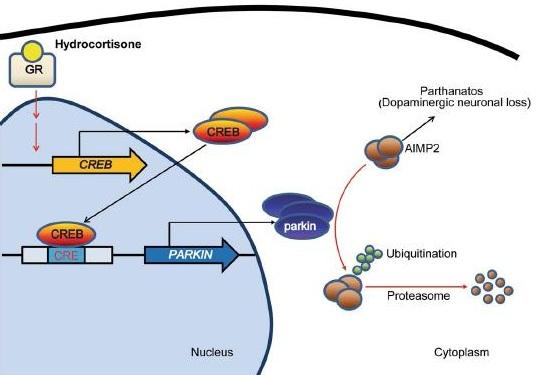
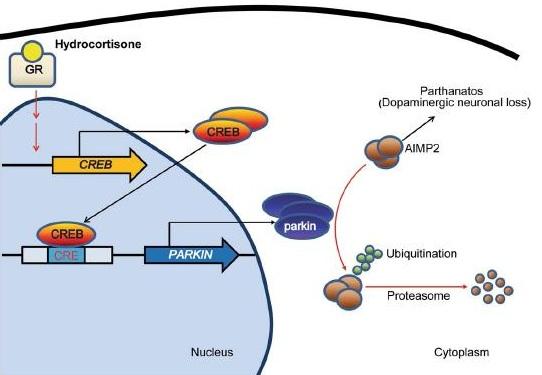
As a result, it has been identified that cortisol* , known as a stress hormone, induces the expression of the parkin protein and prevents dopaminergic neuronal death by eliminating the accumulation of cell death factors through ubiquitin proteasome system.

In addition, the team has demonstrated the mechanism by which cortisol induces the expression of the parkin protein and CREB transcriptional regulator through the hormone receptor regulates the expression of the parkin protein through the cell and animal model experiments. The study also has assured the possibility that cortisol can be used as a therapeutic agent for degenerative Parkinson's disease.

The senior researcher Yoon-Il Lee stated "The significance of this study is that it has identified that the expression of parkin protein induced by a moderate level of stress hormone cortisol could be an important factor in maintaining the viability of dopaminergic neurons. We will continue to conduct follow-up studies such as clinical studies so that the Parkinson's disease will be curable in the future."

###

Media Contact

Dahye Kim
[email protected]
82-053-785-1163

http://www.dgist.ac.kr

############

Story Source: Materials provided by Scienmag

Share12Tweet8Share2ShareShareShare2

Related Posts

Succinate Receptor 1 Limits Blood Cell Formation, Leukemia

February 7, 2026

Palmitoylation of Tfr1 Drives Platelet Ferroptosis and Exacerbates Liver Damage in Heat Stroke

February 7, 2026

Oxygen-Enhanced Dual-Section Microneedle Patch Improves Drug Delivery and Boosts Photodynamic and Anti-Inflammatory Treatment for Psoriasis

February 7, 2026

Scientists Identify SARS-CoV-2 PLpro and RIPK1 Inhibitors Showing Potent Synergistic Antiviral Effects in Mouse COVID-19 Model

February 7, 2026
Please login to join discussion

POPULAR NEWS

  • Robotic Ureteral Reconstruction: A Novel Approach

    Robotic Ureteral Reconstruction: A Novel Approach

    82 shares
    Share 33 Tweet 21
  • Digital Privacy: Health Data Control in Incarceration

    63 shares
    Share 25 Tweet 16
  • Study Reveals Lipid Accumulation in ME/CFS Cells

    57 shares
    Share 23 Tweet 14
  • Breakthrough in RNA Research Accelerates Medical Innovations Timeline

    53 shares
    Share 21 Tweet 13

About

We bring you the latest biotechnology news from best research centers and universities around the world. Check our website.

Follow us

Recent News

Succinate Receptor 1 Limits Blood Cell Formation, Leukemia

Palmitoylation of Tfr1 Drives Platelet Ferroptosis and Exacerbates Liver Damage in Heat Stroke

Oxygen-Enhanced Dual-Section Microneedle Patch Improves Drug Delivery and Boosts Photodynamic and Anti-Inflammatory Treatment for Psoriasis

Subscribe to Blog via Email

Enter your email address to subscribe to this blog and receive notifications of new posts by email.

Join 73 other subscribers
  • Contact Us

Bioengineer.org © Copyright 2023 All Rights Reserved.

Welcome Back!

Login to your account below

Forgotten Password?

Retrieve your password

Please enter your username or email address to reset your password.

Log In
No Result
View All Result
  • Homepages
    • Home Page 1
    • Home Page 2
  • News
  • National
  • Business
  • Health
  • Lifestyle
  • Science

Bioengineer.org © Copyright 2023 All Rights Reserved.