Credit: Glenn Walker
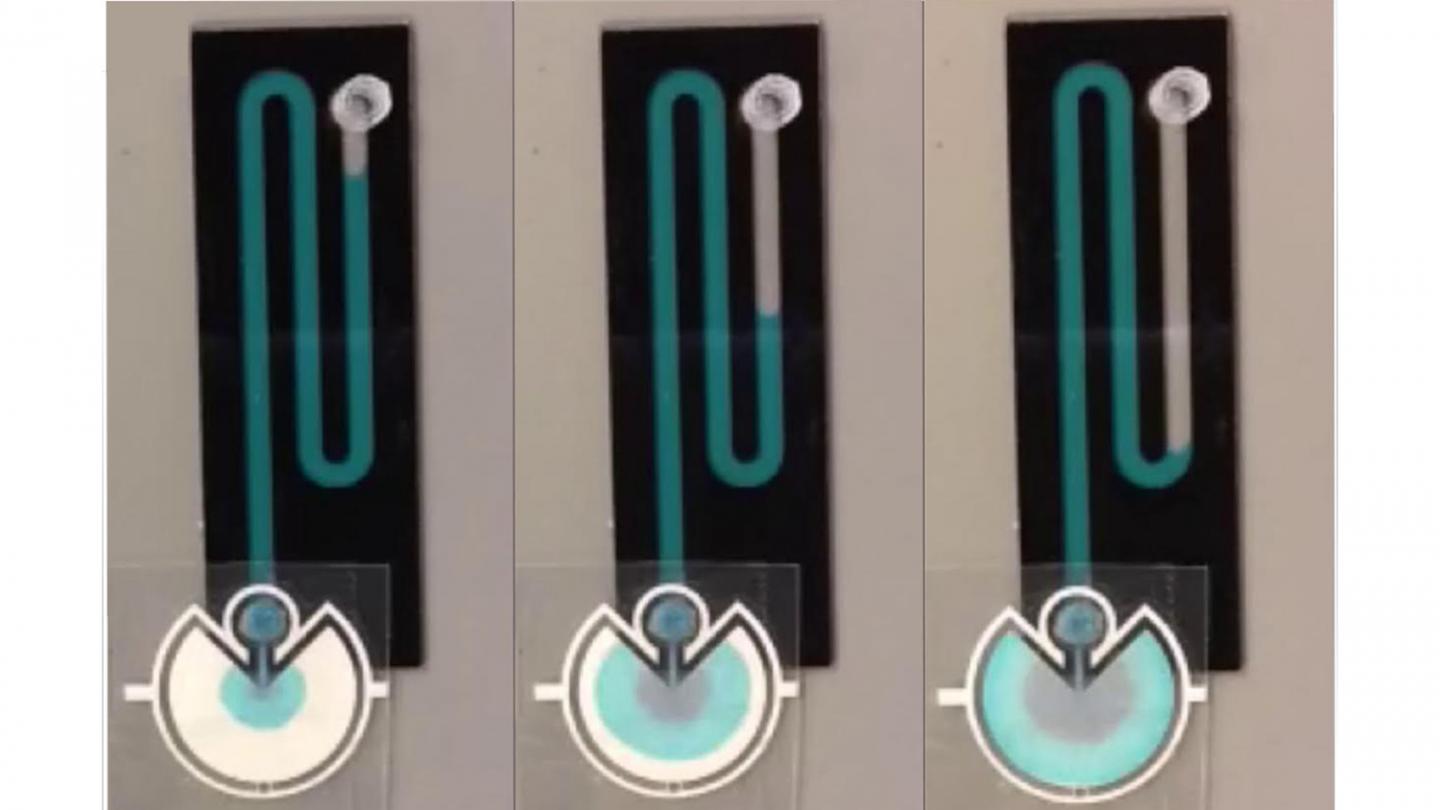
Biomedical engineering researchers from North Carolina State University and the University of North Carolina at Chapel Hill have developed inexpensive paper pumps that use capillary action to power portable microfluidic devices, opening the door to a range of biomedical tools.
Microfluidic devices are devices that manipulate fluids which have a volume of one microliter or less – volumes substantially smaller than a single teardrop. These devices hold promise for use in applications ranging from biomedical diagnostic tools to drug testing technologies.
"One longstanding challenge to the development of portable, real-world microfluidic device technologies has been the need to find a cost-effective way to pump fluids through the device when outside of the lab," says Glenn Walker, co-corresponding author of a journal article on the work and an associate professor in the joint biomedical engineering program at NC State and UNC. "Portability is important, because it makes new applications possible, such as diagnostic tools that can be used in the field. Electric pumps, and tubing to connect them, are fine for a laboratory environment, but those aren't easy to take with you."
Now Walker and his collaborators have developed a new way to not only pump fluids through microfluidic devices, but to exert substantial control over that flow. They can stop and re-start the flow, control the rate of the flow, and control how long the flow lasts.
"And, because our approach is a new twist on an age-old technology, our pumps are extremely cost effective," Walker says.
The age-old technology he's referring to is paper.
The researchers call their pumping system a hydraulic battery, but it doesn't involve electricity in any way. Instead, the "battery" draws its pumping power from capillary action.
If you've ever seen a paper towel soak up a spill, you've seen capillary action at work. Broadly speaking, capillary action is the tendency of liquids to be drawn into small spaces by surface tension. In the context of the hydraulic battery, it is the tendency of water – and aqueous liquids, such as blood – to be drawn into the pores found in a piece of paper.
"Our system uses pieces of paper that are 125 microns thick, little more than the width of a single hair," Walker says. "Capillary action pulls a liquid into the paper. And by changing the shape of the paper, we are able to control how much liquid is pulled through an attached device – and how quickly that happens."
The shape can be changed in two dimensions by simply cutting out the paper. But it can also be manipulated in three dimensions by stacking multiple pumps on top of each other.
"By stacking the paper we are able to create more complex flow profiles, depending on the needs for any given application," Walker says. "And any one of these hydraulic battery pumps costs less than a dime."
There are other portable means for pumping liquid through a microfluidic device, but Walker feels that the paper pumps his team has developed hold several significant advantages.
"Our hydraulic battery is small, lightweight, very inexpensive, easy to connect to a device and disposable," Walker says. "In addition, our paper pumps could be saved for later evaluation, such as to run secondary, lab-based tests to confirm on-site diagnoses."
The researchers have filed a patent application on the paper pump technology and are currently looking for industry partners to help bring it to the marketplace.
"We're optimistic that it could make a difference in both public health and advancing fundamental research," Walker says.
###
The paper, "Modular pumps as programmable hydraulic batteries for microfluidic devices," is published in the journal Technology. Lead author of the paper is Brian Cummins, a former postdoctoral researcher in the joint biomedical engineering program. Co-corresponding author of the paper is Frances Ligler, Lampe Distinguished Professor of Biomedical Engineering at NC State and UNC. The paper was co-authored by Rukesh Chinthapatla and Balaji Lenin, both of whom are undergraduates at NC State. The work was done with support from the NC State University Chancellor's Innovation Fund.
Media Contact
Matt Shipman
[email protected]
919-515-6386
@NCStateNews
############
Story Source: Materials provided by Scienmag