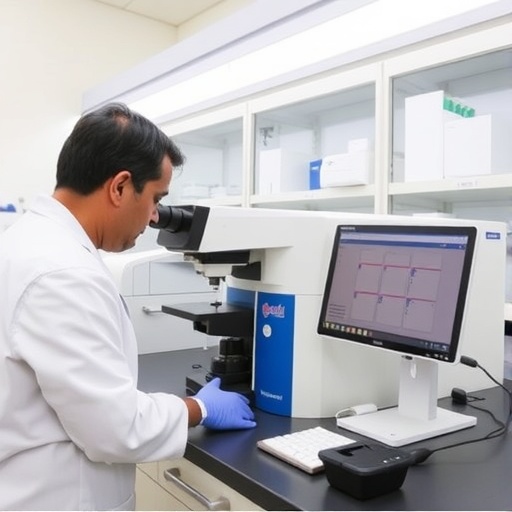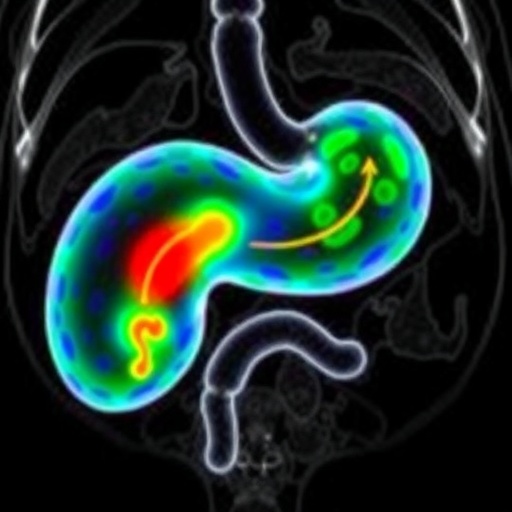
In a groundbreaking advancement poised to revolutionize cancer diagnostics, researchers have introduced PanMETAI, a state-of-the-art tabular foundation model designed to dramatically enhance the accuracy of pancreatic cancer diagnosis. Pancreatic cancer, notorious for its elusive early symptoms and consequently late detection, remains one of the deadliest malignancies worldwide. The advent of this model represents a crucial stride toward early intervention and improved survival rates in patients afflicted by this aggressive disease.
PanMETAI distinguishes itself by leveraging nuclear magnetic resonance (NMR) metabolomics — a sophisticated approach that profiles metabolites, the small molecules involved in cellular processes, providing a detailed metabolic fingerprint of biological samples. This non-invasive technique captures the complex metabolic alterations that pancreatic tumors induce, which are often imperceptible through conventional imaging or biochemical assays.
The model’s foundation rests on a tabular data format, an organizational method that structures the rich, multifaceted datasets derived from NMR spectra into accessible, analyzable arrays. This approach contrasts with traditional image- or sequence-based data, enabling the model to excel in discerning intricate patterns and subtle shifts in metabolic signatures – critical for differentiating between malignant and benign states with high precision.
Central to PanMETAI’s prowess is its architecture, which embodies recent advances in artificial intelligence tailored for tabular data. Unlike typical classification algorithms, this foundation model integrates deep learning techniques calibrated to capture hierarchical and nonlinear associations within metabolomic profiles. It achieves this by employing innovative embedding layers and attention mechanisms that enhance both feature interpretation and model explainability.
The training process involved a vast cohort of metabolomic datasets compiled from diverse patient populations. Crucially, rigorous pre-processing and normalization steps were implemented to ensure data uniformity across centers, overcoming the inherent variability in NMR instrumentation and sample handling. This harmonization fortified the model’s generalizability, a pivotal consideration when translating AI tools into clinical practice.
Notably, PanMETAI underwent extensive validation against existing diagnostic benchmarks, including established biomarkers and imagery modalities. Results unveiled a remarkable surge in diagnostic sensitivity and specificity, outperforming prevailing tools that often falter amidst the nuanced metabolic landscapes of pancreatic cancer. The model’s predictive precision shows promise in minimizing false positives and negatives, which are major hurdles that compromise patient outcomes and healthcare resources.
Interpretability remains a cornerstone of PanMETAI’s design ethos. The developers embedded interpretative frameworks enabling clinicians to comprehend which metabolite features most significantly influence the model’s diagnostic decisions. This transparency fosters trust and facilitates integration into clinical workflows, where explicable AI can augment, rather than replace, physician expertise.
The implications of this work extend beyond diagnostic accuracy. By elucidating the metabolic perturbations underlying pancreatic cancer, PanMETAI also offers a window into tumor biology. This dual capability hints at potential applications in personalized therapeutic targeting and treatment monitoring, ushering in an era of precision oncology where metabolic phenotyping informs tailored interventions.
Moreover, the non-invasive nature of NMR metabolomics paired with PanMETAI’s analytical power positions the approach as an appealing option for screening high-risk populations. Early detection remains a formidable challenge in pancreatic oncology, and tools that enable routine, minimally burdensome assessments could materially shift survival statistics by capturing malignancies at an earlier, more treatable stage.
The researchers emphasize the model’s scalability, highlighting its capacity to integrate additional omics layers or clinical data to further refine diagnostic algorithms. This extensibility underscores a broader vision for foundation models as modular platforms capable of evolving alongside expanding biomedical datasets and emerging molecular insights.
Ethical considerations were conscientiously addressed throughout the study. The team implemented strict data governance protocols, ensuring patient privacy and compliance with regulatory standards. Additionally, the AI model underwent fairness assessments to detect and mitigate biases related to demographic factors, thereby supporting equitable diagnostic application across diverse patient groups.
The publication of PanMETAI in a high-impact journal signals the growing convergence of artificial intelligence, metabolomics, and oncology. As computational models grow increasingly adept at deciphering complex biological systems, their integration promises to transform not only diagnostic paradigms but also broader clinical decision-making and research methodologies.
Looking ahead, the authors call for large-scale clinical trials to validate PanMETAI in real-world settings and to explore its utility in longitudinal disease monitoring. Such studies are essential to move from proof-of-concept to routine medical adoption, ensuring robustness and patient safety across heterogeneous healthcare environments.
In conclusion, PanMETAI represents a seminal innovation in the quest to tackle pancreatic cancer’s formidable diagnostic challenges. By fusing advanced AI with detailed metabolomic profiling, this tabular foundation model offers a beacon of hope — one that could redefine early detection, inform treatment strategies, and ultimately save lives through more precise, timely intervention.
Subject of Research: Pancreatic cancer diagnosis using AI-enhanced NMR metabolomics
Article Title: PanMETAI – a high performance tabular foundation model for accurate pancreatic cancer diagnosis via NMR metabolomics
Article References:
Wu, DN., Jen, J., Fajiculay, E. et al. PanMETAI – a high performance tabular foundation model for accurate pancreatic cancer diagnosis via NMR metabolomics. Nat Commun 17, 1595 (2026). https://doi.org/10.1038/s41467-026-69426-9
Image Credits: AI Generated
DOI: https://doi.org/10.1038/s41467-026-69426-9
Tags: artificial intelligence in healthcarecancer diagnostic advancementsearly detection of pancreatic cancerimproving survival rates in cancermetabolic fingerprinting in oncologynon-invasive cancer detection methodsnuclear magnetic resonance metabolomicspancreatic cancer diagnosispancreatic tumor metabolic alterationsPanMETAI modelprecision medicine for pancreatic cancertabular data analysis in medicine