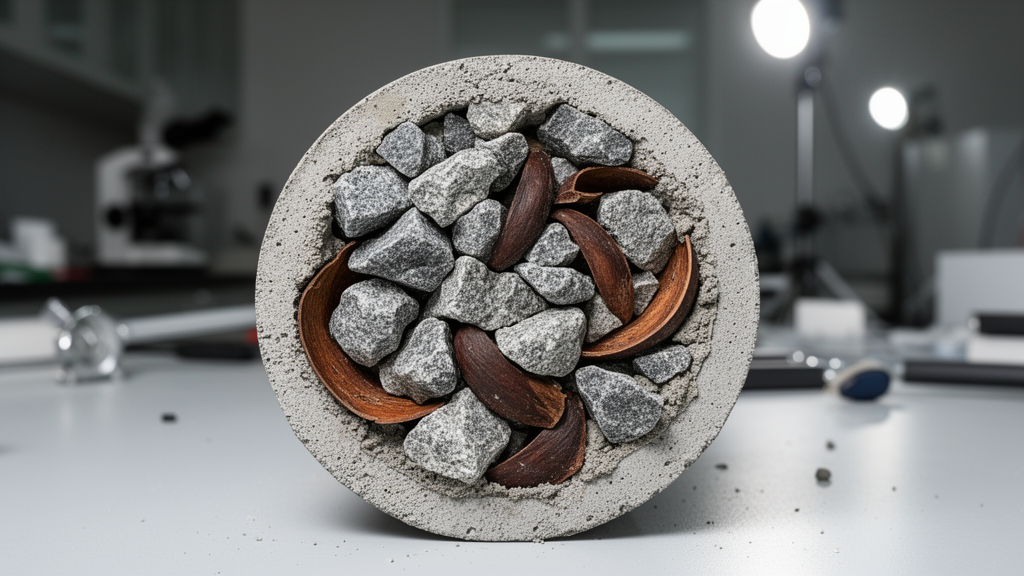
Civil engineering researchers have demonstrated that agricultural waste in the form of palm kernel shells can serve as an effective partial coarse aggregate replacement in structural concrete. In an experimental assessment evaluating concrete mixes designed for standard Grade 20 applications, replacing ten percent of conventional crushed granite with graded palm kernel shells yielded hardened concrete that closely approached target design strengths. The investigation highlights a practical pathway for reducing natural aggregate extraction in construction while simultaneously addressing the disposal challenges associated with large volumes of agricultural processing byproducts.
The study was prompted by the dual pressures of rising construction material costs and the extensive environmental disruptions associated with aggregate quarrying. Granite extraction frequently entails significant land degradation, habitat destruction, deforestation, dust pollution, and greenhouse gas emissions, alongside mounting transportation and procurement expenses that disproportionately affect developers and builders in rural and semi-urban regions. Concurrently, the commercial processing of palm oil generates substantial quantities of hard endocarp shells that are routinely discarded into landfills or open water bodies, causing severe localized pollution and waste management bottlenecks.
To assess whether these discarded agricultural shells could function as a dependable construction aggregate, the research team procured raw palm kernel shells locally from Uselu Market in Benin City, located within Edo State, Nigeria. Because raw shells carry residual organic matter and surface dirt from processing mills, the material was first soaked in water for twenty-four hours, thoroughly washed to eliminate lingering contaminants, and subsequently sun-dried. The prepared shells were mechanically broken and systematically graded to a uniform twenty-millimeter nominal aggregate size to match the standard sizing of crushed granite coarse aggregate.
The experimental campaign was carried out at the Structural Engineering Laboratory at the University of Benin. Investigators formulated an experimental baseline Grade 20 mix design utilizing Portland cement, fine aggregate, coarse aggregate, and potable water in precise batch proportions consisting of 11.79 kilograms of cement, 7.43 kilograms of water, 26.27 kilograms of fine sand, and 39.47 kilograms of coarse aggregate. Within this baseline framework, the twenty-millimeter palm kernel shells replaced conventional crushed granite coarse aggregate at replacement levels of zero percent for the control mix, followed by ten percent, twenty percent, and thirty percent replacement by weight.
Physical characterization of the raw constituent materials revealed notable mechanical and physical contrasts between geological rock and plant-derived shells. Sieve analysis conducted according to BS EN 933-1 standards confirmed that the graded palm kernel shells exhibited an acceptable particle size distribution within recommended specifications for concrete production, although the shells presented more irregular geometries and a wider gradation spread than crushed granite. Standard specific gravity testing in accordance with ASTM C127 demonstrated that the palm kernel shells possessed a specific gravity of 1.2, contrasting sharply with the 2.70 recorded for natural granite stone.
Bulk density measurements corroborated this substantial weight difference, showing an average compacted bulk density of 794 kilograms per cubic meter for the prepared palm kernel shells compared to 1572 kilograms per cubic meter for conventional granite aggregate. Mechanical toughness was evaluated through the Aggregate Impact Value test following the BS EN 1097-2 protocol. Granite coarse aggregate exhibited a mean Aggregate Impact Value of 22.96 percent, whereas palm kernel shells recorded a higher mean value of 30.8 percent, demonstrating that the natural stone aggregates possess superior resistance to crushing under severe mechanical impacts.
The rheological performance of the wet concrete mixtures was evaluated using standard slump cone measurements in accordance with BS EN 12350-2. Fresh mix workability declined progressively as the proportion of palm kernel shells increased, with the unmodified control mix recording the highest slump values. Compared directly to the control concrete, the mixture containing ten percent palm kernel shells exhibited a 0.86 percent decline in workability. Laboratory observations indicated that this decrease stemmed from the porous surface structure and greater specific surface area of the shells, which demand additional water and cement paste to coat aggregate surfaces and maintain fluidity.
Density determinations across fresh and hardened states performed according to BS EN 12390-7 illustrated consistent mass reductions across all substitution levels. The incorporation of ten percent palm kernel shells produced a 0.99 percent drop in density relative to the plain granite control, while higher replacement fractions generated further declines in hardened unit weight. This systematic downward trend directly reflects the significantly lower specific gravity and porous microstructure of the agricultural shells, confirming their technical suitability for formulating lighter concrete components that reduce overall structural dead loads.
Mechanical performance was evaluated across one hundred and forty-four cube specimens measuring one hundred millimeters on each side, cured by complete water immersion at room temperature and tested after seven, fourteen, and twenty-eight days using a two-thousand kilonewton capacity compression machine. In all experimental batches, compressive strength developed steadily over time as the hydration reactions progressed. However, compressive resistance decreased systematically as shell content increased, a phenomenon attributed to the lower intrinsic strength of plant shells and weaker interfacial transition zone bonding between cement paste and organic shell surfaces.
At the standard twenty-eight-day curing benchmark, the granite control concrete reached a mean compressive strength of 21.46 Newtons per square millimeter, satisfying the structural threshold required for Grade 20 concrete applications. The mix incorporating a ten percent palm kernel shell replacement achieved an average compressive strength of 19.21 Newtons per square millimeter, representing an 11.7 percent reduction relative to the control. Despite this strength drop, the ten percent mixture remained sufficiently close to the twenty Newton per square millimeter target design threshold to confirm its practical structural viability.
Statistical modeling of the mechanical test data further clarified the relationship between shell content and compressive performance across the curing timeline. A quadratic regression model demonstrated an improved empirical fit with an R-squared value of 0.820 and an adjusted R-squared of 0.741, pointing to non-linear strength reduction mechanisms as replacement percentages increase beyond modest levels. Descriptive statistical analyses confirmed that both the mean strength values and standard deviations for the ten percent mixture remained substantially closer to the granite control benchmark at both seven and twenty-eight days than higher substitution ratios.
The authors concluded that uniformly graded twenty-millimeter palm kernel shells can successfully substitute for crushed granite up to an optimum ceiling of ten percent by weight in Grade 20 concrete without incurring unacceptable strength degradation. While higher replacement rates introduce notable penalties in crushing resistance and workability, an optimized ten percent substitution provides a practical balance between mechanical capacity and unit weight reduction. The researchers emphasized that adopting this agricultural byproduct offers tangible environmental and economic advantages by lowering natural rock consumption, reducing quarrying disruption, and diverting agricultural waste into functional infrastructure.
Earlier scientific inquiries into agricultural shell aggregates produced contrasting conclusions regarding their structural feasibility. Azunna investigated coarse aggregate replacement across the entire range from zero to one hundred percent and determined that palm kernel shell concrete was not suitable for lightweight concrete applications because compressive strength experienced steep declines. In contrast, other studies reported positive performance characteristics under specialized conditions. Yiwo and colleagues observed favorable outcomes in drainage and structural weight reduction when incorporating untreated shells into lightweight concrete mixes, while Ohene-Coffie and co-authors determined that incorporating the material enhanced interfacial bond strength in reinforced concrete elements. Additionally, investigations by Odeyemi and colleagues showed that shell additions decreased material expenses and total concrete mass in self-compacting formulations, and Yusuf and Jimoh documented durable long-term performance in roadwork applications through ultrasonic pulse velocity testing.
The authors situated their investigation within a recognized gap in existing aggregate research, noting that prior studies had rarely examined the performance of a uniform, single gradation of twenty-millimeter palm kernel shell particles within Grade 20 concrete mixes supported by regression modeling. Because coarse aggregate particle grading directly influences internal packing density, mechanical interlock, and load transfer under stress, isolating a single twenty-millimeter size allowed the investigators to establish precise performance benchmarks. Experimental procedures at the University of Benin laboratory followed strict testing allocations, using twelve specimens for density evaluations and four specimens for workability determinations on twenty-eight-day concrete. In addition, during the compressive strength evaluations, the two-thousand kilonewton capacity testing apparatus exerted force at a designated five kilonewton loading rate across all cured cube specimens.
These technical findings help define the operational boundaries and environmental merits of integrating agricultural byproducts into modern building practices. Because the aggregate impact value reached 30.8 percent, confirming that palm kernel shells possess lower mechanical toughness and crushing resistance than dense granite stone, the researchers concluded that shell-modified concrete is primarily suited for non-critical structural and lightweight building applications rather than heavy-duty structural components. When deployed within these designated low-stress envelopes, an optimum substitution rate of up to ten percent provides a practical, eco-friendly alternative to virgin rock. Diverting agricultural byproducts from Nigerian palm oil processing prevents widespread dumping in waterways and open landfills, curbs the destructive environmental consequences of quarry extraction, reduces natural aggregate consumption, and contributes to potential carbon dioxide reductions in sustainable concrete production.
Subject of Research: Evaluation of palm kernel shell as partial coarse aggregate replacement in Grade 20 concrete
Article Title: Palm Kernel shell evaluation as partial coarse aggregate in concrete
Article References: Umasabor, R., Ikponmwosa, O., & Agholor, J. (2026). Palm Kernel shell evaluation as partial coarse aggregate in concrete. Discover Civil Engineering, 3(1), Article 223. https://doi.org/10.1007/s44290-026-00630-8
Image Credits: AI Generated
DOI: 10.1007/s44290-026-00630-8
Keywords: palm kernel shell, coarse aggregate, concrete technology, Grade 20 concrete, compressive strength, lightweight concrete, sustainable construction, aggregate impact value, slump test, density reduction, agricultural waste, granite replacement, materials engineering, curing age, workability, civil engineering
News Source: Denise Maddox. (November 13, 2026). Palm Kernel Shells Can Replace Ten Percent of Granite in Structural Concrete. Scienmag.