In the quest to understand the dynamics of agricultural expansion and its implications on sustainability, a groundbreaking study has shed light on the historical and potential future distribution of paddy rice fields across Asian highlands. This investigation, led by Song, Wang, Nunes, and colleagues, provides unprecedented insight into how these vital food-producing landscapes have evolved and are poised to expand under changing climatic and socio-economic conditions.
Paddy rice, being a staple food for more than half of the global population, has traditionally been cultivated extensively in lowland regions characterized by abundant water availability and favorable climatic conditions. However, increasing human population pressures, coupled with climate variability, have instigated a shift towards cultivating rice in highland areas previously considered marginal for rice agriculture. This study meticulously maps these transitions and offers projections that underscore the significance of highland rice fields in future food security scenarios.
Central to this research is the utilization of advanced geospatial data and sophisticated modeling techniques that integrate historical land use records with predictive climate models. Through this blend of data, the authors reconstructed the temporal progression of paddy field locations, revealing a nuanced pattern of expansion that defies previous assumptions about static lowland rice farming zones. The findings demonstrate a clear trend of incremental cultivation at higher elevations, a phenomenon driven by both necessity and the gradual amelioration of highland agricultural practices.
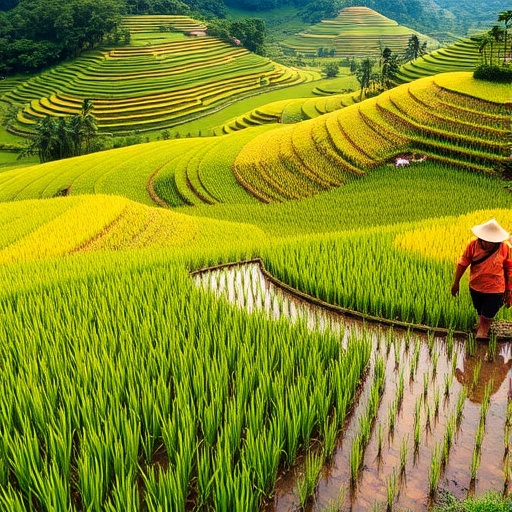
Significantly, the study reveals that the influence of technological advancements in irrigation and terracing has played a pivotal role in enabling the establishment and sustainability of rice paddies in these challenging terrains. These engineering feats not only facilitate water management on steep slopes but also mitigate soil erosion and nutrient runoff, critical factors in sustaining high-yield rice production in less hospitable environments.
Moreover, the authors explored the interplay between socio-economic development and land-use changes in these highland regions. Population growth, urbanization patterns, and economic incentives have collectively fostered the conversion of forested or upland grasslands into productive rice paddies. This conversion is a double-edged sword: while it addresses immediate food production needs, it also poses significant challenges for biodiversity conservation and ecosystem resilience.
From a climatological perspective, the study integrates future climate projections to assess the viability of continued paddy rice expansion into the highlands. Climate warming is anticipated to extend the growing season and reduce frost risks, thereby making higher elevations more amenable to rice cultivation. However, uncertainties remain regarding water availability under altered precipitation regimes, necessitating careful management to ensure sustainable water use.
The research team employed a multi-scalar approach, analyzing data at regional, landscape, and local levels to capture the complexity of factors influencing paddy rice distribution. Such granularity allows for targeted policy recommendations that can balance agricultural development with ecological preservation. The model outputs serve as invaluable tools for stakeholders, offering scenarios that can guide land-use planning and agricultural investments.
In delineating the spatial patterns of paddy field expansion, the study highlights hotspots of rapid agricultural intensification, particularly in South and Southeast Asia. These areas exhibit a convergence of favorable climatic shifts, accessible terrain modifications, and socio-economic drivers that collectively accelerate highland rice cultivation. Understanding these hotspots is critical for prioritizing intervention strategies aimed at minimizing negative environmental impacts.
The implications of this research extend beyond academic circles, touching on global food systems and sustainable development goals. As rice consumption continues to rise, especially in developing nations, ensuring the resilience of rice production in a changing environment becomes paramount. The highland rice fields represent a frontier of adaptation and an opportunity to diversify production landscapes, thereby contributing to food security.
Importantly, the study acknowledges potential trade-offs associated with highland paddy expansion, including habitat loss, altered hydrological cycles, and carbon emissions from land conversion. These environmental costs underscore the need for integrated management approaches that reconcile agricultural gains with ecological stewardship.
The authors advocate for concerted efforts in monitoring and evaluating land-use changes using remote sensing technologies, coupled with participatory approaches involving local communities. Such inclusive frameworks can enhance sustainability by aligning agricultural practices with indigenous knowledge systems and regional conservation priorities.
Furthermore, the study calls attention to the necessity of adaptive agricultural strategies that incorporate climate-smart practices, improved water-use efficiency, and crop diversification. These measures will be integral to maintaining productivity in highland environments that are inherently susceptible to climatic uncertainties and resource constraints.
A particularly notable contribution of this work is the establishment of a comprehensive database of paddy rice distributions across various Asian highlands, offering a baseline for future investigations. This repository facilitates cross-comparative studies and aids in refining predictive models as new data become available.
By integrating historical analysis with forward-looking projections, the research presents a holistic narrative of the evolving landscape of rice cultivation in Asia. This perspective is vital for informing policy frameworks that anticipate challenges and leverage opportunities in the agricultural sector.
Overall, this study exemplifies the intersection of environmental science, agricultural engineering, and socio-economic analysis, providing a blueprint for addressing one of the most pressing issues of our time—sustainable food production in an era of rapid environmental change. The insights derived here serve as a clarion call for innovation, resilience, and responsible stewardship in the expansion of paddy rice fields.
In conclusion, as Asia’s highlands increasingly become arenas for rice cultivation, the balance between fostering agricultural productivity and conserving ecological integrity will define the future of regional and global food systems. This seminal research offers a pathway toward that equilibrium, emphasizing the need for informed, adaptive, and sustainable agricultural development.
Subject of Research: The historical distribution and future expansion of paddy rice fields in Asian highlands.
Article Title: The historical distribution and future expansion of paddy rice fields in Asian highlands.
Article References:
Song, J., Wang, C., Nunes, L.M. et al. The historical distribution and future expansion of paddy rice fields in Asian highlands. npj Sustain. Agric. 3, 65 (2025). https://doi.org/10.1038/s44264-025-00107-8
Image Credits: AI Generated
DOI: https://doi.org/10.1038/s44264-025-00107-8
Tags: agricultural expansion and sustainabilityclimate change and food securityevolving food landscapes in Asiafuture of paddy rice productiongeospatial data in agriculturehighland rice farming trendshistorical distribution of rice fieldsland use change in agriculturepaddy rice cultivation in Asian highlandspredictive climate models in farmingrice as a staple food sourcesocio-economic factors in rice agriculture