• HOME
  • NEWS
  • EXPLORE
    • CAREER
      • Companies
      • Jobs
    • EVENTS
    • iGEM
      • News
      • Team
    • PHOTOS
    • VIDEO
    • WIKI
  • BLOG
  • COMMUNITY
    • FACEBOOK
    • INSTAGRAM
    • TWITTER
Thursday, April 2, 2026
BIOENGINEER.ORG
No Result
View All Result
  • Login
  • HOME
  • NEWS
  • EXPLORE
    • CAREER
      • Companies
      • Jobs
        • Lecturer
        • PhD Studentship
        • Postdoc
        • Research Assistant
    • EVENTS
    • iGEM
      • News
      • Team
    • PHOTOS
    • VIDEO
    • WIKI
  • BLOG
  • COMMUNITY
    • FACEBOOK
    • INSTAGRAM
    • TWITTER
  • HOME
  • NEWS
  • EXPLORE
    • CAREER
      • Companies
      • Jobs
        • Lecturer
        • PhD Studentship
        • Postdoc
        • Research Assistant
    • EVENTS
    • iGEM
      • News
      • Team
    • PHOTOS
    • VIDEO
    • WIKI
  • BLOG
  • COMMUNITY
    • FACEBOOK
    • INSTAGRAM
    • TWITTER
No Result
View All Result
Bioengineer.org
No Result
View All Result
Home NEWS Science News Biology

Oxygen deficiency rewires mitochondria

Bioengineer by Bioengineer
November 11, 2019
in Biology
Reading Time: 3 mins read
0
IMAGE
Share on FacebookShare on TwitterShare on LinkedinShare on RedditShare on Telegram

Researchers slow the growth of pancreatic tumor cells
IMAGE

Credit: MPI f. Biology of Ageing / Thomas MacVicar


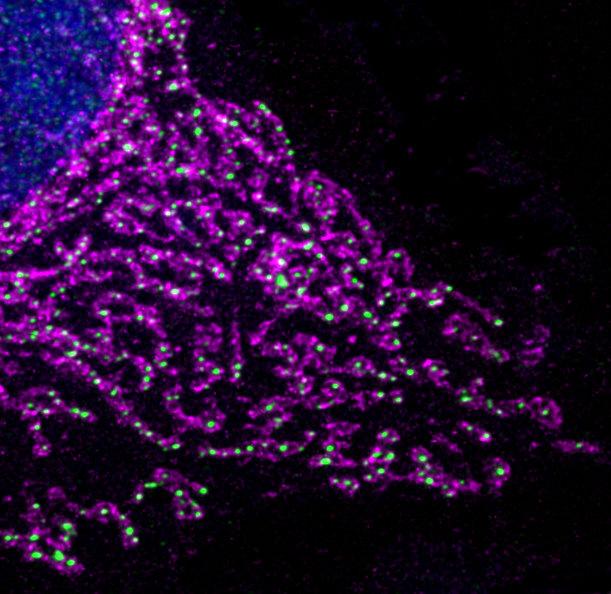
Mitochondria burn oxygen and provide energy for the body. Cells lacking oxygen or nutrients have to change their energy supply quickly in order to keep growing. Scientists from the Max Planck Institute for Biology of Ageing have now shown that mitochondria are reprogrammed under depleted oxygen and nutrients. Tumours of the pancreas may also use this reprogramming mechanism to keep growing despite reduced nutrient and oxygen levels. The researchers believe that proteins in this newly discovered signaling pathway could be a good target for therapies against pancreatic cancer, for which no drug is currently available.

Cells adapt to oxygen deficiency by switching their energy supply to glycolysis, in which sugar is fermented without oxygen. This may be necessary in old age, for example, as the cells in the body are often less supplied with oxygen and nutrients. Also, cancer cells can face this problem, because some tumours have poor blood supply and thus little oxygen and nutrients reach the cells.

“It has been known for some time that cells reduce the number of mitochondria when they lack oxygen and switch to glycolysis. We have now discovered that the remaining mitochondria are additionally reprogrammed to meet the new requirements,” explains Max Planck Director Thomas Langer.

Changeover with built-in timer

This happens via a newly discovered signalling pathway in the cell: a protease in the membrane of mitochondria is activated during the conversion to glycolysis and then breaks down various proteins in the organelles. As a result, no new mitochondria can be formed and the remaining mitochondria change their metabolism. This process eventually stops on its own, as the protease begins to degrade itself at high activity. “This signalling pathway not only has a built-in timer, but also enables a very rapid response to oxygen deficiency,” said Langer.

Reduced growth of tumour cells

The researchers examined cancer cells originating from patients with pancreatic tumours. These tumours grow under oxygen deficiency and are highly aggressive. The scientists were able to reduce tumour growth by switching off the signalling pathway in the mitochondria. This was seen in cancer cells in the Petri dish as well as in pancreatic tumours in mice. “There is currently no treatment available for pancreatic cancer. I believe that this protease can be a very interesting therapeutic target because we have seen that the signalling pathway is also active in human patients with pancreatic cancer,” explains Langer. “However, there are no known substances that have an effect on this protease.”

###

Original publication

Thomas MacVicar, Yohsuke Ohba, Hendrik Nolte, Fiona Carola Mayer, Takashi Tatsuta, Hans-Georg Sprenger, Barbara Lindner, Yue Zhao, Jiahui Li, Christiane Bruns, Marcus Krüger, Markus Habich, Jan Riemer, Robin Schwarzer, Manolis Pasparakis, Sinika Henschke, Jens C. Brüning, Nicola Zamboni, Thomas Langer

Lipid signalling drives proteolytic rewiring of mitochondria by YME1L

Nature, 6 November 2019

Media Contact
Dr. Maren Berghoff
[email protected]
49-221-379-70207

Original Source

https://www.mpg.de/14102743/1106-balt-110438-oxygen-deficiency-rewires-mitochondria

Tags: BiologyCell Biology
Share13Tweet8Share2ShareShareShare2

Related Posts

Newly Discovered Chronic Pain Circuit Unveils Potential Avenues for Innovative Treatments

Newly Discovered Chronic Pain Circuit Unveils Potential Avenues for Innovative Treatments

April 2, 2026
DNA Transforms from Blueprint to Active Field Agent

DNA Transforms from Blueprint to Active Field Agent

April 2, 2026

UBC Okanagan Study Reveals How Trees Visually Signal Their Spring Rehydration

April 1, 2026

Rising Temperatures from Climate Change Associated with Reduced Newborn Size

April 1, 2026
Please login to join discussion

POPULAR NEWS

  • blank

    Revolutionary AI Model Enhances Precision in Detecting Food Contamination

    96 shares
    Share 38 Tweet 24
  • Imagine a Social Media Feed That Challenges Your Views Instead of Reinforcing Them

    1007 shares
    Share 398 Tweet 249
  • Promising Outcomes from First Clinical Trials of Gene Regulation in Epilepsy

    51 shares
    Share 20 Tweet 13
  • Popular Anti-Aging Compound Linked to Damage in Corpus Callosum, Study Finds

    44 shares
    Share 18 Tweet 11

About

We bring you the latest biotechnology news from best research centers and universities around the world. Check our website.

Follow us

Recent News

Blocking RUNX1/2 Boosts Fat Tissue Thermogenesis

Cysteine Sulfenylation of p-GSK-3β Drives Liver Insulin Resistance

Transonic Safe Mode Empowers Next-Gen Wind Turbines

Subscribe to Blog via Email

Enter your email address to subscribe to this blog and receive notifications of new posts by email.

Join 78 other subscribers
  • Contact Us

Bioengineer.org © Copyright 2023 All Rights Reserved.

Welcome Back!

Login to your account below

Forgotten Password?

Retrieve your password

Please enter your username or email address to reset your password.

Log In
No Result
View All Result
  • Homepages
    • Home Page 1
    • Home Page 2
  • News
  • National
  • Business
  • Health
  • Lifestyle
  • Science

Bioengineer.org © Copyright 2023 All Rights Reserved.