• HOME
  • NEWS
  • EXPLORE
    • CAREER
      • Companies
      • Jobs
    • EVENTS
    • iGEM
      • News
      • Team
    • PHOTOS
    • VIDEO
    • WIKI
  • BLOG
  • COMMUNITY
    • FACEBOOK
    • INSTAGRAM
    • TWITTER
Monday, April 6, 2026
BIOENGINEER.ORG
No Result
View All Result
  • Login
  • HOME
  • NEWS
  • EXPLORE
    • CAREER
      • Companies
      • Jobs
        • Lecturer
        • PhD Studentship
        • Postdoc
        • Research Assistant
    • EVENTS
    • iGEM
      • News
      • Team
    • PHOTOS
    • VIDEO
    • WIKI
  • BLOG
  • COMMUNITY
    • FACEBOOK
    • INSTAGRAM
    • TWITTER
  • HOME
  • NEWS
  • EXPLORE
    • CAREER
      • Companies
      • Jobs
        • Lecturer
        • PhD Studentship
        • Postdoc
        • Research Assistant
    • EVENTS
    • iGEM
      • News
      • Team
    • PHOTOS
    • VIDEO
    • WIKI
  • BLOG
  • COMMUNITY
    • FACEBOOK
    • INSTAGRAM
    • TWITTER
No Result
View All Result
Bioengineer.org
No Result
View All Result
Home NEWS Science News Biology

Out of the darkness: A new spider found deep within an Indiana cave

Bioengineer by Bioengineer
June 28, 2018
in Biology
Reading Time: 2 mins read
0
Share on FacebookShare on TwitterShare on LinkedinShare on RedditShare on Telegram
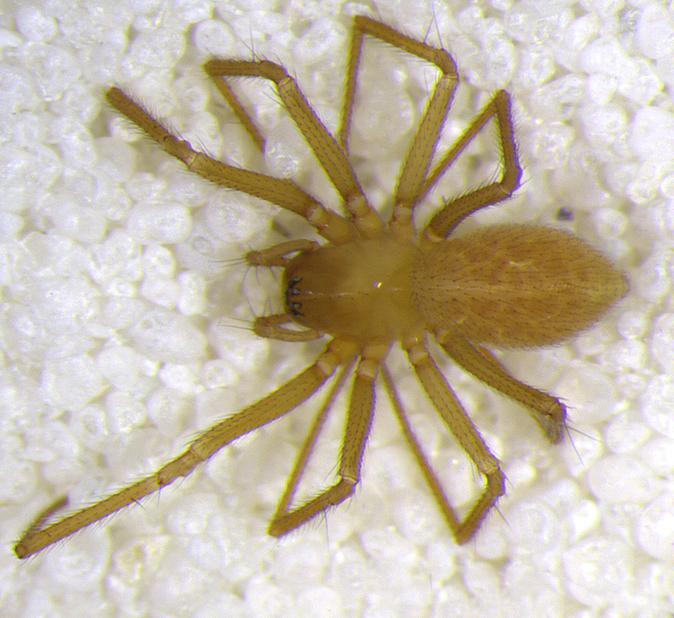
IMAGE

Credit: Dr. Marc Milne

Spiders are ubiquitous within our forests, fields, and backyards. Although you may be used to seeing the beautiful yellow and black spiders of the genus Argiope in your garden, large ground-scurrying wolf spiders in your yard, or spindly cellar spiders in your basement, this new sheet-web-building spider is probably one you haven't seen before. The reason is that it's known from a single cave in the world, Stygeon River Cave, in southern Indiana.

The University of Indianapolis assistant professor, Dr. Marc Milne, described the rare species in the open access journal Subterranean Biology with the help of a University of Indianapolis alumnus, Elizabeth Wells, who illustrated the spider for the manuscript.

Sheet weavers, also known as dwarf spiders or money spiders, are minute creatures growing no larger than a few centimetres in length, which makes them particularly elusive. Their peculiar webs are flat and sheet-like, hence their common English name.

The new spider, Islandiana lewisi, is an homage. Milne was shown the spider by a fellow scientist, Dr. Julian Lewis, who noticed the critter on one of his many cave expeditions. In appreciation for his help, Milne and Wells named the spider after Lewis.

This is the fifteenth species in its genus (Islandiana) and the fifth known to live exclusively in caves. It has been over 30 years since the last species has been added to this group.

At about 2 mm in size, Islandiana lewisi is thought to feed on even smaller arthropods, such as springtails living in the debris on the cave floor. It is unknown when it reproduces or if it exists anywhere else. The spider is likely harmless to humans.

The collectors of the spider, Milne and Lewis, described the hostile conditions within the cave, which the new species calls home: "because the cave floods from time to time, the insides were wet, muddy, slippery, and dangerous to walk on without the proper equipment."

Milne and Lewis found the spider in small, horizontal webs between large, mud-caked boulders in the largest room in the cave. It was collected in October 2016 with the permission of the landowner.

Milne hypothesized that he had collected something special, stating, "I didn't know what the spider was at first, I just thought it was odd that so many were living within this dark cave with no other spider species around."

After returning to the lab and inspecting the spider under a microscope, Milne initially misidentified the species. However, when he re-examined it months later, he realized that the species was indeed new to science.

###

Original source:

Milne MA, Wells E (2018) A new species of spider (Araneae, Linyphiidae, Islandiana) from a southern Indiana cave. Subterranean Biology 26: 19-26. https://doi.org/10.3897/subtbiol.26.25605

Media Contact

Marc Milne
[email protected]
@Pensoft

http://www.pensoft.net

Related Journal Article

http://dx.doi.org/10.3897/subtbiol.26.25605
Share14Tweet8Share2ShareShareShare2

Related Posts

Damselfly Mating Strategies Shed Light on Reproductive Barriers

Damselfly Mating Strategies Shed Light on Reproductive Barriers

April 4, 2026
blank

Custom Biochar Approaches Enhance Alfalfa Growth and Stress Tolerance in Saline Soils

April 3, 2026

Mutant Clownfish Sheds Light on How Nature Defines Boundaries

April 3, 2026

Scientists Discover How Bacterial Enzyme Breaks Down Sturdy Collagen

April 3, 2026
Please login to join discussion

POPULAR NEWS

  • blank

    Revolutionary AI Model Enhances Precision in Detecting Food Contamination

    97 shares
    Share 39 Tweet 24
  • Promising Outcomes from First Clinical Trials of Gene Regulation in Epilepsy

    51 shares
    Share 20 Tweet 13
  • Imagine a Social Media Feed That Challenges Your Views Instead of Reinforcing Them

    1008 shares
    Share 398 Tweet 249
  • Popular Anti-Aging Compound Linked to Damage in Corpus Callosum, Study Finds

    44 shares
    Share 18 Tweet 11

About

We bring you the latest biotechnology news from best research centers and universities around the world. Check our website.

Follow us

Recent News

Japanese Health Promotion Questionnaire: Validity Confirmed

Frailty, Depression, Social Participation Linked in Older Adults

Seismic Impact on Integrated Slope Stabilization: Numerical Study

Subscribe to Blog via Email

Enter your email address to subscribe to this blog and receive notifications of new posts by email.

Join 78 other subscribers
  • Contact Us

Bioengineer.org © Copyright 2023 All Rights Reserved.

Welcome Back!

Login to your account below

Forgotten Password?

Retrieve your password

Please enter your username or email address to reset your password.

Log In
No Result
View All Result
  • Homepages
    • Home Page 1
    • Home Page 2
  • News
  • National
  • Business
  • Health
  • Lifestyle
  • Science

Bioengineer.org © Copyright 2023 All Rights Reserved.