A University of Oklahoma-led article published in Geophysical Research Letters highlights newly measured extremes recorded during the National Aeronautics and Space Administration Dynamics and Chemistry of the Summer Stratosphere field project.
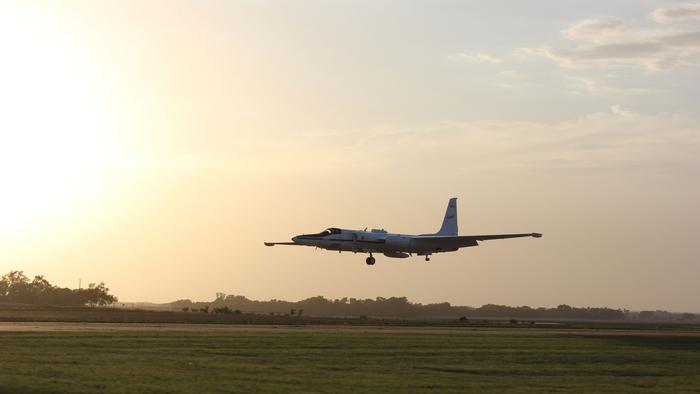
Credit: Photo by Cameron Homeyer.
A University of Oklahoma-led article published in Geophysical Research Letters highlights newly measured extremes recorded during the National Aeronautics and Space Administration Dynamics and Chemistry of the Summer Stratosphere field project.
“Extreme Altitudes of Stratospheric Hydration by Midlatitude Convection Observed During the DCOTSS Field Campaign,” led by OU School of Meteorology Interim Director and Associate Professor Cameron Homeyer, summarizes the extremes in measured stratospheric depth of hydration by convection recorded during the DCOTSS project as a whole, and then highlights a specific storm, a supercell that erupted on June 23, 2022. The storm in question lasted approximately five hours, produced six tornadoes, and instigated hail and wind reports.
The focus of the research is to determine how deep, how much and how frequently water in the stratosphere is being increased by thunderstorms. “We’re used to seeing the impacts in terms of hazardous weather that these storms produce, but some of the most impactful storms in terms of hazardous weather are also leaving a really big imprint on the climate system by enhancing water vapor in the stratosphere,” Homeyer said.
Increases in water vapor in the stratosphere contribute to climate warming and can contribute to the destruction of ozone. Improved understanding of increased stratospheric water vapor aids in the understanding of Earth’s climate system.
There is a significant need for purposeful research in this area. Measurements of the air impacted by thunderstorms and the stratosphere have been sporadic and often incidental for much of the past five decades, Homeyer said. Only in recent years have the efforts to deliberately sample environments for such measurements been made. The DCOTSS project is one such effort.
Researchers deployed for the project in the summer of 2021 and 2022 based primarily out of Salina, Kansas. NASA ER-2 high-altitude research aircraft were used to acquire measurements of convective plumes with the intention of determining their effects on the stratosphere. The aircraft were equipped with 12 instruments and the deployments resulted in up to 29 flights with research-quality data. Those flights repeatedly broke records for measuring stratospheric depth of hydration by convection on multiple flights.
The collected aircraft observations demonstrate that high-level thunderstorms do in fact enhance water vapor in the stratosphere at levels higher than previously understood.
Homeyer served as the project’s data manager and science investigation manager for theory, forecasting and flight planning. Other researchers participated from Texas A&M, the University of Miami, the Massachusetts Institute of Technology, Harvard, the University of Maryland Baltimore County, the National Center for Atmospheric Research, the University of Colorado’s Cooperative Institute for Research in Environmental Sciences, the National Oceanic Atmospheric Administration and NASA.
Learn more about the School of Meteorology at meteorology.ou.edu and about the DCOTSS project at dcotss.org.
Journal
Geophysical Research Letters
DOI
10.1029/2023GL104914
Article Title
Extreme Altitudes of Stratospheric Hydration by Midlatitude Convection Observed During the DCOTSS Field Campaign
Article Publication Date
26-Sep-2023