• HOME
  • NEWS
  • EXPLORE
    • CAREER
      • Companies
      • Jobs
    • EVENTS
    • iGEM
      • News
      • Team
    • PHOTOS
    • VIDEO
    • WIKI
  • BLOG
  • COMMUNITY
    • FACEBOOK
    • INSTAGRAM
    • TWITTER
Wednesday, April 8, 2026
BIOENGINEER.ORG
No Result
View All Result
  • Login
  • HOME
  • NEWS
  • EXPLORE
    • CAREER
      • Companies
      • Jobs
        • Lecturer
        • PhD Studentship
        • Postdoc
        • Research Assistant
    • EVENTS
    • iGEM
      • News
      • Team
    • PHOTOS
    • VIDEO
    • WIKI
  • BLOG
  • COMMUNITY
    • FACEBOOK
    • INSTAGRAM
    • TWITTER
  • HOME
  • NEWS
  • EXPLORE
    • CAREER
      • Companies
      • Jobs
        • Lecturer
        • PhD Studentship
        • Postdoc
        • Research Assistant
    • EVENTS
    • iGEM
      • News
      • Team
    • PHOTOS
    • VIDEO
    • WIKI
  • BLOG
  • COMMUNITY
    • FACEBOOK
    • INSTAGRAM
    • TWITTER
No Result
View All Result
Bioengineer.org
No Result
View All Result
Home NEWS Science News Chemistry

Organic photovoltaic cell with 17% efficiency and superior processability for large-area coating

Bioengineer by Bioengineer
February 13, 2020
in Chemistry
Reading Time: 2 mins read
0
IMAGE
Share on FacebookShare on TwitterShare on LinkedinShare on RedditShare on Telegram

IMAGE

Credit: ©Science China Press


Organic photovoltaic (OPV) cells have attracted considerable research interest because of advantages of lightweight, flexibility and low-cost solution processing. With the development of organic photoactive materials, especially the new-emerging non-fullerene electron acceptors (NFAs), OPV cells have yielded power conversion efficiencies (PCEs) of over 16% in recent years. However, these devices were usually fabricated by spin-coating method at small areas below 0.1 cm2 in laboratories, which are not suitable for future upscale productions.

For the spin-coating process, wet films dry rapidly due to the high spinning speed. However, when large-area coating methods, such as blade-coating, slot-die coating, and spraying-coating methods, are used, wet films dry slowly. The significantly decreased volatilization rate of the solvent gives a much longer time for ordered molecular alignment and aggregation, which may lead to the formation of a larger domain size or excessive phase separation in the active layer. Therefore, it’s still a challenge to fabricate highly efficient OPV cells via large-area fabrication methods.

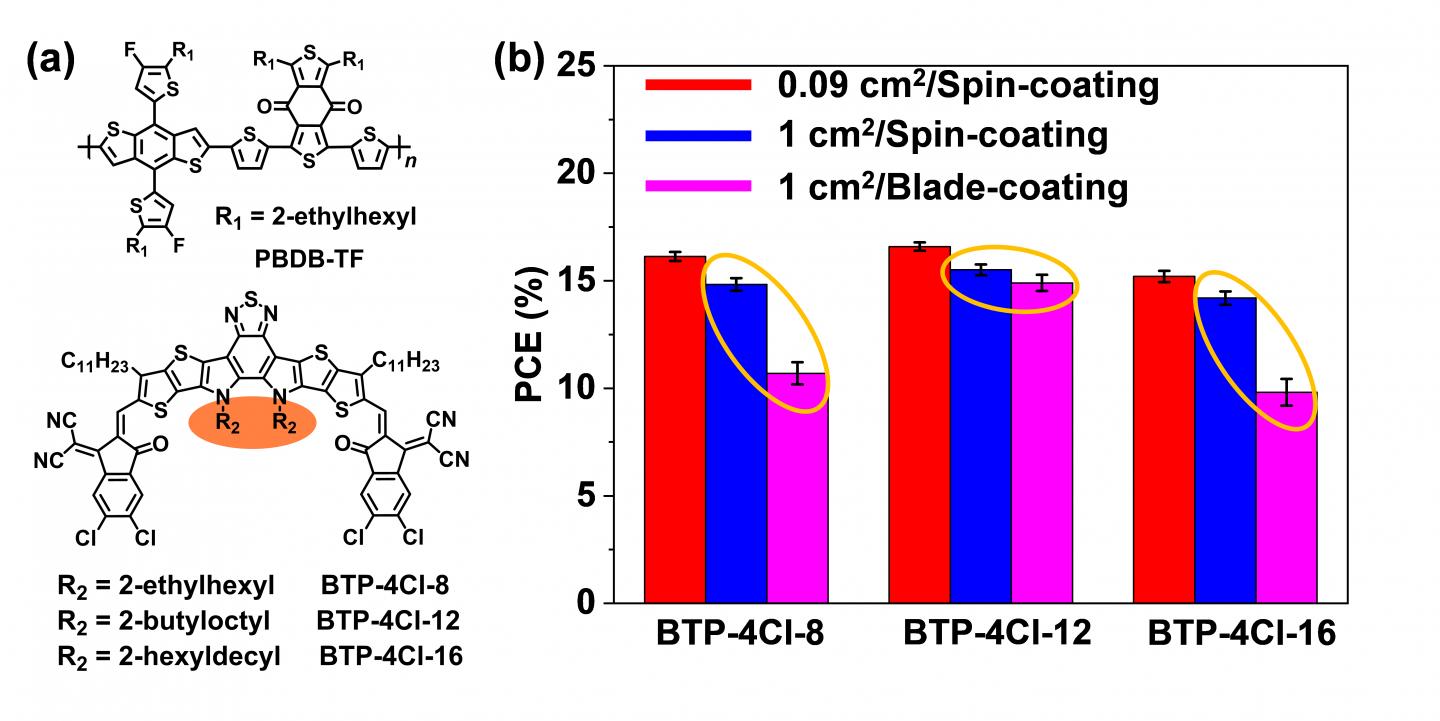
Recently, the research team led by Prof. Jian-Hui Hou at Institute of Chemistry, Chinese Academy of Sciences, finely optimized the alkyl chains of the BTP-4Cl (a derivative of a well-known NFA, Y6) and synthesized a series of new NFAs BTP-4Cl-X (X = 8, 12 or 16). They applied the new NFAs in fabricating large-area coated OPV cells and achieved good results. The study entitled “17% efficiency organic photovoltaic cell with superior processability” was published in National Science Review.

Researchers successfully demonstrated a high PCE of 17% in the small-area (0.09 cm2) OPV cells based on BTP-4Cl-12. When the blade-coating method was used to extend the active area, 1 cm2 OPV cells obtained an excellent PCE of 15.5%, which is among the top values in the field of OPV cells so far. By cooperating closely with Prof. Wei Ma from Xi’an Jiaotong University, they revealed that BTP-4Cl-12 had balanced solution processability and aggregation features. As a result, the blade-coating film showed a very good phase separation morphology, which contributed to the high carrier transport and suppressed charge recombination in the OPV cells. This work demonstrated the optimization of the chemical structures of the photoactive materials had great significance in larger-area production.

###

See the article:

Yong Cui, Hui-Feng Yao,* Ling Hong, Tao Zhang, Ya-Bing Tang, Bao-Jun Lin, Kai-Hu Xian, Bo-Wei Gao, Cun-Bin An, Peng-Qing Bi, Wei Ma, and Jian-Hui Hou
17% efficiency organic photovoltaic cell with superior processability
Natl Sci Rev DOI: 10.1093/nsr/nwz200
https://doi.org/10.1093/nsr/nwz200

The National Science Review is the first comprehensive scholarly journal released in English in China that is aimed at linking the country’s rapidly advancing community of scientists with the global frontiers of science and technology. The journal also aims to shine a worldwide spotlight on scientific research advances across China.

Media Contact
Hui-Feng Yao
[email protected]

Related Journal Article

http://dx.doi.org/10.1093/nsr/nwz200

Tags: Chemistry/Physics/Materials Sciences
Share12Tweet8Share2ShareShareShare2

Related Posts

UH Engineer Uncovers Structural Flaw Behind Lithium-Ion Battery Failures

UH Engineer Uncovers Structural Flaw Behind Lithium-Ion Battery Failures

April 8, 2026
Harnessing Light to Manipulate Nuclear Spins in Molecules Opens New Avenues for Quantum Technology

Harnessing Light to Manipulate Nuclear Spins in Molecules Opens New Avenues for Quantum Technology

April 8, 2026

Innovative Method for Creating Branched Molecules Promises to Speed Up Future Drug Development

April 8, 2026

Cr³⁺-Doped InP Quantum Dots Achieve Breakthrough in Pure Blue Emission and Room-Temperature Ferromagnetism

April 8, 2026
Please login to join discussion

POPULAR NEWS

  • blank

    Revolutionary AI Model Enhances Precision in Detecting Food Contamination

    98 shares
    Share 39 Tweet 25
  • Imagine a Social Media Feed That Challenges Your Views Instead of Reinforcing Them

    1011 shares
    Share 399 Tweet 250
  • Popular Anti-Aging Compound Linked to Damage in Corpus Callosum, Study Finds

    44 shares
    Share 18 Tweet 11
  • Promising Outcomes from First Clinical Trials of Gene Regulation in Epilepsy

    51 shares
    Share 20 Tweet 13

About

We bring you the latest biotechnology news from best research centers and universities around the world. Check our website.

Follow us

Recent News

Social Support, Sleep Quality, and Pain Management: Key Factors Influencing Mental Health in Older Adults

Study Finds Long-Term Opioid Prescriptions Decline, Yet Millions Continue Extended Therapy

UH Engineer Uncovers Structural Flaw Behind Lithium-Ion Battery Failures

Subscribe to Blog via Email

Enter your email address to subscribe to this blog and receive notifications of new posts by email.

Join 78 other subscribers
  • Contact Us

Bioengineer.org © Copyright 2023 All Rights Reserved.

Welcome Back!

Login to your account below

Forgotten Password?

Retrieve your password

Please enter your username or email address to reset your password.

Log In
No Result
View All Result
  • Homepages
    • Home Page 1
    • Home Page 2
  • News
  • National
  • Business
  • Health
  • Lifestyle
  • Science

Bioengineer.org © Copyright 2023 All Rights Reserved.