• HOME
  • NEWS
  • EXPLORE
    • CAREER
      • Companies
      • Jobs
    • EVENTS
    • iGEM
      • News
      • Team
    • PHOTOS
    • VIDEO
    • WIKI
  • BLOG
  • COMMUNITY
    • FACEBOOK
    • INSTAGRAM
    • TWITTER
Sunday, February 8, 2026
BIOENGINEER.ORG
No Result
View All Result
  • Login
  • HOME
  • NEWS
  • EXPLORE
    • CAREER
      • Companies
      • Jobs
        • Lecturer
        • PhD Studentship
        • Postdoc
        • Research Assistant
    • EVENTS
    • iGEM
      • News
      • Team
    • PHOTOS
    • VIDEO
    • WIKI
  • BLOG
  • COMMUNITY
    • FACEBOOK
    • INSTAGRAM
    • TWITTER
  • HOME
  • NEWS
  • EXPLORE
    • CAREER
      • Companies
      • Jobs
        • Lecturer
        • PhD Studentship
        • Postdoc
        • Research Assistant
    • EVENTS
    • iGEM
      • News
      • Team
    • PHOTOS
    • VIDEO
    • WIKI
  • BLOG
  • COMMUNITY
    • FACEBOOK
    • INSTAGRAM
    • TWITTER
No Result
View All Result
Bioengineer.org
No Result
View All Result
Home NEWS Science News Chemistry

Organic heterostructures composed of one- and two-dimensional polymorph

Bioengineer by Bioengineer
April 24, 2020
in Chemistry
Reading Time: 2 mins read
0
IMAGE
Share on FacebookShare on TwitterShare on LinkedinShare on RedditShare on Telegram

IMAGE

Credit: ©Science China Press

Organic heterostructures (OHSs) with high spatial and angular precision are key component of the organic optoelectronics, such as organic photovatic (OPV), organic light emitting diodes (OLED), and photo-detectors. Moreover, heterostructure can integrate multiple components into one structure to overcome the challenge of single output channel and provide feasibility for realizing more transmission modes. Besides, the OHSs inherently have advantages including simple solution preparation and synthesis, flexible molecular structure design and broad spectral tenability.

However, OHSs usually require two or more kinds of organic molecules, which brings difficulty to search the universal condition for all materials to grow together. Moreover, the phase separation during the self-assembly of OHSs remains a big challenge. As we know, polymorphism is quite a convenient approach to tune the chemical/physical properties of organic crystal based on one organic compound. Thus, Organic materials with polymorph property can be utilized to fabricate OHSs with enormous structural diversity and novel optical/electronical properties.

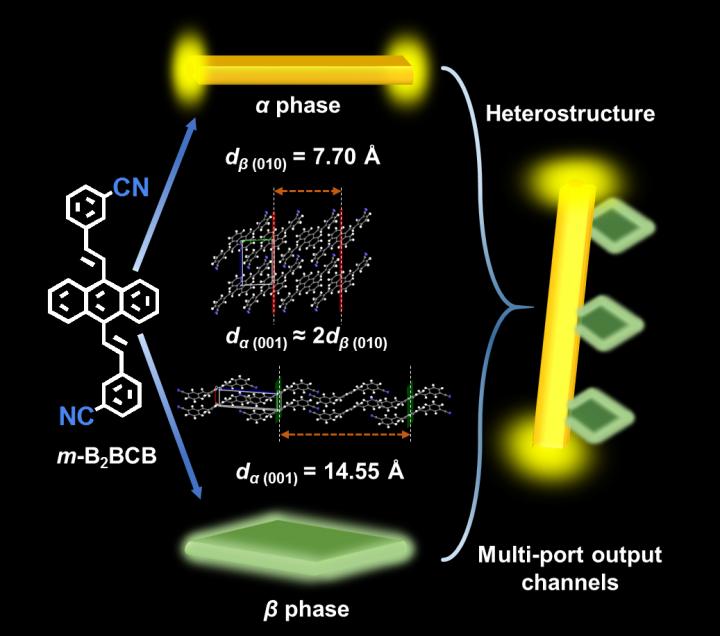
Very recently, through the polymorphism, Dr. Xue-Dong Wang and colleagues in Soochow University elaborately fabricated the OHSs of one organic compound of 3,3′-((1E,1’E)-anthracene-9,10-diylbis(ethane-2,1-diyl))dibenzonitril (m-B2BCB), which can simultaneously be self-assembled into one-dimensional (1D) microrods (α phase) and 2D microplates (β phase).The growth mechanism of OHSs is due to the low interplanar spacing mismatch rate of 5.8% between the (010) crystal plane of the 2D branch microplate and (001) of the 1D trunk microrod. These two organic polymorph microcrystals both have good optical waveguide performance with the Rα = 0.022 dB/μm of 1D microrod and the average Rβ = 0.036 dB/μm of 2D microplate. More significantly, the multiple output channels have been achieved in the OHSs, which exhibits the structure-dependent optical signals (green and yellow light) at the different output channel in the OHSs. This work exhibits the great value of polymorphism in OHSs, which could provide further applications on multifunctional organic integrated photonics circuits.

###

See the article:

Yu Y, Tao Y-C, Zou S-N, Li Z-Z, Zhuo M-P, Yan C-C, Wang X-D, Liao L-S. Organic heterostructures composed of one- and two-dimensional polymorph for photonic applications. Sci. China Chem., 2020, DOI:10.1007/s11426-019-9706-x.
http://engine.scichina.com/publisher/scp/journal/SCC/doi/10.1007/s11426-019-9706-x

Media Contact
Xue-Dong Wang
[email protected]

Related Journal Article

http://dx.doi.org/10.1007/s11426-019-9706-x

Tags: Chemistry/Physics/Materials Sciences
Share12Tweet8Share2ShareShareShare2

Related Posts

blank

Breakthrough in Environmental Cleanup: Scientists Develop Solar-Activated Biochar for Faster Remediation

February 7, 2026
blank

Cutting Costs: Making Hydrogen Fuel Cells More Affordable

February 6, 2026

Scientists Develop Hand-Held “Levitating” Time Crystals

February 6, 2026

Observing a Key Green-Energy Catalyst Dissolve Atom by Atom

February 6, 2026
Please login to join discussion

POPULAR NEWS

  • Robotic Ureteral Reconstruction: A Novel Approach

    Robotic Ureteral Reconstruction: A Novel Approach

    82 shares
    Share 33 Tweet 21
  • Digital Privacy: Health Data Control in Incarceration

    63 shares
    Share 25 Tweet 16
  • Breakthrough in RNA Research Accelerates Medical Innovations Timeline

    53 shares
    Share 21 Tweet 13
  • Mapping Tertiary Lymphoid Structures for Kidney Cancer Biomarkers

    50 shares
    Share 20 Tweet 13

About

We bring you the latest biotechnology news from best research centers and universities around the world. Check our website.

Follow us

Recent News

Attitudes Toward Aging Impact Early Nursing Home Quality

Transforming Healthcare: Just Culture and Restorative Practices

Guiding Patients Through Obesity Diagnosis: A Primer

Subscribe to Blog via Email

Success! An email was just sent to confirm your subscription. Please find the email now and click 'Confirm' to start subscribing.

Join 73 other subscribers
  • Contact Us

Bioengineer.org © Copyright 2023 All Rights Reserved.

Welcome Back!

Login to your account below

Forgotten Password?

Retrieve your password

Please enter your username or email address to reset your password.

Log In
No Result
View All Result
  • Homepages
    • Home Page 1
    • Home Page 2
  • News
  • National
  • Business
  • Health
  • Lifestyle
  • Science

Bioengineer.org © Copyright 2023 All Rights Reserved.