Because the bumblebee that an orchid relies on for pollination does not exist on a remote island, the plant gets pollinated by an island wasp. Kobe University researchers found that this came at the cost of being hybridized with another orchid species adapted to being pollinated by the wasp. The finding showcases how plants in ecological relationships adapt to changing circumstances.
Remote islands have been exciting study grounds for biologists since at least the days of Darwin. When studying ecological relationships between different species, the differences between mainland and island can hint at how such relationships evolve and what this means for the participating species. This is what piqued plant scientists’ curiosity when they discovered Goodyera henryi, an orchid which on mainland Japan is pollinated exclusively by a very specific bumblebee, on remote Japanese Kozu Island where the bumblebee doesn’t exist.
Credit: ANSAI Shun
Because the bumblebee that an orchid relies on for pollination does not exist on a remote island, the plant gets pollinated by an island wasp. Kobe University researchers found that this came at the cost of being hybridized with another orchid species adapted to being pollinated by the wasp. The finding showcases how plants in ecological relationships adapt to changing circumstances.
Remote islands have been exciting study grounds for biologists since at least the days of Darwin. When studying ecological relationships between different species, the differences between mainland and island can hint at how such relationships evolve and what this means for the participating species. This is what piqued plant scientists’ curiosity when they discovered Goodyera henryi, an orchid which on mainland Japan is pollinated exclusively by a very specific bumblebee, on remote Japanese Kozu Island where the bumblebee doesn’t exist.
For Kobe University Professor SUETSUGU Kenji this fit perfectly into his long-term effort to understand the dynamics of island biology and evolutionary processes. The orchid specialist says: “The combination of our expertise, access to the location, and our interdisciplinary methodology puts us in a special position to study the impact of bumblebee absence on orchid evolution in this context.” With his team he studied the pollination of the orchids both on mainland Japan and on Kozu Island, and also employed genetic analysis to learn about the relationship patterns between the different populations of the plants.
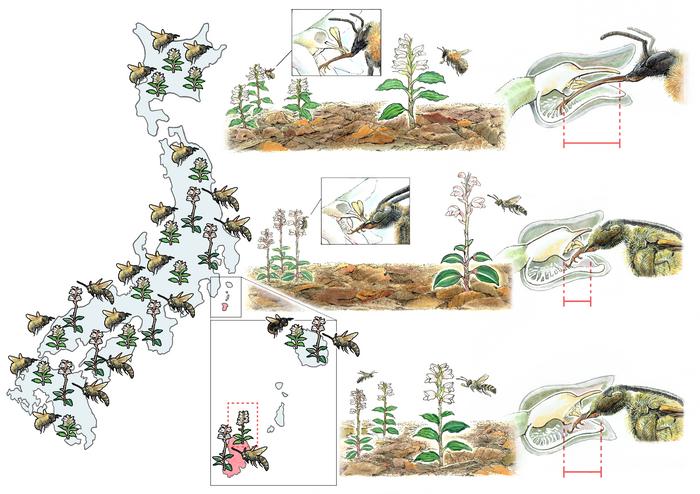
The results, now published in the journal New Phytologist, came with a surprise. The researchers first noticed that, on Kozu Island, Goodyera henryi is pollinated by the same scoliid wasp as the closely related orchid Goodyera similis, also found on the island. While in orchids the length of the flower tube closely matches the length of the pollinating insect mouthparts, the island wasp has much shorter mouthparts than the bumblebee that pollinates Goodyera henryi on the mainland. The researchers also noticed that the orchid’s flower tube was shorter on the island than the mainland. The surprise came when they compared the genetic makeup of the orchids. Suetsugu explains: “All specimens initially categorized as Goodyera henryi on Kozu Island are hybrids, leading to the absence of the pure species on the island.”
The research team speculate that, when Goodyera henryi first arrived on the island, it must have been visited by a wasp by chance, or precisely because the plant was not being visited by the bumblebee. While the wasp’s mouthparts are shorter than the bumblebee’s and therefore unable to carry Goodyera henryi pollen from one flower to another, if the insect had just before visited its usual orchid, Goodyera simils, pollen from that plant might have ended up on the new arrival, hybridizing it. This changed the appearance of the orchid such that it was now able to attach pollen to its substitute pollinator and thus establish itself on the island in its new hybridized form. “The most exciting aspect of this result is probably the implication for our understanding of how plants can adapt and evolve in response to changing ecological conditions, particularly in the context of declining pollinator populations,” says the Kobe University researcher.
Suetsugu says that this has implications beyond the academic study of evolutionary dynamics. Bumblebee species are on a global decline, but because bee removal experiments are unethical and impractical, it has been difficult to predict the ecological consequences. Explaining what the newly published results mean he says, “Even if bumblebee-dependent plants successfully engage substitute pollinators amidst the global decline of long-tongued bumblebees, the maintenance of plants’ species boundaries could be compromised due to the sharing of pollinators via hybrid formation.”
This study was financially supported by the Japan Science and Technology Agency (PRESTO JPMJPR21D6), by the Ministry of Environment, Japan (Environment Research and Technology Development Fund #4-2001), by the Ichimura Foundation for New Technology (26-01 and 27-7), and by the MEXT Promotion of Distinctive Joint Research Center Program (JPMXP0622716984). It was conducted in collaboration with researchers from Tohoku University, the Forestry and Forest Products Research Institute, the Museum of Natural and Environmental History Shizuoka, Kokubunji High School and from the Kozu Island village.
Kobe University is a national university with roots dating back to the Kobe Commercial School founded in 1902. It is now one of Japan’s leading comprehensive research universities with nearly 16,000 students and nearly 1,700 faculty in 10 faculties and schools and 15 graduate schools. Combining the social and natural sciences to cultivate leaders with an interdisciplinary perspective, Kobe University creates knowledge and fosters innovation to address society’s challenges.
Journal
New Phytologist
DOI
10.1111/nph.19325
Method of Research
Observational study
Subject of Research
Animals
Article Title
The absence of bumblebees on an oceanic island blurs the species boundary of two closely related orchids
Article Publication Date
18-Oct-2023