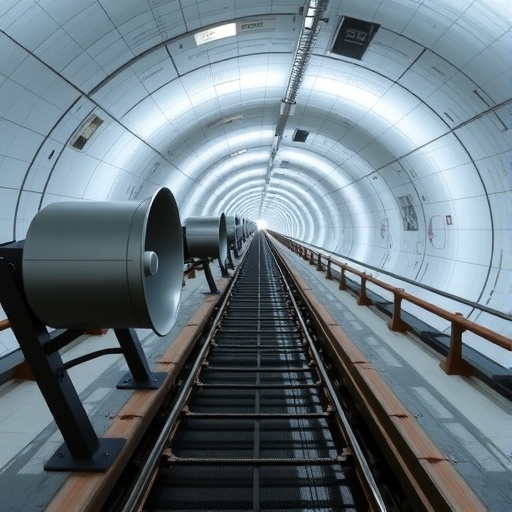
In a groundbreaking study published in the renowned journal Scientific Reports, researchers have delved into a vital aspect of modern urban transportation—subway tunnel ventilation systems. The intricate dynamics of air flow and pressure within these underground structures are not only critical for passenger comfort but also play a significant role in ensuring safety during emergencies. The research, which focuses on the implementation of variable frequency control in multi-fan systems, hints at innovative solutions to longstanding challenges in tunnel ventilation.
The research team, comprising experts in environmental engineering and fluid dynamics, embarked on a detailed investigation into the operational efficiency of ventilation systems. They found that conventional methods often unsatisfactorily meet the dual requirements of maintaining adequate air quality and reducing noise levels. The introduction of variable frequency control offers a potential remedy, allowing for more precise modulation of fan speeds. This adaptability ensures that the system can respond in real-time to changing conditions, such as increased passenger loads or heightened pollution levels due to tunnel congestion.
Subway tunnels are uniquely challenging environments where air quality can deteriorate quickly. As trains move, they displace a substantial volume of air, leading to issues such as dust accumulation and the circulation of exhaust gases. The research highlights how variable frequency controls can optimize the airflow generated by multi-fan systems, thus significantly reducing the time needed to restore acceptable air quality levels post-train passage. This is a critical consideration for subway operators, who face increasing scrutiny over environmental performance.
The study also explored the impact of air leakage on overall system efficiency. Air leaks, whether from construction joints or aging infrastructure, can drastically reduce the effectiveness of ventilation systems. By employing advanced modeling techniques, the researchers were able to simulate various leakage scenarios and their effects on airflow dynamics. This insight is pivotal for infrastructure design, suggesting that preventative measures against air leakage could yield remarkable improvements in system performance.
Implementing variable frequency control requires a comprehensive understanding of both physics and engineering principles. In their experimental setup, the researchers utilized sophisticated instruments to gauge air velocity, pressure differentials, and noise levels. The team meticulously recorded data and adjusted fan settings iteratively to discern the ideal configurations for different operational scenarios. Their attention to detail and rigorous methodology lend credibility to their findings.
A key takeaway from the research is the substantial potential for energy savings that these ventilation improvements can foster. Traditional fans often operate at fixed speeds, leading to wasted energy when full power is unnecessary. In contrast, the variable frequency approach tailors energy consumption to real-time needs, promising not only economic benefits for transit authorities but also aligning with global sustainability goals. Efficient energy use in public transport systems is an increasingly pressing issue as cities confront climate change and strive for greener public transport options.
Moreover, the authors underscore the broader implications of their findings beyond subway systems. The principles of variable frequency control and improved air management could be adopted by a variety of industries dealing with large indoor spaces, from commercial buildings with extensive basement levels to industrial facilities requiring stringent air quality controls. The versatility of these findings could inspire a paradigm shift in how air management systems are engineered across numerous applications.
Safety is paramount in subway operations, and the ramifications of inadequate airflow during emergencies cannot be overstated. The researchers detailed how improved ventilation could facilitate safer evacuations by maintaining safer air quality levels and reducing smoke concentrations. This could make a critical difference in emergencies, where every moment counts, and lives are on the line. The study emphasizes that prioritizing ventilation design in subway tunnels must go hand-in-hand with ensuring passenger safety.
The methodology adopted by the research team is laid out in clear detail in the published paper, offering insights for future researchers aiming to replicate or build upon their work. They advocated for an interdisciplinary approach, merging knowledge from fluid dynamics, control systems, and environmental health, to address the complex challenges inherent in urban infrastructure. This collaborative spirit is essential in fostering innovation and progress in environmental controls.
As the researchers present their results, they acknowledge that while promising, the transition to these advanced ventilation systems requires substantial investment and commitment from urban planners and transit authorities. They advocate for pilot projects to demonstrate the efficacy of variable frequency control systems in real-world settings, which could serve as a beacon for broader implementation across global subway systems.
The implications of their research extend beyond technical advancements, inviting urban planners, engineers, and policy-makers to consider ventilation as a critical component of infrastructure resilience. Improving air quality management in subway tunnels represents not just an engineering challenge but a public health imperative, prompting urgent reforms in transport policies.
Across cities worldwide, the lessons from this research resonate deeply as standards for air quality become more stringent. Understanding that clean air plays a vital role in public health will likely galvanize support for implementing these innovative controls. Propelling dialogues about urban air quality will help harness collective efforts to prioritize infrastructure improvements essential for sustainable urban living.
As cities evolve and subterranean transit systems expand to meet growing demands, the research presents a timely reminder of the importance of sustainable practices in overcoming logistical challenges. By adopting advanced ventilation solutions, cities can improve transportation efficacy while also safeguarding public health, thus shaping a future where urban air quality is not an afterthought but a foundational principle.
Ultimately, as subway systems lay the groundwork for future mobility, the innovative partnerships formed through this research are set to catalyze a movement toward more resilient city infrastructures. With a focus on both environmental and human health, this study is a testament to the intersection of technology and urban responsibility, advocating for a proactive approach to future transit developments.
This continuing exploration not only benefits frequent travelers but also establishes a legacy of research that future generations can build upon, ensuring that urban infrastructure remains robust, efficient, and responsive to the needs of its citizens.
Subject of Research:
The study focuses on improving subway tunnel ventilation through variable frequency control and air leakage management in multi-fan systems.
Article Title:
Experimental study on variable frequency control and air leakage control of multi-fan combination in subway tunnels.
Article References:
Ying, G., Wenqing, P., Shiqiang, C. et al. Experimental study on variable frequency control and air leakage control of multi-fan combination in subway tunnels.
Sci Rep (2025). https://doi.org/10.1038/s41598-025-34171-4
Image Credits:
AI Generated
DOI:
Keywords:
Subway ventilation, variable frequency control, air leakage management, subway tunnel safety, urban air quality, energy efficiency, fluid dynamics, environmental engineering.
Tags: air leakage challenges in subway tunnelsemergency safety in subway tunnelsenhancing air quality in underground environmentsenvironmental engineering in transportationfluid dynamics in subway systemsinnovative solutions for tunnel congestionoperational efficiency of multi-fan systemsoptimizing air flow in urban transportationreal-time modulation of fan speedsreducing noise levels in tunnel ventilationsubway tunnel ventilation systemsvariable frequency control in tunnel fans