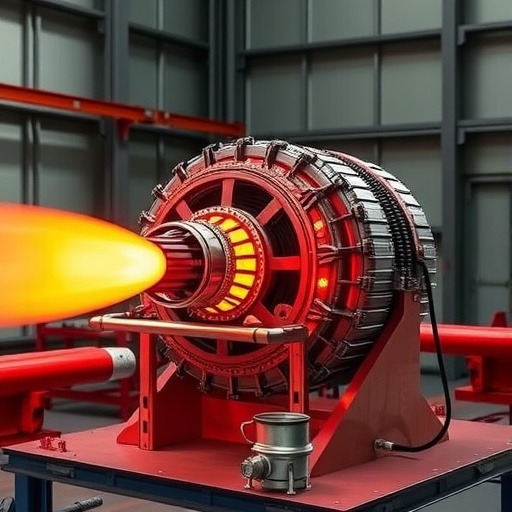
The landscape of aerospace propulsion is undergoing a transformative shift with the advancements in pulse detonation engine (PDE) technology. Researchers have been tirelessly innovating this powerful technology, revealing promising pathways for the future of aerospace applications. The drive for optimization in PDEs is critical, as aerospace demands efficiency, speed, and reduced environmental impact. A recent exploration by Thakur, Debbarma, and Pallela, published in 2025, addresses the intricate enhancements in PDE technology that can redefine air travel and space exploration.
At the heart of pulse detonation engines lies the fundamental principle of pressure wave generation. Unlike traditional jet engines that rely on continuous combustion, PDEs operate by detonating a mixture of fuel and air in a series of pulses. This remarkable mechanism generates thrust in bursts, significantly enhancing efficiency. Recent research highlights the effectiveness of this cyclic approach in elevating performance metrics, which could lead to considerable advancements in both military and civilian aerospace applications. Such engines promise to provide higher specific impulse, improved fuel economy, and a reduced thermal signature, crucial for stealth operations.
Optimization strategies for PDEs are being dissected with an analytical lens, paving the way for more robust designs. Computational fluid dynamics simulations have become indispensable tools in understanding the complex behaviors of pulsed combustion. Researchers are employing sophisticated modeling techniques to analyze flow characteristics, combustion stability, and heat transfer within PDE systems. By leveraging these simulations, scientists can identify the most efficient combustion chamber geometries and injection strategies that maximize thrust while minimizing emissions, a critical concern in today’s environmentally conscious world.
Moreover, the journey into the realm of alternative fuels represents a significant breakthrough in PDE technology. With the aviation sector under pressure to curtail its carbon footprint, exploring biofuels and synthetic fuels has emerged as a formidable avenue. These fuels not only contribute to reduced greenhouse gas emissions but also enhance performance at higher altitudes, where traditional fuels might falter. Integrating such alternative fuels into PDE designs could potentially hasten the adaptation of eco-friendly engines in aerospace applications, marrying sustainability with cutting-edge technology.
A piece of critical research emphasizes the importance of optimizing the structural design of PDE components. The materials used in constructing these engines must withstand extreme conditions, including high pressures and temperatures generated during detonation cycles. Advances in materials science are paving the way for lightweight, heat-resistant alloys and composites that can enhance engine durability and efficiency. This ongoing innovation allows for lightweight yet robust engine designs, a factor that is increasingly vital in modern aerospace engineering as weight savings directly correlate with fuel savings and overall performance.
Control mechanisms in PDEs are another focal point of ongoing studies. Efficiently managing the timing and frequency of detonation events is crucial to harnessing the engine’s full potential. Research shows that incorporating advanced control algorithms and real-time sensors can vastly improve the performance of PDE systems. These technologies will enable more precise adjustments in operating conditions, translating into enhanced reliability and performance across varying flight regimes.
A pivotal challenge facing engineers and researchers is the need to balance the explosive nature of detonation with the structural integrity of engine components. Safety is paramount, and innovative containment strategies are being developed to ensure stable operation during detonation cycles. Reinforced combustion chambers are being designed to absorb shock waves and dissipate energy efficiently, minimizing the risk of catastrophic failure while maximizing operational efficiency.
Furthermore, the transition from theoretical studies to practical applications necessitates rigorous testing protocols. Wind tunnel experiments and full-scale engine trials are essential to validate the theoretical models and simulations. These experimental setups help in uncovering real-world challenges that may not be apparent in computational models, providing critical feedback for further optimization efforts. Such empirical evidence is vital for convincing regulatory bodies and stakeholders of the viability and safety of PDE technology for commercial use.
Natural synergies between PDE technology and advancements in unmanned aerial vehicles (UAVs) are also drawing attention. The capability of PDEs to operate efficiently at various altitudes aligns perfectly with the operational profiles of UAVs, which are often deployed in diverse and challenging environments. Researchers envision a future where UAVs equipped with pulse detonation engines can achieve longer flight times, higher speeds, and greater payload capacities, effectively broadening the operational scope of these versatile aircraft.
Collaboration across disciplines marks the advancement of PDE technology. Engineers, physicists, and chemists are increasingly working together to address the multifaceted challenges posed by pulse detonation engines. The combination of efforts from diverse fields is fostering innovative approaches and leading to breakthroughs that would not be possible in siloed environments. Interdisciplinary research is necessary to tackle problems such as detonation stability and energy losses, ensuring the evolution of PDEs into robust and reliable propulsion systems.
As we look ahead, the future of pulse detonation engines appears promising yet challenging. The path towards widespread adoption in aerospace applications requires continued investment in research and development. The establishment of dedicated research programs and funding initiatives targeting PDE technology can accelerate these advancements, transforming theoretical concepts into practical solutions for the aviation and aerospace industries.
In summary, the optimization of pulse detonation engine technology encapsulates a vibrant and dynamic field within aerospace engineering. With its potential to revolutionize propulsion systems, researchers like Thakur and his colleagues are at the forefront, providing vital insights and innovation strategies. These advancements not only hold the promise of improving performance and efficiency but also contribute positively to the evolving narrative of sustainable aviation.
As our global society continues to prioritize advancements that align with environmental stewardship, optimizing pulse detonation engines stands as a testament to human ingenuity. The quest for high-performance, eco-friendly propulsion systems remains at the cutting edge of aerospace technology. With continued innovation and collaboration, the skies of tomorrow may very well be powered by these revolutionary engines.
Subject of Research: Pulse Detonation Engine Technology
Article Title: Advancements in pulse detonation engine technology: optimization strategies for next-generation aerospace applications.
Article References:
Thakur, A.K., Debbarma, K., Pallela, A. et al. Advancements in pulse detonation engine technology: optimization strategies for next-generation aerospace applications. AS (2025). https://doi.org/10.1007/s42401-025-00418-1
Image Credits: AI Generated
DOI: 10.1007/s42401-025-00418-1
Keywords: Pulse Detonation Engine, Aerospace Propulsion, Fuel Optimization, Alternative Fuels, Materials Science
Tags: aerospace propulsion advancementscomputational fluid dynamics in engine designcyclic combustion mechanisms in PDEsenvironmental impact of aerospace propulsion systemsfuture of air travel and space explorationinnovative strategies for PDE optimizationmilitary and civilian aerospace applicationsoptimizing PDE for efficiencypressure wave generation in enginespulse detonation engine technologyreduced thermal signature in aerospace enginesspecific impulse and fuel economy improvements