• HOME
  • NEWS
  • EXPLORE
    • CAREER
      • Companies
      • Jobs
    • EVENTS
    • iGEM
      • News
      • Team
    • PHOTOS
    • VIDEO
    • WIKI
  • BLOG
  • COMMUNITY
    • FACEBOOK
    • INSTAGRAM
    • TWITTER
Thursday, June 25, 2026
BIOENGINEER.ORG
No Result
View All Result
  • Login
  • HOME
  • NEWS
  • EXPLORE
    • CAREER
      • Companies
      • Jobs
        • Lecturer
        • PhD Studentship
        • Postdoc
        • Research Assistant
    • EVENTS
    • iGEM
      • News
      • Team
    • PHOTOS
    • VIDEO
    • WIKI
  • BLOG
  • COMMUNITY
    • FACEBOOK
    • INSTAGRAM
    • TWITTER
  • HOME
  • NEWS
  • EXPLORE
    • CAREER
      • Companies
      • Jobs
        • Lecturer
        • PhD Studentship
        • Postdoc
        • Research Assistant
    • EVENTS
    • iGEM
      • News
      • Team
    • PHOTOS
    • VIDEO
    • WIKI
  • BLOG
  • COMMUNITY
    • FACEBOOK
    • INSTAGRAM
    • TWITTER
No Result
View All Result
Bioengineer.org
No Result
View All Result
Home NEWS Science News

Optimizing neural networks on a brain-inspired computer

Bioengineer by Bioengineer
July 22, 2020
in Science News
Reading Time: 2 mins read
0
IMAGE
Share on FacebookShare on TwitterShare on LinkedinShare on RedditShare on Telegram

IMAGE

Credit: Heidelberg University

Many computational properties are maximized when the dynamics of a network are at a “critical point”, a state where systems can quickly change their overall characteristics in fundamental ways, transitioning e.g. between order and chaos or stability and instability. Therefore, the critical state is widely assumed to be optimal for any computation in recurrent neural networks, which are used in many AI applications.

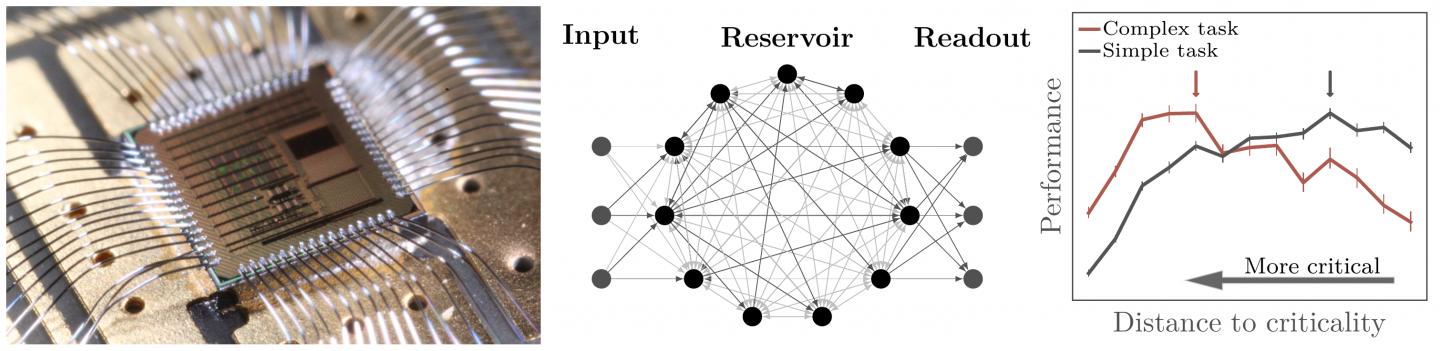
Researchers from the HBP partner Heidelberg University and the Max-Planck-Institute for Dynamics and Self-Organization challenged this assumption by testing the performance of a spiking recurrent neural network on a set of tasks with varying complexity at – and away from critical dynamics. They instantiated the network on a prototype of the analog neuromorphic BrainScaleS-2 system. BrainScaleS is a state-of-the-art brain-inspired computing system with synaptic plasticity implemented directly on the chip. It is one of two neuromorphic systems currently under development within the European Human Brain Project.

First, the researchers showed that the distance to criticality can be easily adjusted in the chip by changing the input strength, and then demonstrated a clear relation between criticality and task-performance. The assumption that criticality is beneficial for every task was not confirmed: whereas the information-theoretic measures all showed that network capacity was maximal at criticality, only the complex, memory intensive tasks profited from it, while simple tasks actually suffered. The study thus provides a more precise understanding of how the collective network state should be tuned to different task requirements for optimal performance.

Mechanistically, the optimal working point for each task can be set very easily under homeostatic plasticity by adapting the mean input strength. The theory behind this mechanism was developed very recently at the Max Planck Institute. “Putting it to work on neuromorphic hardware shows that these plasticity rules are very capable in tuning network dynamics to varying distances from criticality”, says senior author Viola Priesemann, group leader at MPIDS. Thereby tasks of varying complexity can be solved optimally within that space.

The finding may also explain why biological neural networks operate not necessarily at criticality, but in the dynamically rich vicinity of a critical point, where they can tune their computation properties to task requirements. Furthermore, it establishes neuromorphic hardware as a fast and scalable avenue to explore the impact of biological plasticity rules on neural computation and network dynamics.

“As a next step, we now study and characterize the impact of the spiking network’s working point on classifying artificial and real-world spoken words”, says first author Benjamin Cramer of Heidelberg University.

###

Media Contact
Peter Zekert
[email protected]

Original Source

https://www.humanbrainproject.eu/en/follow-hbp/news/optimizing-neural-networks-on-a-brain-inspired-computer/

Related Journal Article

http://dx.doi.org/10.1038/s41467-020-16548-3

Tags: Algorithms/ModelsComputer ScienceElectrical Engineering/ElectronicsHardwareResearch/DevelopmentRobotry/Artificial IntelligenceSoftware EngineeringSystems/Chaos/Pattern Formation/ComplexityTechnology TransferTechnology/Engineering/Computer Science
Share12Tweet8Share2ShareShareShare2

Related Posts

Tracking Lanthanide-Labeled Microplastics in Plants

June 25, 2026

POSTECH Researchers Slash Cost of Reconstituted Cell-Free Systems by 95%

June 25, 2026

AI and Physics Collaborate to Design Advanced Hydrogen Storage Materials

June 25, 2026

Natural Hallucinogens: Evolution’s Ecological Tools, Not Mere Chemical Byproducts

June 25, 2026
Please login to join discussion

POPULAR NEWS

  • Saying Goodbye to PGY-6: Pediatric Fellowship Realities

    103 shares
    Share 41 Tweet 26
  • Multi-Hospital Study Reveals Long Covid Burden Is Twice as High as Current Estimates

    92 shares
    Share 36 Tweet 23
  • Detection of EDCs in Breast Milk and Infant Urine Up to Six Months Highlights Early Exposure Risks

    77 shares
    Share 31 Tweet 19
  • New Drug Candidate Developed at McMaster Shows Potential for Treating Brain Cancer

    58 shares
    Share 23 Tweet 15

About

We bring you the latest biotechnology news from best research centers and universities around the world. Check our website.

Follow us

Recent News

Tracking Lanthanide-Labeled Microplastics in Plants

POSTECH Researchers Slash Cost of Reconstituted Cell-Free Systems by 95%

AI and Physics Collaborate to Design Advanced Hydrogen Storage Materials

Subscribe to Blog via Email

Enter your email address to subscribe to this blog and receive notifications of new posts by email.

Join 82 other subscribers
  • Contact Us

Bioengineer.org © Copyright 2023 All Rights Reserved.

Welcome Back!

Login to your account below

Forgotten Password?

Retrieve your password

Please enter your username or email address to reset your password.

Log In
No Result
View All Result
  • Homepages
    • Home Page 1
    • Home Page 2
  • News
  • National
  • Business
  • Health
  • Lifestyle
  • Science

Bioengineer.org © Copyright 2023 All Rights Reserved.