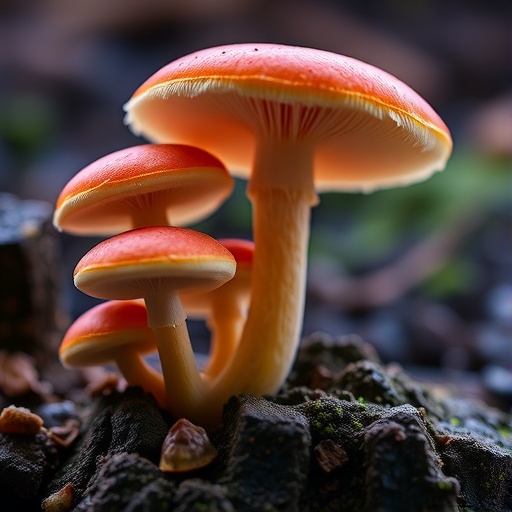
In a groundbreaking study that uncovers the potential of sustainable practices in the field of waste management and bioproduct development, a research team led by Dong, H., Su, H., and Zhou, W. has illuminated the pathway to optimizing the use of hydrogen peroxide in the preparation of fulvic acid from edible mushroom residues. The detailed research was published in the prestigious journal Waste Biomass Valor, and it provides critical insights into both the optimization processes involved and the underlying mechanisms driving this innovative approach.
Fulvic acid, a significant organic compound that is formed during the decomposition of organic matter, plays a crucial role in enhancing soil health and promoting plant growth. Its extraction from natural resources typically involves complex processes that can have ecological implications. However, the researchers have turned their attention to the by-products of the edible mushroom industry, which, despite being nutrient-rich, often end up in landfills. This turning point highlights a dual benefit — waste reduction and value addition in agricultural practices.
The researchers began by examining the different methodologies available for the oxidation of organic materials. They discovered that hydrogen peroxide, a commonly used oxidizing agent, has the potential to effectively break down complex organic compounds present in mushroom residues. However, the efficiency of this process often varies, contingent on parameters such as concentration, temperature, and reaction time, which need careful calibration to maximize yields while minimizing any detrimental by-products.
Through a series of meticulous experiments, the research team optimized the conditions under which hydrogen peroxide could act effectively on mushroom residues. It became increasingly clear that adjusting the pH levels and controlling the temperature were pivotal to enhancing the oxidation process. These parameters were systematically varied, and the resulting fulvic acid was analyzed for its quality and purity, establishing a direct correlation between optimized conditions and the desirable characteristics of the resulting bioactive compound.
The researchers also delved into the biochemical interactions between hydrogen peroxide and the organic matter within the mushroom residues. An in-depth understanding of these mechanisms opens new doors to maximizing efficiency and yields in future applications. By elucidating how chemical bonds are altered and how reactive oxygen species interact with organic matrices, the team lays a foundation for further advancements in bioprocessing technologies that can extend well beyond mushroom residues.
Moreover, the studies revealed that the fulvic acid obtained through this optimized oxidation process exhibits enhanced binding properties. This characteristic enhances the soil’s nutrient uptake, thus potentially improving agricultural productivity. Furthermore, the researchers noted that this method showcases the effective application of a circular economy model, whereby waste is transformed into a valuable product that benefits both the environment and agricultural systems.
The implications of this research are profound. With the global push towards sustainability, the incorporation of waste materials from various industries into productive applications is not just desirable but necessary. Transitioning toward such innovative solutions can significantly reduce the environmental impact often associated with agricultural practices while simultaneously tackling issues of organic waste management.
In addition to providing a valuable agricultural compound, the process underscores the importance of interdisciplinary research. This research integrates aspects of biochemistry, agricultural science, and environmental technology, reflecting a holistic approach to problem-solving in a world that increasingly faces challenges shaped by climate change and resource scarcity.
The promising results from this study present a call to action for industry leaders, policymakers, and researchers alike. Efforts should be directed towards scaling up this oxidation process, ensuring that the methodologies developed are economically viable and accessible for widespread application. As the world continues to innovate and adapt to the challenges posed by waste management and agricultural sustainability, such research serves as a catalyst for collaborative solutions that transcend disciplinary boundaries.
In conclusion, the optimization and mechanistic study of using H₂O₂ for producing fulvic acid from mushroom residues represent a significant stride toward sustainable and responsible waste management practices. The ramifications extend far beyond the immediate findings, fueling ongoing discussions within scientific communities about the importance of resource efficiency and the transition towards a more sustainable future. The challenges posed by food waste and environmental degradation need innovative insights, and this research positions itself as a prime example of how science can bridge these gaps.
This study stands to inspire future research endeavors aimed at similar applications, laying the groundwork for further explorations into the recovery of valuable organic compounds from various waste materials. Ultimately, embracing the tenets of innovation, sustainability, and resource efficiency is crucial as we navigate the complex landscape of modern environmental challenges.
In the age of heightened awareness and action towards sustainability, integrating such findings into broader agricultural practices can propel us closer to an environmentally harmonious future that values both productivity and ecological health.
Subject of Research: Optimization and mechanism study of H₂O₂ oxidation process for preparing fulvic acid from edible mushroom residues.
Article Title: Optimisation and Mechanism Study on H₂O₂ Oxidation Process for Preparing Fulvic Acid from Edible Mushroom Residues.
Article References:
Dong, H., Su, H., Zhou, W. et al. Optimisation and Mechanism Study on H₂O₂ Oxidation Process for Preparing Fulvic Acid from Edible Mushroom Residues.
Waste Biomass Valor (2025). https://doi.org/10.1007/s12649-025-03422-w
Image Credits: AI Generated
DOI: https://doi.org/10.1007/s12649-025-03422-w
Keywords: Fulvic Acid, Hydrogen Peroxide, Mushroom Residues, Waste Management, Sustainable Practices, Circular Economy, Organic Chemistry, Bioproduct Development.
Tags: agricultural value of mushroom residuesecological benefits of fulvic acidenhancing soil health through fulvic acidenvironmental impact of food wastefulvic acid extraction techniqueshydrogen peroxide optimizationinnovative bioproduct developmentmushroom waste valorizationnutrient recycling in agricultureoptimizing oxidation processesorganic compound decompositionsustainable waste management practices