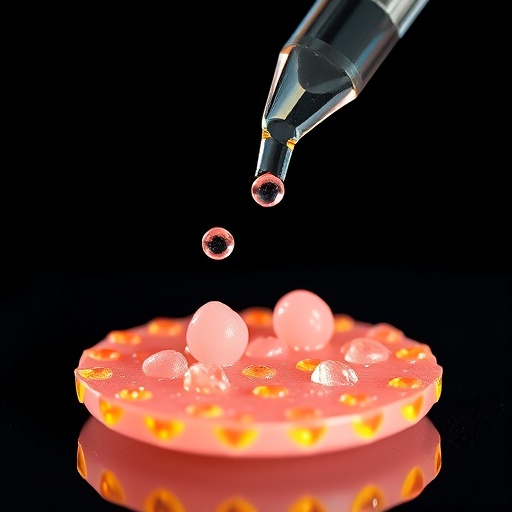
In the realm of pharmaceutical innovations, the development of advanced drug delivery systems remains a cornerstone for enhancing therapeutic efficacy and patient compliance. Recently, a groundbreaking study by Dass, Rani, Verma, and their colleagues introduced a novel gastro-expandable film formulated with Eudragit S100 and ethylcellulose, optimized through a sophisticated design of experiment (DoE) approach. This pioneering work, published in Scientific Reports in 2026, promises to revolutionize oral drug delivery mechanisms by addressing the significant challenge of prolonged gastric retention and controlled drug release.
The central innovation lies in the formulation of a gastro-expandable film designed to expand within the stomach, thereby extending the residence time of the drug dosage form. Traditional oral dosage forms suffer from relatively rapid gastric emptying, which can limit the absorption of drugs primarily absorbed in the stomach or upper small intestine. By leveraging polymers such as Eudragit S100, a pH-responsive polymer, and ethylcellulose, known for its film-forming and controlled-release capabilities, the research team has engineered a system capable of swelling and maintaining its structural integrity in the harsh gastric environment.
The design of experiment method employed served as a powerful tool for optimization, allowing the researchers to systematically evaluate and refine various formulation parameters. This statistical approach enabled the identification of the optimal proportions of Eudragit S100 and ethylcellulose to achieve the desired mechanical strength, swelling capacity, and controlled release profile. The meticulous adjustment of these variables underscores the role of DoE in streamlining pharmaceutical development, ensuring a data-driven progression from concept to optimized formulation.
Importantly, the blend of Eudragit S100 and ethylcellulose in the gastro-expandable films manifests a synergistic effect. Eudragit S100’s gastro-resistance and pH sensitivity enable the film to swell predominantly in gastric conditions, while ethylcellulose enhances mechanical strength and retards drug release. This combination resolves a long-standing conflict between achieving expansion and maintaining film stability, which is critical for safely extending gastric retention without premature degradation or disintegration.
In vitro characterization studies demonstrated remarkable swelling behavior of the films, with controlled expansion achieved within minutes of exposure to simulated gastric fluid. The films exhibited a robust mechanical profile capable of withstanding gastric motility forces without rupture, ensuring sustained gastric retention. Furthermore, release kinetics studies revealed a sustained, controlled drug release over extended periods—surpassing conventional immediate-release formulations and thereby potentiating improved bioavailability for drugs exhibiting narrow absorption windows.
The research also emphasized the importance of polymer concentration and film thickness in modulating both the expansion and drug release profiles. Increasing ethylcellulose concentration enhanced mechanical properties but reduced swelling, necessitating a balanced ratio with Eudragit S100 to optimize these competing attributes. Such nuanced understanding of polymer interplay is crucial for translating laboratory findings into clinically viable gastro-retentive dosage forms.
Furthermore, the study detailed the solubility and diffusion mechanisms underpinning drug release from the gastro-expandable films. Eudragit S100, being an anionic copolymer, undergoes swelling due to osmotic pressure in acidic conditions, enhancing the diffusional pathways for drug molecules. Simultaneously, ethylcellulose, being hydrophobic, limits water penetration and drug diffusion rate, effectively modulating sustained release. This dual polymer matrix represents a significant advance in rational drug delivery system design.
The methodological rigor of the study was complemented by extensive physicochemical characterization including Fourier-transform infrared spectroscopy (FTIR), X-ray diffraction (XRD), and scanning electron microscopy (SEM) analyses. These techniques confirmed the compatibility of the drug with the polymer matrix, the amorphous nature of the loaded drug in the film, and a homogenous surface morphology—all indicative of an optimized formulation with consistent release behavior.
Clinically, the gastro-expandable film technology holds vast potential for drugs requiring prolonged gastric residence, such as antibiotics, anti-diabetics, and drugs with limited intestinal absorption. By prolonging drug contact with the gastric mucosa, the approach can enhance systemic bioavailability, reduce dosing frequency, and improve therapeutic outcomes, particularly in drugs with narrow therapeutic indices. This patient-centered advantage underscores the translational significance of the study.
Additionally, the DoE approach in this context also sets a new benchmark for systematic pharmaceutical formulation development. It advocates for the integration of robust experimental designs in the pharmaceutical industry, ensuring efficiency and reproducibility. This strategy reduces trial-and-error steps, accelerates formulation timelines, and potentially cuts development costs—key benefits for drug manufacturers seeking to innovate responsibly.
Moreover, the compact and thin profile of the gastro-expandable film aligns well with patient compliance. It avoids the bulkiness often associated with gastric retention devices such as large polymeric beads or tablets, making swallowing easier for patients, including pediatric and geriatric populations. This ergonomic consideration further enhances the translational applicability of the technology.
The study also opens avenues for tailoring films with specific drug release profiles by manipulating the ratio of Eudragit S100 to ethylcellulose and film thickness parameters. This modularity implies the potential to customize delivery for a broad spectrum of drugs, metabolic profiles, and patient needs. Such adaptability marks a paradigm shift in personalized medicine through pharmaceuticals.
In conclusion, the gastro-expandable film system developed by Dass et al. signifies a milestone in gastroretentive drug delivery research. Its highly engineered composition, validated through high-resolution characterization and optimized via advanced statistical models, presents a versatile platform capable of enhancing oral bioavailability and therapeutic efficacy. The successful demonstration of this system beckons further clinical investigation and potential market translation, promising to redefine standards in oral drug delivery science.
The innovative potential of this system also encourages exploration of combination therapies encapsulated within such films, offering synergistic drug release and multi-faceted therapy with sustained residence. This prospective utility amplifies the scope of research, beckoning cross-disciplinary collaborations to unlock new horizons in controlled drug delivery.
With biodegradability and safety profiles yet to be fully elucidated in vivo, future studies are expected to focus on long-term gastric compatibility and pharmacokinetic outcomes, ensuring the technology meets stringent regulatory requirements. Nevertheless, the foundational work presented here offers a compelling glimpse into the future of oral pharmacotherapy, wherein sophisticated materials science converges with clinical need to produce truly intelligent delivery systems.
Subject of Research:
Article Title:
Article References:
Dass, R., Rani, P., Verma, V. et al. Optimization and evaluation of gastro-expandable film of Eudragit S100 and ethylcellulose by using the design of experiment. Sci Rep (2026). https://doi.org/10.1038/s41598-026-45540-y
Image Credits: AI Generated
DOI: https://doi.org/10.1038/s41598-026-45540-y
Keywords: gastro-expandable film, Eudragit S100, ethylcellulose, design of experiment, gastroretentive drug delivery, controlled release, oral drug delivery
Tags: advanced oral dosage formsadvanced polymeric drug deliverydesign of experiment in drug developmentdesign of experiment in pharmaceutical formulationethylcellulose controlled release filmsEudragit S100 polymer applicationsexperimental design for film formulationfilm-forming polymers in drug deliverygastric residence time enhancementgastric retention enhancement techniquesgastro-expandable drug delivery systemsgastro-retentive drug delivery mechanismsoral drug delivery innovationsoral drug delivery optimizationpH-responsive polymer drug carrierspH-responsive polymer drug deliverypharmaceutical formulation optimizationprolonged gastric residence timeprolonged gastric retention strategiesstatistical optimization in pharmaceuticssustained release oral dosage forms