Hydrogen peroxide (H₂O₂) has garnered considerable attention in the chemical and industrial sectors due to its role as a mild yet potent oxidizing agent. Its applications span various fields, including environmental remediation, disinfection, and the burgeoning area of sustainable chemical processes. As the world increasingly seeks environmentally friendly methods for chemical synthesis, the photocatalytic generation of hydrogen peroxide has emerged as a promising avenue, capitalizing on the abundant and clean energy provided by sunlight.
A significant contribution to this field comes from the recent research published by Professors Jiang and Wang, who have meticulously investigated the intricate relationship between donor and acceptor units in covalent organic frameworks (COFs) and their impact on the efficiency of photocatalytic H₂O₂ synthesis. Their paper, featured in Science Bulletin, meticulously details how the structural and electronic compatibility of these building blocks can enhance photocatalytic activity, leading to remarkable yields of hydrogen peroxide.
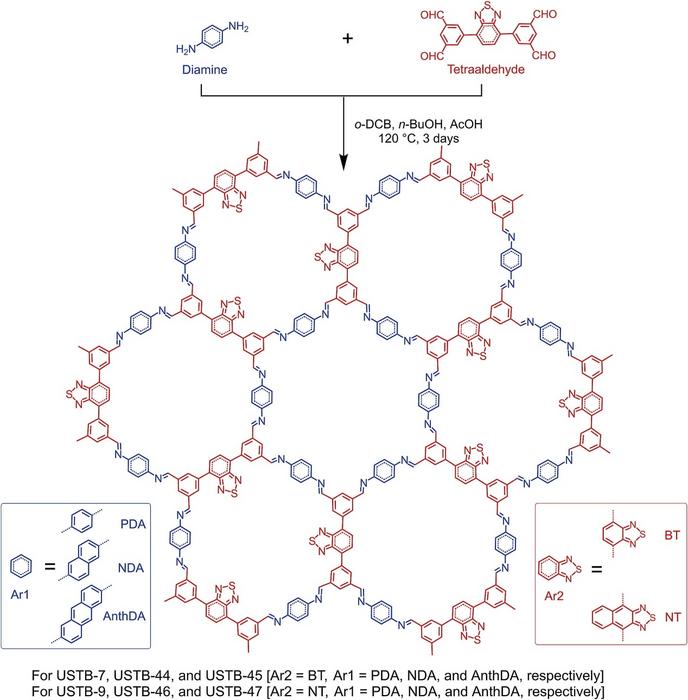
Focusing on the synthesis of six two-dimensional donor-acceptor (D-A) COFs, the researchers selected three distinct donor units and two acceptor units, each varying in their conjugation characteristics. The conjugation between these units is critical; it influences the materials’ electronic properties and, consequently, their photocatalytic efficiency. By tailoring these interactions through careful engineering, the team was able to achieve optimal compatibility between the donor and acceptor components, which is essential for efficient charge transfer and light harvesting.
The standout material from this research, identified as USTB-46, exhibited a remarkable H₂O₂ production rate of 8274 mmol g⁻¹ h⁻¹. This impressive performance is not merely a product of its inherent structure but is deeply rooted in the synergistic effects arising from the optimized light absorption capabilities and the favorable thermodynamic properties of the A units. The intricate balance of electronic interactions facilitated by the structural alignment of the donor and acceptor units underscores the significance of material design in enhancing photocatalytic processes.
This investigation represents a pioneering step toward understanding how the engineering of donor and acceptor unit compatibility can dramatically influence photocatalytic outcomes. The researchers provide robust evidence that the careful design of COFs can lead to substantial improvements in photocatalytic efficiency, marking a significant advancement in the field. These findings open up new avenues for the development of efficient photocatalysts in hydrogen peroxide synthesis, a process traditionally marred by low yields and the necessity of sacrificial reagents.
The implications of these findings extend beyond hydrogen peroxide production; they herald a new paradigm in the design of photocatalytic materials. The ability to manipulate electronic interfaces at a molecular level allows for the exploration of a broader range of chemical reactions that can be harnessed for sustainable technologies. The interdisciplinary approach taken by the researchers, combining insights from materials science, chemistry, and photonics, elucidates the complexity behind photocatalytic mechanisms and offers a template for future research in this domain.
Further exploration into the adaptability of these frameworks can lead to significant improvements in the efficiency of not only H₂O₂ synthesis but also other related chemical transformations. The maximization of performance through innovative material design is critical for realizing the potential of photocatalysis in industrial applications. As the green chemistry movement continues to gain momentum, the findings from Jiang and Wang’s study epitomize the type of sustainable research that could revolutionize chemical manufacturing processes.
The study’s comprehensive approach goes beyond mere empirical observations; it delves into the underlying principles governing charge transfer and energy alignment within COFs. The findings challenge existing paradigms and encourage researchers to rethink conventional strategies in photocatalytic design. As more researchers recognize the potential of such materials in photocatalysis, we may begin to see a paradigm shift in how chemicals like hydrogen peroxide are produced—moving away from traditional processes towards more sustainable methods fueled by renewable energy sources.
In conclusion, the groundbreaking research led by Jiang and Wang offers a fresh perspective on the engineering of donor-acceptor interactions in covalent organic frameworks, demonstrating that the compatibility of these units is crucial for advancing photocatalytic efficiency. Their work not only contributes to the scientific community’s understanding of photocatalytic systems but also serves as an inspiration for future innovations aimed at creating efficient, sustainable chemical processes—aligning perfectly with the global quest for sustainable solutions and green technologies.
Subject of Research: Photocatalytic hydrogen peroxide production via engineered covalent organic frameworks (COFs).
Article Title: “Engineering the Conjugation of Donor and Acceptor Units in Covalent Organic Frameworks for Efficient Photocatalytic H₂O₂ Synthesis.”
News Publication Date: TBD
Web References: https://doi.org/10.1016/j.scib.2024.11.024
References: Science Bulletin
Image Credits: ©Science China Press
Keywords
Hydrogen peroxide, photocatalysis, covalent organic frameworks, donor-acceptor units, sustainable chemistry, chemical synthesis, renewable energy, light harvesting, material design.
Tags: chemical and industrial applications of hydrogen peroxidecovalent organic frameworks researchdonor-acceptor interactions in COFsengineering electronic properties in COFsenvironmental applications of H₂O₂Jiang and Wang research findingsoptimizing donor-acceptor unitsphotocatalytic efficiency enhancementphotocatalytic hydrogen peroxide productionstructural compatibility in photocatalystssustainable chemical synthesis methodstwo-dimensional COFs design