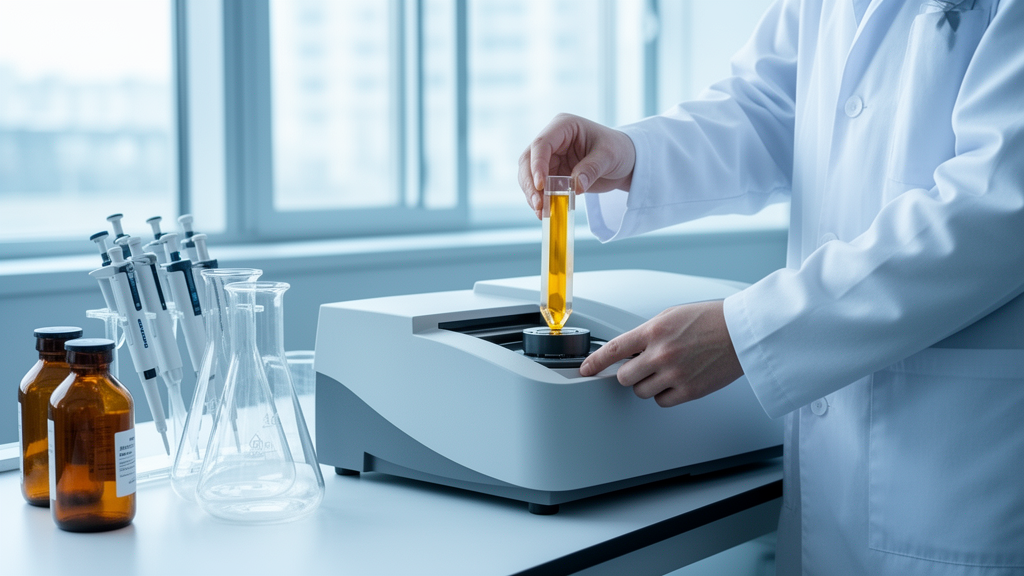
A greener validated spectrophotometric investigation has demonstrated an effective analytical procedure for evaluating nimesulide in pharmaceutical formulations and bulk material. The analytical method is based on the chemical formation of a coloured product when nimesulide reacts with potassium permanganate in an alkaline medium created using sodium hydroxide. Following this chemical reaction, the resulting absorbance of the coloured mixture is monitored spectrophotometrically at a wavelength of 601 nanometers.
A Box–Behnken design was employed to optimize the reaction conditions. This experimental framework was employed to optimize three key system variables: the reaction time, the concentration of potassium permanganate, and the concentration of nimesulide. The final selected operating conditions established from the optimization process were an 11-minute reaction time, a potassium permanganate concentration of 0.001 M, a nimesulide concentration of 0.028 M, and a sodium hydroxide concentration of 0.1 M.
Following the optimization phase, the spectrophotometric methodology underwent comprehensive validation in alignment with International Council for Harmonisation oriented requirements. The validation program evaluated multiple essential analytical criteria, including method specificity, linearity, accuracy, precision, detection limits, quantitation limits, and analytical robustness.
The experimental validation results revealed that the spectrophotometric method exhibits a robust linear response across a concentration range of 1.8 to 22.5 micrograms per milliliter. Within this calibrated working range, statistical evaluation of the sensitivity parameters established a limit of detection of 0.56 micrograms per milliliter and a limit of quantitation of 1.70 micrograms per milliliter.
Recovery values were 99.225% to 99.794%. Intraday and interday precision produced relative standard deviation ranges of 0.201% to 0.763% and 0.342% to 1.025%, respectively.
In addition to validating analytical performance, the authors conducted an extensive examination of the method’s environmental footprint and operational practicality. The sustainability and practical performance of the procedure were appraised using five established greenness assessment tools: AGREE, BAGI, AES, EPPI, and RAPI.
The investigators concluded that the validated approach is fully suitable for determining nimesulide concentrations in both bulk material and finished pharmaceutical formulations.
Subject of Research: Greener spectrophotometric determination of nimesulide in pharmaceutical formulations
Article Title: Greener validated spectrophotometric investigation optimized with Box–Behnken design for nimesulide in pharmaceutical formulations
Article References: Haque, S. M., Obaydo, R. H., Umar, Y., Judeh, A. A., & Alsmail, N. H. (2026). Greener validated spectrophotometric investigation optimized with Box–Behnken design for nimesulide in pharmaceutical formulations. BMC Chemistry. https://doi.org/10.1186/s13065-026-01960-5
Image Credits: AI Generated
DOI: 10.1186/s13065-026-01960-5
Keywords: Nimesulide, Spectrophotometry, Box–Behnken design, Potassium permanganate, Sodium hydroxide, Pharmaceutical formulations, Bulk material, Method validation, ICH guidelines, Limit of detection, Limit of quantitation, Precision and accuracy, Absorbance monitoring, AGREE metric, BAGI metric, Analytical Eco-Scale, EPPI, RAPI
News Source: Bethany Barker. (November 12, 2026). Optimized Green Spectrophotometric Assay Reliably Quantifies Nimesulide in Formulations. Scienmag.