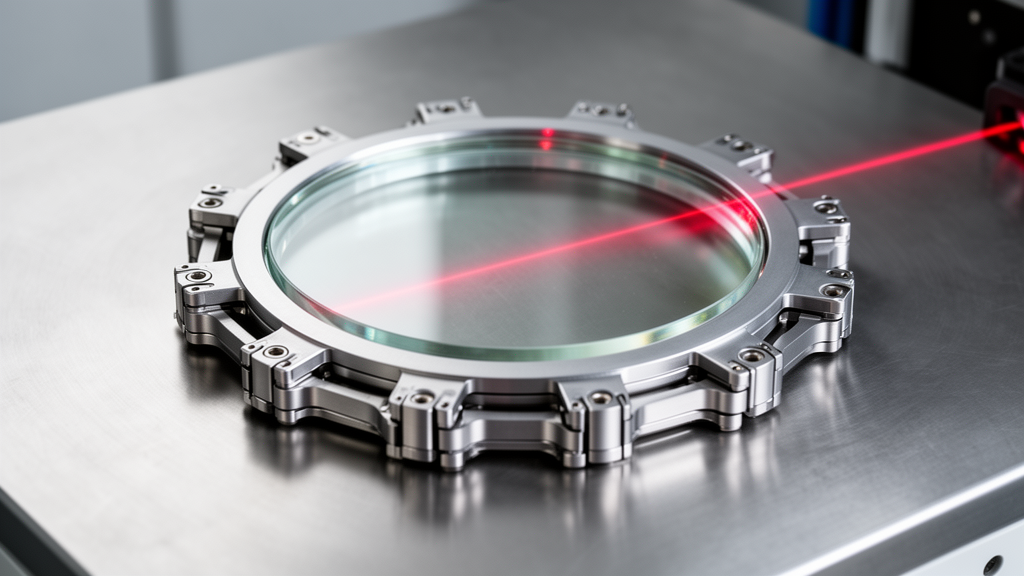
Optical engineers have developed a single-layer eighteen-point flexible positioning mount for large-diameter ground-based laser emission windows that improves wavefront surface shape accuracy across varying tilt attitudes by up to 19.35 percent. Optical windows serve as the critical boundary channel separating the internal environment of high-power optical instruments from external environmental factors such as dust, salt spray, moisture, and mold while permitting laser radiation to pass through unimpeded. As ground-based optical systems continue to expand in aperture size, power output, and integrated spectral bands, preserving the index specifications and structural stability of large transmitting windows under dynamic gravitational and thermal loading poses severe mechanical challenges. Excessive deformation of the window lens can induce unwanted convergence or divergence of the emitted beam, severely degrading overall beam quality during propagation to distant targets. By replacing heavy, space-consuming traditional multi-layer mounts with a streamlined eighteen-point axial flexible assembly and radial restraint ring, researchers established a compact architecture that simultaneously satisfies tight mechanical packaging constraints, preserves structural rigidity, and significantly mitigates wavefront aberration.
To solve the dual challenges of thermal stress and gravitational sag in high-power directed emission, the research team analyzed a ring-shaped window lens having an outer diameter of 550 millimeters, an inner diameter of 140 millimeters, and an axial thickness of 22 millimeters. The central opening accommodates the primary and secondary mirror architecture of a Cassegrain beam-expanding system, which leaves an emission blind zone behind the secondary mirror while directing multi-band laser radiation through the surrounding clear aperture. The lens material selected for this long-wave infrared application operating between 8 and 12 micrometers is zinc selenide, which provides near-total transmission at the critical 10.6 micrometer operating wavelength, an absorption coefficient below 0.0005 inverse centimeters, and the capacity to withstand incident power densities up to 20,000 watts per square centimeter. With a high diameter-to-thickness ratio exceeding 10, the window behaves mechanically as a thin lens whose surface shape is exceptionally sensitive to gravitational deflection and mount-induced contact stresses, establishing a baseline design requirement that the surface root-mean-square error must remain strictly below one-fifth of a wavelength across all operational pointing angles.
Theoretical estimation based on Hall empirical formulations demonstrated that supporting the zinc selenide ring lens under strict deformation limits necessitated a minimum of seventeen discrete axial support points, leading the investigators to adopt a single-tier eighteen-point flexible positioning layout rather than a conventional Hindle mount. Standard Hindle support structures rely on multi-tier triangular rocker mechanisms that consume extensive axial installation depth and cast significant obstructions across the optical transmission path. By eliminating intermediate structural tiers, the researchers devised an eighteen-point configuration where three primary points fix the spatial orientation of the optic while fifteen auxiliary flexible elements provide distributed compliant support. To house these elements while maintaining an open optical path, the base frame utilizes a radial spider bar architecture joined to a central hub, creating a total clear aperture area of 212,028.5 square millimeters with an obscuration area limited to 12,378.6 square millimeters, which restricts the total structural beam obscuration rate to approximately 6 percent.
Radial and axial flexible assemblies were directly integrated into the titanium alloy base frame to isolate the fragile zinc selenide optic from external mechanical distortion and differential thermal expansion. The radial support subsystem incorporates a precision-machined toothed shaft and an outer radial flexible ring to provide controlled lateral restraint. To prevent damaging interfacial stresses caused by the mismatch between the thermal expansion coefficient of the zinc selenide lens and the titanium alloy housing, a continuous silicone rubber ring with a calculated radial thickness of 1 millimeter was inserted between the optic periphery and the mount, applying Bayar analytical formulations for athermalized radial boundaries. In the axial direction, eighteen discrete flexible shaft assemblies comprising a compliant neck, an axial adjustment pad for leveling height consistency, and an interfacial silicone rubber pad were bonded directly to the rear face of the lens, matching the thermal isolation and protective buffering behavior of the radial ring.
Dynamic operational requirements dictate that the laser emission terminal must tilt continuously through a pitch range from 0 degrees horizontal to 90 degrees vertical, exposing the window assembly to constantly shifting gravity vectors, ambient thermal variations, and operational mechanical vibrations. Finite element analysis established that the first six natural vibration modes of the integrated window assembly span from 222.55 hertz to 735.32 hertz. Because operational vibration generated by launch mechanisms typically requires the fundamental structural resonance to exceed 180 hertz, the baseline first-order mode of 222.55 hertz satisfied dynamic stiffness criteria without risking mechanical resonance. Static mechanical analysis evaluated coupled gravitational and thermal loads under a 5-degree Celsius temperature variation across five specific operational attitudes: 0 degrees, 22.5 degrees, 45 degrees, 67.5 degrees, and 90 degrees. Initial finite element computations with rigid body displacements removed revealed that peak-to-valley wavefront errors ranged from 292.28 nanometers at 90 degrees to 631.45 nanometers at 22.5 degrees, while root-mean-square errors reached 145.68 nanometers at 22.5 degrees and 122.42 nanometers at 45 degrees, confirming that intermediate inclined attitudes experienced the most severe axial bending deformations.
To streamline the computational burden of global structural optimization, the investigators applied Spearman rank correlation coefficient screening across fourteen structural parameters governing the flexible mount geometry. Generating a design space of 300 discrete sample evaluations perturbed within plus or minus 10 percent of baseline values, the team quantified parameter sensitivity against the root-mean-square wavefront errors calculated at the three most critical operational attitudes of 0 degrees, 22.5 degrees, and 45 degrees. The resulting correlation matrix identified that the outer radius of the radial flexible ring exhibited a dominant correlation with optical surface distortion, while the flexible shaft neck dimensions, the inner radius of the flexible ring, its mounting angle, and the radial positioning circle of the flexible shafts demonstrated moderate correlations. The remaining eight parameters displayed minimal sensitivity and were excluded from optimization routines, allowing the team to isolate six primary design variables: flexible shaft neck dimensions, radial ring inner and outer radii, radial ring opening angle, and axial shaft radial position.
Using an Optimal Space-Filling design methodology, the authors sampled 45 representative parameter combinations across the constrained six-variable design space to construct second-order polynomial response surface approximation models for each critical operating angle. The established response surface equations mapped the mathematical interactions among the primary structural parameters and the corresponding root-mean-square wavefront error metrics derived from finite element analysis. Significance tests confirmed high approximation fidelity, yielding determination coefficients of 0.9184 for the 0-degree attitude, 0.9520 for the 22.5-degree attitude, and 0.9493 for the 45-degree attitude. Goodness-of-fit evaluations revealed that data points clustered tightly along the ideal unity line, verifying that the surrogate response surface accurately captured non-linear mechanical-thermal coupling behaviors without necessitating computationally prohibitive full-scale finite element recalculations during subsequent iterative optimization cycles.
A multi-island genetic algorithm was deployed to resolve conflicting structural performance trade-offs across the simultaneous multi-objective minimization problem targeting the root-mean-square errors at 0 degrees, 22.5 degrees, and 45 degrees. Operating with an initial population of 100 individuals, a crossover probability of 0.98, a mutation probability of 0.01, a maximum allowable Pareto front percentage of 70 percent, and a convergence stability criterion of 2 percent, the algorithm mapped the Pareto frontier to identify non-dominated structural geometries. The designers selected an optimal parameter configuration from the Pareto frontier: an inner flexible ring radius of 282.27 millimeters, an outer flexible ring radius of 292.69 millimeters, a ring angle of 45.369 degrees, flexible shaft neck dimensions of 4.079 millimeters and 4.463 millimeters, and an axial shaft installation radius of 225.46 millimeters.
Re-evaluating the window assembly within the coupled finite element framework using the optimized structural parameters confirmed comprehensive improvements in surface shape accuracy across all operational attitudes. The root-mean-square error decreased from 106.07 nanometers to 103.14 nanometers at 0 degrees, representing an improvement of 2.76 percent, while at 22.5 degrees the error dropped from 145.68 nanometers to 122.13 nanometers, achieving a 16.16 percent improvement. The most substantial enhancement occurred at the 45-degree working inclination, where root-mean-square deformation fell from 122.42 nanometers to 98.72 nanometers, marking an improvement of 19.35 percent. At steeper angles of 67.5 degrees and 90 degrees, root-mean-square errors decreased to 61.81 nanometers and 35.45 nanometers, reflecting gains of 4.54 percent and 3.47 percent respectively, while peak-to-valley values across all attitudes remained well below target wavefront thresholds.
Physical validation of the optimized structural design was carried out using a 24-inch ZYGO phase-shifting laser interferometer to evaluate actual optical wavefront distortion across all five inclination attitudes following the removal of rigid body displacement. Experimental interferometry measurements registered actual root-mean-square surface errors of 99.98 nanometers at 0 degrees, 112.01 nanometers at 22.5 degrees, 89.22 nanometers at 45 degrees, 58.22 nanometers at 67.5 degrees, and 35.44 nanometers at 90 degrees. Comparing the physical experimental values with the simulated numerical predictions demonstrated a maximum relative deviation rate of only 9 percent at 45 degrees, with deviations at 0 degrees, 22.5 degrees, 67.5 degrees, and 90 degrees measuring 3 percent, 8 percent, 5 percent, and 0.03 percent respectively. This tight correspondence confirms that the surrogate-based optimization methodology accurately models thermo-mechanical behaviors and provides an effective engineering framework for supporting large-diameter transmissive optical elements in high-power laser systems.
Subject of Research: Structural design and multi-objective optimization of large-diameter laser emission window supports
Article Title: Design and optimization of support structure for large diameter laser emission window
Article References: Men, S., Shi, Y., Han, K., Shen, J., & Lu, Z. (2026). Design and optimization of support structure for large diameter laser emission window. Results in Optics, Article 101220. https://doi.org/10.1016/j.rio.2026.101220
Image Credits: AI Generated
DOI: 10.1016/j.rio.2026.101220
Keywords: laser emission window, large aperture optics, flexible support structure, surface shape accuracy, root mean square error, peak to valley, zinc selenide, response surface methodology, genetic algorithm, pareto frontier, finite element analysis, force thermal coupling, natural frequency, zygo interferometer, spearman correlation, titanium alloy TC4, silicone rubber damping
News Source: Denise Maddox. (November 24, 2026). Optimized Eighteen-Point Flexible Mount Enhances Optical Accuracy in Laser Windows. Scienmag.