Credit: The authors
BELLINGHAM, Washington, USA , and CARDIFF, UK — A new technique developed by researchers at Lawrence Livermore National Lab promises to improve accuracy and lower costs of real-time assessment of kidney function, reports an article published this week by SPIE, the international society for optics and photonics, in the Journal of Biomedical Optics.
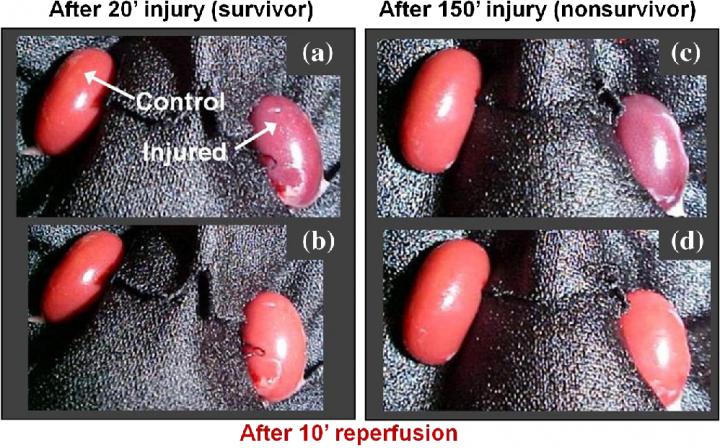
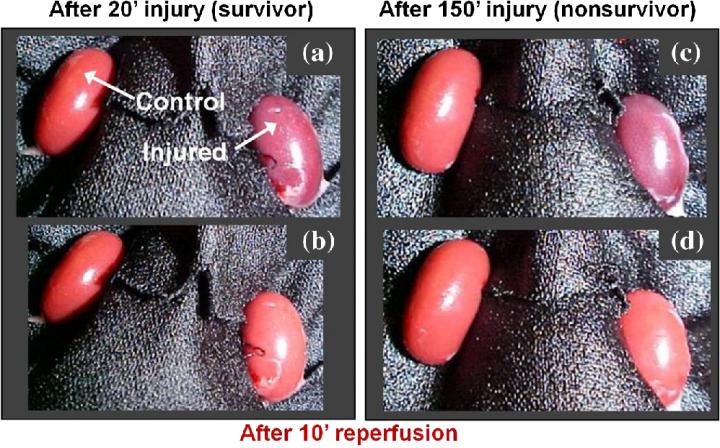
The paper, published 3 May and accessible via open access, explores the use of multimodal autofluorescence and light scattering to evaluate functional changes in the kidneys after ischemic injury. Conditions including accumulated arterial plaque or blood clots restrict the flow of oxygen and glucose to organs, and prolonged periods of such ischemia can compromise function.
In "Predictive assessment of kidney functional recovery following ischemic injury using optical spectroscopy," the authors report on their evaluation of various optical signatures to predict kidney viability and suggest a noncontact approach to provide clinically useful information in real time.
While other current work in this area uses expensive multiphoton and laser-based techniques, the authors reduced expenses by switching to camera-based imaging.
Currently, there is no real-time tool to measure the degree of ischemic injury incurred in tissue or to predict the return of its function. The inability to decisively determine tissue functional status runs two great risks: that dysfunctional tissue may be transplanted, increasing the morbidity and mortality of the patient; and that much-needed functional kidney tissue may be discarded.
In their study, Rajesh Raman of Lawrence Livermore National Lab and co-authors Christopher Pivetti and Christoph Troppmann of the University of California Davis, Rajendra Ramsamooj of California Northstate University, and Stavros Demos of Lawrence Livermore acquired autofluorescence images of kidneys in vivo under 355, 325, and 266 nm illumination. Light-scattering images were collected at the excitation wavelengths while using a relatively narrow band light centered at 500 nm.
The images were simultaneously recorded using a multimodal optical imaging system. The recorded signals were then analyzed to obtain time constants, which were correlated to kidney dysfunction as determined by a subsequent survival study and histopathological analysis.
Analysis of the light-scattering and autofluorescence images suggests that variations in tissue microstructure, fluorophore emission, and blood absorption spectral characteristics, combined with vascular response, contribute to the behavior of the recorded signals. These are used to obtain tissue functional information and enable the ability to predict post-transplant kidney function.
This information can also be applied to the prediction of kidney failure when visual observation cannot, almost immediately following an injury.
Reviewers of the study suggested other promising applications for future development, and envisioned this approach being used as a screening tool for assessing kidney viability prior to transplant. In particular, they said, these cost-effective screening methods could benefit healthcare in developing countries.
Multimodal imaging also has provided insights into other physiological events that may occur during ischemia and reperfusion.
"This work's exceptional value lies in the realization of a workable practical system that has excellent potential to be adopted in field situations," said journal associate editor Andreas Mandelis (University of Toronto).
###
Lihong Wang, Gene K. Beare Distinguished Professor of Biomedical Engineering at Washington University in St. Louis, is editor-in-chief of the Journal of Biomedical Optics. The journal is published in print and digitally in the SPIE Digital Library, which contains more than 458,000 articles from SPIE journals, proceedings, and books, with approximately 18,000 new research papers added each year.
About SPIE
SPIE is the international society for optics and photonics, an educational not-for-profit organization founded in 1955 to advance light-based science, engineering, and technology. The Society serves nearly 264,000 constituents from approximately 166 countries, offering conferences and their published proceedings, continuing education, books, journals, and the SPIE Digital Library. In 2016, SPIE provided $4 million in support of education and outreach programs. http://www.spie.org
Media Contact
Amy Nelson
[email protected]
360-685-5478
@SPIEtweets
http://spie.org/
############
Story Source: Materials provided by Scienmag