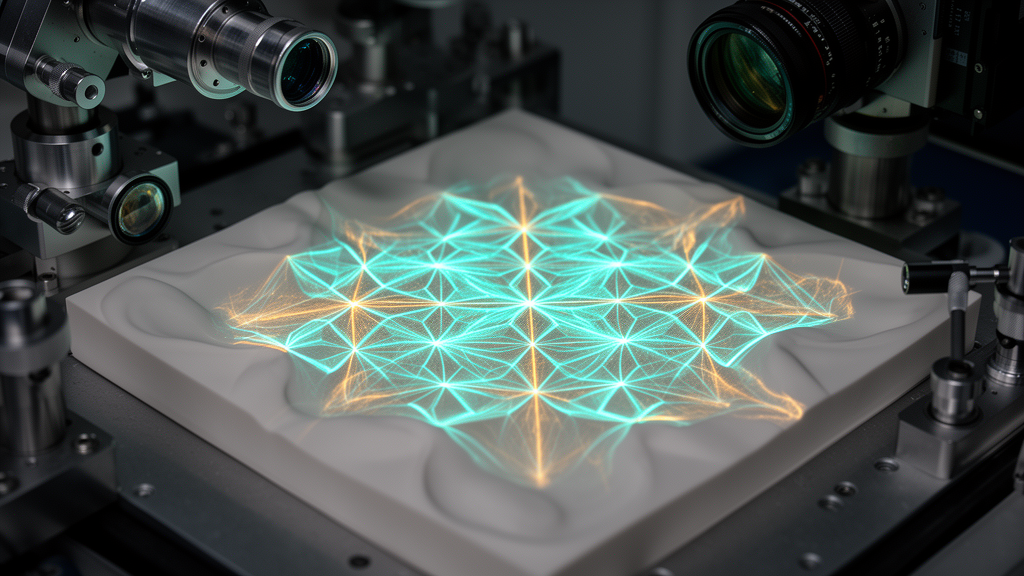
A research team has demonstrated an optical quasicrystal-based imaging approach that combines structured light with artificial intelligence to reconstruct three-dimensional objects from a single synchronized stereo exposure. The investigation, conducted by researchers led by Professor Dayong Qiao at Northwestern Polytechnical University and Assistant Professor Yijie Shen at Nanyang Technological University alongside collaborators at the University of Stuttgart, shows that rich geometric information can be embedded into one projected pattern to yield sub-0.1 mm surface-fitting precision. Published in Light Dynography, the peer-reviewed study addresses the longstanding challenge of capturing the spatial coordinates of complex surfaces and moving targets without relying on multiple sequential illumination sweeps.
Conventional high-precision structured light scanners typically capture three-dimensional topology by projecting a succession of fringe or geometric patterns across an object. To overcome this limitation, the investigators looked to the physics of nonperiodic materials to design a pattern architecture capable of packing high-density, multi-angle geometric markers into an individual exposure frame.
The structural framework of the system draws directly from quasicrystalline arrangements originally identified in materials science. Unlike ordinary crystals, which display periodic lattices that repeat uniformly in space like tiles across a floor, quasicrystals are strictly ordered and deterministic yet never repeat periodically. When multiple distinct wave fronts are superposed to construct an optical quasicrystal, they generate an intricate optical fingerprint that appears irregular to visual inspection but maintains a precisely engineered distribution of directional spatial frequencies.
In this design, the researchers integrated 12 differently oriented stripe patterns into a single synthesized optical quasicrystal pattern instead of projecting them sequentially. Because each orientation occupies a discrete and separable region within the spatial frequency spectrum of the optical design, the individual components carry distinct directional spatial coordinates while remaining fully distinguishable. When this composite field illuminates a scene, surface contours and depth variations bend and distort the projected stripes. A synchronized pair of calibrated cameras captures these optical deformations simultaneously from two different perspective views, recording the encoded shape information within a single synchronized exposure.
Decoding the overlapping spatial information recorded by the stereo camera pair required the creation of a specialized computational reconstruction framework designated as OQ-Stereo. Because the 12 projected stripe patterns coincide in space within the captured sensor frames, the artificial intelligence algorithm must isolate and resolve the individual directional components before triangulating depths. Functioning analogously to separating individual acoustic instruments from a complex orchestral recording, OQ-Stereo disentangles the overlapping directional patterns, isolates the complementary geometric features from the frequency domain, and performs coordinated disparity matching across both synchronized camera perspectives.
The algorithmic pipeline then cross-examines the dual camera views to calculate depth distributions. Rather than applying a uniform matching criterion across entire surface regions, OQ-Stereo computes multiple independent depth estimates across the extracted directional cues and merges them according to calculated local reliability metrics.
The experimental validation evaluated the system across multiple geometric targets to measure baseline accuracy and structural fidelity. Quantitative surface-fitting assessments conducted on geometric reference standards—including flat planes, cylinders, and spheres—demonstrated surface-fitting precision below 0.1 mm using only the single projected quasicrystal pattern.
Despite rapid continuous blade motion across the field of view, individual synchronized exposures produced clear, structurally resolved three-dimensional models of both the central rotating hub and the individual moving fan blades.
By unifying the nonperiodic wave mechanics of optical quasicrystals with artificial intelligence reconstruction, the study provides a viable architecture for compact, high-precision three-dimensional vision systems. The researchers identify potential operational applications in automated robotic navigation through unstructured terrain, inline quality verification of moving industrial assemblies, and high-speed geometric diagnostics where transient physical events restrict optical observation to a single photographic exposure.
Subject of Research: Optical quasicrystal structured light for single-shot three-dimensional imaging
Article Title: A single shot opens a new world of 3D vision
Article References: A single shot opens a new world of 3D vision. Original publication (Bibliographic details unavailable.)
Image Credits: AI Generated
DOI: Not provided
Keywords: optical quasicrystals, structured light, single-shot 3D reconstruction, artificial intelligence, OQ-Stereo, Dayong Qiao, Yijie Shen, Northwestern Polytechnical University, Nanyang Technological University, University of Stuttgart, surface-fitting precision, optical engineering, computer vision, stereo exposure, 3D imaging, robotics vision, industrial inspection
News Source: Blake Davidson. (November 13, 2026). Optical Quasicrystal Structured Light Achieves Sub-0.1 Millimeter Single-Shot 3D Reconstruction. Scienmag.