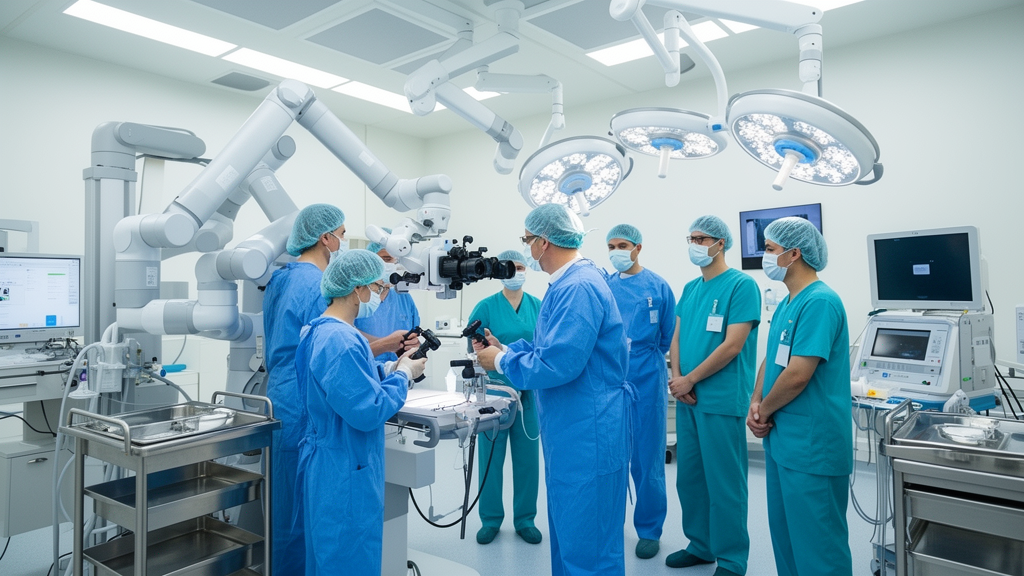
Robotic-assisted surgery has expanded across modern clinical environments, offering minimally invasive procedures that rely on smaller incisions than traditional open surgery while delivering enhanced precision, dexterity, vision, and ergonomics to the operating surgeon. Controlled from a physical console positioned at a distance from the patient and bedside personnel, robotic platforms have historically demonstrated measurable clinical associations with improved patient outcomes, including reduced intraoperative blood loss, decreased postoperative pain, accelerated recovery timelines, shortened hospital stays, and lower rates of complications such as surgical site infections. However, the operational landscape of robotic surgery is undergoing a major technological diversification. While Intuitive Surgical’s da Vinci Robotic System has served as the dominant platform familiar to most surgical teams for more than two decades, alternative multi-arm platforms have entered active hospital practice and training programs. Medtronic’s Hugo robotic-assisted surgery system obtained clinical clearance in 2021, and CMR Surgical’s Versius platform secured its European Certification mark in 2019. Consequently, healthcare institutions increasingly acquire multiple competing robotic platforms within identical surgical suites, and novice surgeons frequently encounter varied systems during residency. A perspectives analysis published by Julnar Albulushi, Natalie Sanford, and Kyi Phyu Nyein in Human Factors in Healthcare examines the resulting demands placed on surgical teams, emphasizing that managing multiple robotic architectures introduces novel operational disruptions that require structured organizational, cognitive, and communicative adaptation.
The structural diversification of surgical robotics introduces substantial differences in hardware design, ergonomics, and spatial arrangements that alter how clinicians interact with equipment and each other. The authors examine how console architecture dictates team dynamics, contrasting the enclosed configuration of the da Vinci platform with the open configurations found in newer systems like Hugo and Versius. In the closed console model, the surgeon places their head inside an enclosed viewing apparatus to inspect high-definition three-dimensional imagery of the operative site. Although this physical enclosure can promote deep technical concentration, it restricts the surgeon’s direct visual monitoring of the broader operating suite, obscuring the bedside assistant, circulating staff, and patient. Consequently, communication in closed console environments relies heavily on explicit verbal exchanges transmitted via dedicated microphone and audio systems, virtually eliminating the subtle nonverbal cues, peripheral glances, and physical gestures that traditionally coordinate operative teams. Conversely, open console designs equip the operating surgeon with specialized three-dimensional eyewear to view the surgical field on a free-standing flat monitor. This open layout preserves a direct line of sight between the console operator, bedside practitioners, and the patient, while allowing the surgeon to monitor robotic arm trajectories peripherally. Nevertheless, open consoles expose the operator to background operating room distractions, noise, and ambient movement, necessitating conscious behavioral adjustments to balance situational awareness against cognitive focus.
Beyond console architecture, distinct mechanical arrangements and spatial footprints among robotic platforms generate substantial physical and logistical challenges for surgical personnel. In contrast to the da Vinci system, which houses four robotic arms mounted on a unified central patient cart, both the Hugo and Versius systems utilize four individual, modular arm units. During operative setup, perioperative personnel must independently transport each mechanical arm into the operating room, dock it sequentially around the operating table, and customize its trajectory and spatial angle to accommodate the patient’s specific anatomical positioning. Furthermore, mechanical components such as instrument carriages and robotic arms can differ markedly in physical volume; for example, the Hugo platform incorporates bulkier robotic arms and carriages than those found on the legacy da Vinci system. These larger dimensions demand a significantly expanded working clearance around the patient table and introduce tangible collision risks. Surgeons manipulating remote controls must remain acutely aware of mechanical trajectories to prevent moving robotic arms from striking bedside assistants who must maneuver directly alongside bulky hardware to exchange instruments or clear operative fields. Because these hardware discrepancies influence console hand motions, system docking, equipment positioning, and interpersonal team configurations, teams cannot rely on generic operative routines and must flexibly modify communication patterns and motor coordination based on the specific machine deployed.
To conceptualize the demands imposed by these evolving surgical technologies, the perspectives paper contextualizes robotic operations within broader cross-disciplinary team adaptation literature. Team adaptation processes represent the behavioral, cognitive, and communicative modifications enacted by team members in response to internal or external disturbances, termed adaptive triggers. A team’s underlying capacity to execute these modifications rests upon an interconnected, four-tier framework encompassing situational, individual, team, and organizational elements. Situational factors encompass the environmental stability of the operative theatre, physical equipment availability, and baseline familiarity with immediate working conditions. Individual factors involve team members’ cognitive ability, domain-specific clinical expertise, prior operational experience, psychological resilience, personal self-efficacy, and openness toward technological evolution. At the team level, functional adaptation depends on group diversity, interpersonal familiarity, role clarity, shared leadership, and the presence of shared mental models, which represent common cognitive understandings of system mechanics and member responsibilities. Finally, the organizational or systemic level provides institutional boundaries, management backing, resources, culture, and structured training that either support or restrict adaptive processes. The authors observe that an operative team’s ultimate resilience emerges from continuous interactions among these multi-level factors rather than isolated individual technical competence.
Historical human factors research into robotic surgery primarily tracked how surgical teams managed the initial transition away from conventional open or laparoscopic surgery toward the single-platform da Vinci system. Those historical transitions forced fundamental redistributions of clinical tasks: surgeons stepped away from the physical operating table to a distant console, leaving bedside surgical assistants and scrub practitioners to manage patient contact, tissue retraction, and mechanical port exchanges independently. To counter the visual separation and equipment obstructions inherent in console surgery, teams learned to replace visual gestures with formal read-back protocols and structured verbal assertions. Proactive administrative mechanisms, such as structured pre-operative team briefings and standardized checklists covering docking, patient alignment, and role distributions, were introduced to reduce workflow breakdowns and equip teams to address technical failures. However, the authors argue that modern surgical practice presents a fundamentally different adaptive trigger. Rather than adjusting once from manual techniques to a standardized robotic cart, contemporary surgical teams must repeatedly alternate between divergent robotic platforms or master multiple distinct architectures simultaneously. Because existing surgical literature has focused overwhelmingly on individual technical metrics, clinical safety, skill transferability, and procedural completion times, systematic empirical evidence guiding multi-system team dynamics remains severely limited.
To bridge this operational gap, the authors formulate three structured, transferable recommendations grounded in human factors principles, beginning with the routine institutionalization of team reflexivity across three surgical phases. Team reflexivity describes the extent to which group members reflect upon and explicitly communicate regarding collective objectives, environmental challenges, performance patterns, and collaborative strategies to update their shared mental model. The authors outline specific reflexivity routines before, during, and after surgical interventions. During pre-operative reflexivity, or team briefing, clinicians convene to review case requirements, finalize preferred instruments, verify console placement, establish the docking sequence, check patient positioning, and assign specific intraoperative responsibilities tailored to the chosen robotic system. Operatively, teams enact in-action reflexivity by holding informal pauses or formal time-outs to assess ongoing tissue manipulation, resolve emerging technical hitches, request alternate instrumentation, confirm availability, and affirm ongoing clinical strategies. Following surgery, post-operative reflexivity involves dedicated team debriefing to evaluate docking and undocking efficiency, analyze technical disruptions, review operative duration, assess communication efficacy, and identify required workflow adjustments. Crucially, the authors recommend recording individual surgeons’ specific preferences, docking plans, and procedural configurations in an accessible department record book, ensuring operational continuity across fluctuating staffing rosters.
The authors’ second core recommendation addresses training methodology, advocating for the systematic integration of whole-team process training and cross-training alongside individual technical instruction. Traditional surgical onboarding frequently emphasizes isolated technical manipulation, leaving perioperative personnel unprepared for the collective coordination demands of unfamiliar robotic hardware. Process-oriented team training places the entire operative unit into simulated environments or avatar-based virtual simulators where clinicians practice team coordination, establish novel workflows, and navigate complex system setups without the pressure of live procedural benchmarks or time constraints. Simulation provides a psychologically safe learning environment where teams can safely experience errors and explore configuration strategies. Alongside whole-team simulation, the authors emphasize positional cross-training, particularly through positional modeling, which involves explicit verbal discussions and direct behavioral observation of expert teams utilizing the novel robotic platform via live operating room visits or recorded video footage. Cross-training enhances team members’ appreciation of interdependent roles, clarifying how bedside assistants and console operators must synchronize tasks. For institutions facing unstable staffing schedules, clinicians should train across diverse team combinations to foster adaptability; meanwhile, resource-constrained centers can utilize low-fidelity options such as video modules, role-playing, and standardized paper protocols.
The third recommendation highlights system-level organizational support, targeted empirical research, and coordinated regulatory policy to sustain team adaptability over extended operational horizons. Healthcare organizations must commit administrative personnel and material resources to support ongoing reflexivity and collaborative training rather than treating human factors interventions as reactive measures deployed solely following critical adverse events. To operationalize these standards, hospitals should appoint dedicated staff members, such as a specialized robotic surgical coordinator or clinical nurse manager, tasked with facilitating pre- and post-case reflexivity dialogues and maintaining updated institutional record books detailing surgeon preferences and multi-system docking protocols. Furthermore, healthcare facilities should actively involve professional human factors specialists to conduct objective workflow assessments and systematically evaluate physical theater layouts, team communication patterns, and equipment ergonomics across different platforms. On the research front, the authors call for longitudinal investigations tracking team adaptation processes and clinical outcomes across diverse robotic systems over extended timeframes, noting that expanding this empirical foundation is an essential prerequisite before comprehensive, evidence-based clinical practice guidelines can be formulated through formal systematic reviews.
At the governance and policy level, the perspectives paper underscores an urgent need for standardized credentialing and unified professional education across surgical specialities and regulatory jurisdictions. Currently, significant discrepancies exist regarding how healthcare institutions assess proficiency, structure training pathways, and grant operating privileges on robotic equipment. The authors support emerging calls for professional medical associations, surgical colleges, and hospital governing boards to establish standardized guidelines for system-specific and multi-system credentialing alongside continuous professional development frameworks. Regulatory deliberations should systematically address policies governing concurrent training on multiple platforms, defining clear prerequisites before surgeons or perioperative personnel switch between distinct machines. Such standards might mandate achieving verifiable proficiency benchmarks on an initial system, completing a designated threshold of procedures under experienced proctor supervision or independent practice, and performing a defined minimum caseload annually on each platform to maintain clinical privileges. Establishing rigorous credentialing frameworks ensures that surgical teams develop and preserve the structural adaptive capacity required to deliver safe, effective, and reproducible surgical care across an increasingly varied technological landscape.
Ultimately, the rapid introduction of competing robotic-assisted surgery systems represents an important evolution in minimally invasive surgical care that requires an equivalent evolution in operating room teamwork. While technological advancements in multi-arm platforms, modular ergonomics, and digital visualization provide valuable operative capabilities, their safe implementation cannot rely solely on the manual skill of the operating surgeon. Operating room teams operate within high-risk, dynamic sociotechnical systems where physical hardware, spatial layouts, and sensory constraints directly influence team coordination, situational awareness, and communicative clarity. By systematically implementing pre-operative, intraoperative, and post-operative reflexivity, expanding collaborative simulation and observational cross-training, designating clinical coordination personnel, and formulating rigorous institutional credentialing policies, healthcare organizations can effectively mitigate the disruption associated with changing robotic technologies. As surgical departments continue transitioning from single-platform reliance to diverse multi-system fleets, embedding these human factors principles into routine clinical culture provides the essential foundation needed to protect patient safety and optimize operative performance.
Subject of Research: Human factors and team adaptation strategies across diverse robotic-assisted surgery systems
Article Title: Helping teams adapt in the operating room: Recommendations for effective adaptation to different robotic-assisted surgery systems
Article References: Albulushi, J., Sanford, N., & Nyein, K. P. (2026). Helping teams adapt in the operating room: Recommendations for effective adaptation to different robotic-assisted surgery systems. Human Factors in Healthcare, 10, Article 100157. https://doi.org/10.1016/j.hfh.2026.100157
Image Credits: AI Generated
DOI: 10.1016/j.hfh.2026.100157
Keywords: Robotic-Assisted Surgery, Operating Room Teams, Team Adaptation, Human Factors, da Vinci Robotic System, Hugo RAS System, Versius, Team Reflexivity, Surgical Safety, Shared Mental Models, Simulation Training, Cross-Training, Positional Modeling, Credentialing Standards, Surgical Workflow, Console Ergonomics
News Source: Ophelia Keating. (November 25, 2026). Operating Room Teams Require Structured Training to Adapt Across Robotic Systems. Scienmag.