

• HOME
  • NEWS
  • EXPLORE
    • CAREER
      • Companies
      • Jobs
    • EVENTS
    • iGEM
      • News
      • Team
    • PHOTOS
    • VIDEO
    • WIKI
  • BLOG
  • COMMUNITY
    • FACEBOOK
    • INSTAGRAM
    • TWITTER
Tuesday, April 7, 2026
BIOENGINEER.ORG
No Result
View All Result
  • Login
  • HOME
  • NEWS
  • EXPLORE
    • CAREER
      • Companies
      • Jobs
        • Lecturer
        • PhD Studentship
        • Postdoc
        • Research Assistant
    • EVENTS
    • iGEM
      • News
      • Team
    • PHOTOS
    • VIDEO
    • WIKI
  • BLOG
  • COMMUNITY
    • FACEBOOK
    • INSTAGRAM
    • TWITTER
  • HOME
  • NEWS
  • EXPLORE
    • CAREER
      • Companies
      • Jobs
        • Lecturer
        • PhD Studentship
        • Postdoc
        • Research Assistant
    • EVENTS
    • iGEM
      • News
      • Team
    • PHOTOS
    • VIDEO
    • WIKI
  • BLOG
  • COMMUNITY
    • FACEBOOK
    • INSTAGRAM
    • TWITTER
No Result
View All Result
Bioengineer.org
No Result
View All Result
Home NEWS Science News Health

Opening up a drug delivery route — Discovery of a new vehicle peptide

Bioengineer by Bioengineer
June 21, 2018
in Health
Reading Time: 2 mins read
0
Share on FacebookShare on TwitterShare on LinkedinShare on RedditShare on Telegram
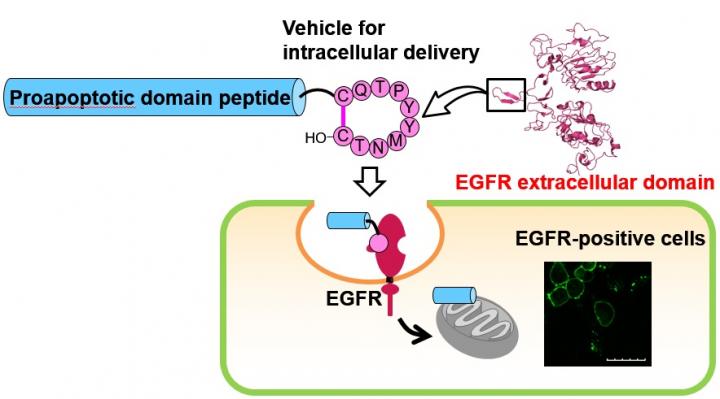
IMAGE

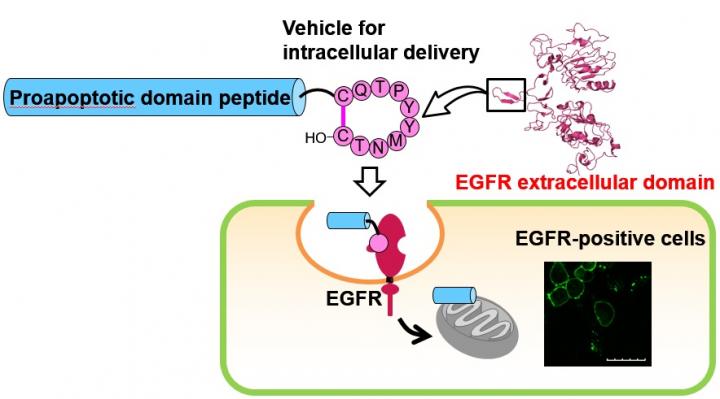
Credit: Department of Medicinal Chemistry,TMDU

Tokyo Medical and Dental University (TMDU) study identifies promising lead compound for delivery of therapeutically effective peptides

Tokyo – In the field of anticancer therapeutics, cationic antimicrobial peptides (AMPs) have gained prominence because of their cytotoxic and anticancer activity in drug-resistant cancer cells. Peptides are compounds consisting of two or more amino acids linked in a chain.

A membrane impermeable proapoptotic domain (PAD) peptide [KLAKLAK]2 is known to be an antimicrobial agent and to cause mitochondrial membrane disruption, followed by cell death. Most AMPs including PAD have antitumor functions because of a multifunctional host defense system of multicellular organisms; however, they cannot penetrate cell membranes, and alone, they have little cytotoxicity.

Previous studies have shown PAD peptides entering cells by their conjugation with cell-penetrating peptides (CPPs). Particularly, a team of Tokyo Medical and Dental University (TMDU) researchers has shown a cyclic decapeptide, termed peptide 1, mimics the dimerization arm of the EGF receptor (EGFR). EGFR is involved in cellular signal transductions and cancer progression, and is overexpressed in many cancer cells. Hence, binding of peptide 1 to EGFR could potentially retard cancer growth.

In its latest study, the team aimed to verify the selectivity of peptide 1 to EGFR and investigated its efficacy as a vehicle for intracellular delivery to cells. The researchers reported their study in Bioconjugate Chemistry.

"As a proof-of-concept study, the cellular delivery of the PAD peptide was challenged by conjugation with peptide 1," study first author Kei Toyama explains. "The cellular uptake of a conjugated peptide 2, composed of peptide 1, the PAD peptide, and a linker cleavable with a protease, was evaluated by treatment of an EGFR-positive lung cancer cell line."

Significant suppression of proliferation by peptide 2 was observed in cell viability assays, whereas conjugate 3, which does not contain peptide 1, had no significantly inhibitory activity in the cell lines. Notably, the PAD peptide alone had no effect on the cells.

"Our findings suggest peptide 1 is a promising lead compound as a new intracellular delivery vehicle for therapeutically effective peptides," senior author Hirokazu Tamamura says. "Also, conjugate 2, with its apoptosis induction activity, can be explored as a new apoptotic peptide that could contribute to the development of anticancer reagents based on the AMP functions."

###

The article, "Delivery of a Proapoptotic Peptide to EGFR-Positive Cancer Cells by a Cyclic Peptide Mimicking the Dimerization Arm Structure of EGFR" was published in Bioconjugate Chemistry at DOI: 10.1021/acs.bioconjchem.8b00250.

Media Contact

Hirokazu TAMAMURA
[email protected]

http://www.tmd.ac.jp/english/

Original Source

http://www.tmd.ac.jp/english/press-release/20180620_1/index.html http://dx.doi.org/10.1021/acs.bioconjchem.8b00250


Share12Tweet8Share2ShareShareShare2

Related Posts

Daily Steps Reduce Sedentary Risks: All of Us

April 7, 2026

Study Predicts 10% Rise in HIV Infections if CDC HIV Testing Funds are Cut, Johns Hopkins Research Shows

April 7, 2026

FGFR1 Halts Ovarian Cancer via Metabolic Shift

April 7, 2026

Breakthrough in Epilepsy Research: Scientists Successfully Reverse Severe Seizures in Lab Mice, Paving the Way for a Potential Cure

April 7, 2026
Please login to join discussion

POPULAR NEWS

  • blank

    Revolutionary AI Model Enhances Precision in Detecting Food Contamination

    98 shares
    Share 39 Tweet 25
  • Promising Outcomes from First Clinical Trials of Gene Regulation in Epilepsy

    51 shares
    Share 20 Tweet 13
  • Imagine a Social Media Feed That Challenges Your Views Instead of Reinforcing Them

    1009 shares
    Share 399 Tweet 249
  • Popular Anti-Aging Compound Linked to Damage in Corpus Callosum, Study Finds

    44 shares
    Share 18 Tweet 11

About

We bring you the latest biotechnology news from best research centers and universities around the world. Check our website.

Follow us

Recent News

Daily Steps Reduce Sedentary Risks: All of Us

Study Predicts 10% Rise in HIV Infections if CDC HIV Testing Funds are Cut, Johns Hopkins Research Shows

Pioneering Multimodal Intelligence to Revolutionize Colonoscopy

Subscribe to Blog via Email

Success! An email was just sent to confirm your subscription. Please find the email now and click 'Confirm' to start subscribing.

Join 78 other subscribers
  • Contact Us

Bioengineer.org © Copyright 2023 All Rights Reserved.

Welcome Back!

Login to your account below

Forgotten Password?

Retrieve your password

Please enter your username or email address to reset your password.

Log In
No Result
View All Result
  • Homepages
    • Home Page 1
    • Home Page 2
  • News
  • National
  • Business
  • Health
  • Lifestyle
  • Science

Bioengineer.org © Copyright 2023 All Rights Reserved.
