


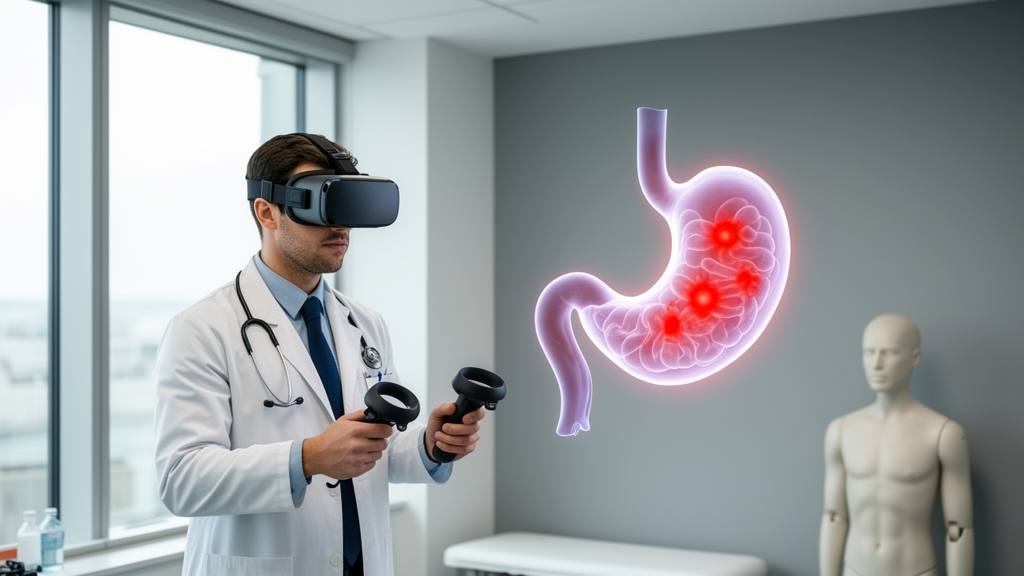
Upper gastrointestinal bleeding is one of the most urgent situations an endoscopist can face: a patient is bleeding inside the stomach or esophagus, and a rapid, highly precise endoscopic intervention is required to stop it. Yet the standard way of training physicians for this procedure has long been problematic. Trainees either practice directly on patients or on living animal models, options that are limited in availability, raise ethical concerns, and come with high costs. A team of German researchers now reports the development and evaluation of an open-source virtual reality simulator, called OPTESK, that lets doctors rehearse the endoscopic treatment of gastric bleeding without any animal material or risk to patients.
The study, published in the journal Bioelectronic Medicine, describes both the technical design of the simulator and the results of a multicenter user study with 44 physicians from more than 20 centers. The acronym OPTESK stands for the German name of the platform, which translates as Open Platform for Animal Material-Free Endoscopic Simulation and Complication Management. Its central idea is deceptively simple: instead of building a custom controller, the system uses a real, commercially available gastroscope from routine clinical practice as the input device for the virtual environment. Sensors attached to the endoscope detect its movements and translate them into movements of a virtual endoscope that the trainee sees through a commercially available head-mounted display.
The hardware setup combines several off-the-shelf and custom-built components. The gastroscope is docked at a 3D-printed station containing a sensor assembly, including an inertial measurement unit mounted on the tip of the insertion tube to track bending. A Meta Quest 3 headset, connected to a gaming laptop, renders the virtual endoscopy room. One controller is attached to the control section of the real endoscope to track its position, while a second controller anchored to the docking station aligns the entire virtual environment with the physical setup. Custom foot pedals with push buttons trigger instrument use during the simulation, and the pedals are made visible to the user through a passthrough window on the virtual floor, which displays a live camera view of the real world. The software was developed in Unity, and the complete package, including 3D printing files, wiring schematics, and software, is publicly available for training and research purposes.
The simulator covers two training scenarios. The second, more demanding scenario simulates a bleeding angiodysplasia that must first be treated with an injection of diluted adrenaline, followed by argon plasma coagulation to achieve hemostatic control. This mirrors the sequence used in real clinical practice, where injection therapy and thermal coagulation are among the standard endoscopic tools for managing upper gastrointestinal bleeding, alongside endoscopic clips and hemostatic powder.
To evaluate the system, the researchers recruited physicians on a voluntary basis at two national German conferences: the Congress of the German Society for Endoscopy and Imaging Techniques in March 2026 and the Congress of the German Society of Internal Medicine in April 2026. Only participants with a specialty in gastroenterology, internal medicine, or surgery with endoscopy experience were included in the final analysis. After signing informed consent, participants completed a tutorial to familiarize themselves with the virtual environment, then performed both treatment tasks while the system recorded task durations, the percentage of treated angiodysplasia area, the correctness of the applied coagulation intensity, and whether hemostatic control was achieved. They then filled out standardized questionnaires on workload and usability, along with Likert-scale items on immersion, face validity, content validity, and cybersickness.
The results paint a largely favorable picture. In the bleeding scenario, 97.4 percent of the 39 participants with complete data successfully achieved hemostatic control. Participants rated the helpfulness of the simulator for training the management of bleeding with a median of 4 on a five-point scale, and face validity questions covering the realism of endoscope movement, stomach anatomy, and application of argon plasma coagulation also received a median of 4. The mean System Usability Scale score was 69.6 out of 100, which the authors describe as good usability, and the mean perceived workload on the NASA Task Load Index was 34.2 out of 100, indicating a low overall burden. Symptoms of cybersickness were minimal, with a median rating of 1.0 on a scale where 1 means none.
Participants were split into 11 less experienced and 33 experienced gastroscopists based on whether they had performed more or fewer than 500 gastroscopies. The experienced group completed both tasks significantly faster: 65.8 seconds versus 98.0 seconds for the non-bleeding task, and 150.4 seconds versus 254.2 seconds for the bleeding task, with p-values of 0.008 and 0.011 respectively. Experienced gastroscopists also achieved higher percentages of treated area and slightly better coagulation intensity scores. This pattern suggests that the simulator’s performance metrics track real-world endoscopic competence, a key requirement for any training tool intended to develop novice skills.
The study was not without caveats, several of which the authors discuss openly. One content validity item stood out: participants rated the simulator’s helpfulness for training experts with a median of only 2, indicating that the current version is seen mainly as a tool for novices rather than seasoned endoscopists. Free-text feedback from 36 participants, analyzed inductively, echoed this. Respondents appreciated the handling of the real endoscope and judged the simulation a good learning tool, but suggested improvements including more realistic argon plasma coagulation effects, better mucosa texture, more realistic injection, improved depth perception, and reduced motion artifacts. The authors also note that the current implementation tracks only rotations of the endoscope, not linear movement, limiting the range of maneuvers that can be practiced, and that the simulator currently covers only angiodysplasias within the fundus of the stomach.
There are also methodological limitations. Recruitment at two large national congresses could introduce selection bias, and the unfamiliar, time-pressured conference environment may have influenced how participants perceived the simulator, although participation was voluntary across multiple days. The subgroup analyses also revealed that the level of immersion mattered: participants reporting higher immersion gave significantly lower workload scores, higher usability scores, and higher realism ratings on half of the face validity questions, leading the authors to argue that immersion should be a high priority in future virtual reality simulator development. The authors call for future work comparing immersive to non-immersive simulators, ideally with performance improvement in real clinical cases as the primary outcome, and for expanding the platform with new pathologies, additional tools, gamification elements, and artificial intelligence assistance.
The broader significance of the work lies in its accessibility. Because OPTESK follows a do-it-yourself, open-source approach, the requirements for setting it up are modest: a computer, an endoscope, and a virtual reality headset, with hardware components printable on any low-cost consumer 3D printer and sensors that can be assembled with minimal electronics knowledge following the provided instructions. The participants themselves were broadly supportive of this direction, with 84 percent agreeing that simulator training should be implemented in endoscopy training and 55 percent believing it should be mandatory before first patient examinations. If validated further, platforms like OPTESK could reduce dependence on animal-based training models, allow risk-free rehearsal before clinical interventions, and help address the persistent shortage of supervised hands-on training opportunities in therapeutic endoscopy.
Subject of Research: Development and multicenter validation of an open-source virtual reality simulator for training endoscopic treatment of upper gastrointestinal bleeding
Article Title: Evaluation of the OPTESK VR training simulator for gastric bleeding treatment
Article References: Köhler, A., Syed, I. A., Theile, J. S., Kafetzis, I., Troya, J., Grunz, J.-P., Denzer, U. W., Grgic, I., Walter, B. M., Pryss, R., Dimitriadis, S., & Hann, A. (2026). Evaluation of the OPTESK VR training simulator for gastric bleeding treatment. Bioelectronic Medicine, 12(1), Article 22. https://doi.org/10.1186/s42234-026-00216-w
Image Credits: AI Generated
DOI: 10.1186/s42234-026-00216-w
Keywords: virtual reality, endoscopy training, upper gastrointestinal bleeding, OPTESK, medical simulation, argon plasma coagulation, gastroscope, construct validity, surgical education, open-source hardware, angiodysplasia, cybersickness
News Source: Denise Maddox. (October 27, 2026). Open-source VR simulator lets doctors practice gastric bleeding treatment risk-free. Scienmag.



