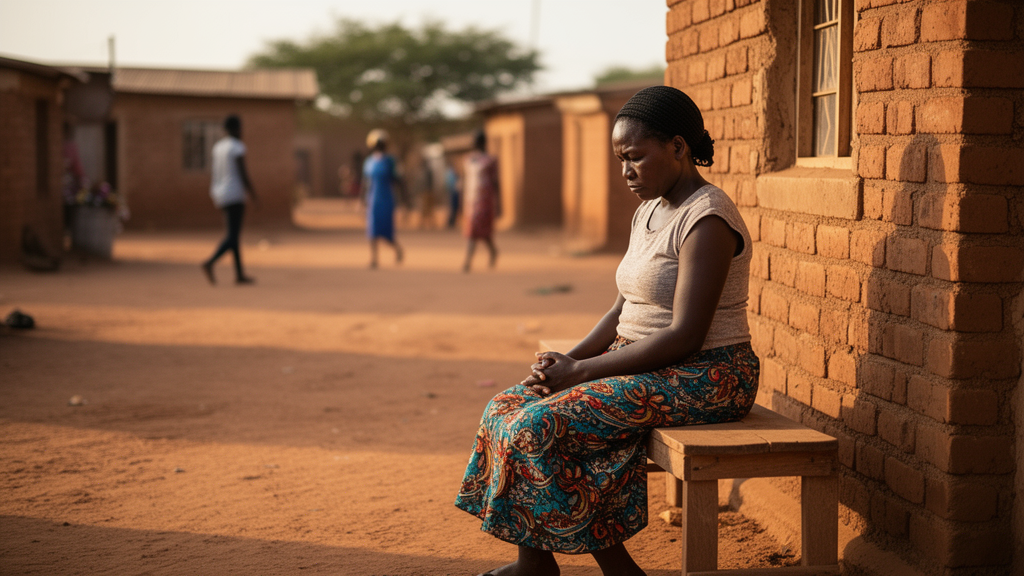
Roughly one in twelve Zambian adults screens positive for probable depression or anxiety, according to a multilevel analysis of the 2024 Zambia Demographic and Health Survey published in BMC Public Health. The study, a secondary cross-sectional analysis covering 26,536 adults aged 15 to 59 years, provides one of the first nationally representative estimates of the mental health burden in the country, where epidemiological evidence has long been scarce despite depression and anxiety ranking among the leading causes of disability worldwide. The researchers defined probable depression as a score of 10 or higher on the nine-item Patient Health Questionnaire (PHQ-9), and probable anxiety as a score of 6 or higher on the seven-item Generalized Anxiety Disorder scale (GAD-7).
A composite binary outcome counted as positive if either threshold was met. Overall prevalence of depression and/or anxiety stood at 8.2 percent, with a 95 percent confidence interval of 7.8 to 8.6 percent. Prevalence climbed steadily with age, from 4.2 percent among those aged 15 to 19 years to 11.5 percent in the 40 to 44 year group.
Some of the starkest contrasts appeared across lifestyle and adversity measures. Among adults who reported daily alcohol consumption, prevalence reached 35.5 percent, more than four times the national average. Women who had experienced sexual violence showed a prevalence of 16.7 percent, compared with 8.2 percent among those who had not, a difference the authors report as statistically significant at p < 0.001.
Adults who were widowed, divorced, or separated had a prevalence of 12.5 percent. Geography mattered as well: provincial prevalence ranged from 3.3 percent in North-Western Province to 14.4 percent in Copperbelt Province, a more than fourfold spread across the country. To disentangle individual risk factors from the influence of where people live, the team fitted two-level random-intercept multilevel logistic regression models, using survey clusters as the grouping factor.
In the fully adjusted model, daily alcohol consumption emerged as the strongest risk factor, with an AOR of 3.74 (95 percent CI: 2.25 to 6.21), followed by HIV-positive status at an AOR of 1.71 (95 percent CI: 1.30 to 2.26) and older age, with adults aged 40 to 44 years showing an AOR of 2.56 (95 percent CI: 1.99 to 3.28) relative to the youngest group. Two factors appeared protective. Female sex was associated with lower odds of screening positive, with an AOR of 0.70, and being married carried an AOR of 0.85.
These adjusted associations held after accounting for other measured characteristics, though as with any cross-sectional analysis, the design captures associations at a single point in time and cannot establish causal direction. One of the study's central contributions is its quantification of community-level clustering. Strikingly, this clustering barely changed after full statistical adjustment: the ICC remained at 0.113, and a likelihood ratio test confirmed the residual community variation was significant (χ² = 247.64, p < 0.001).
In other words, the measured individual characteristics explained almost none of the geographic variation, leaving unobserved community-level determinants as a major open question. The authors argue the findings carry direct policy implications. Because HIV-positive status was independently associated with higher odds of depression or anxiety, they recommend integrating mental health screening into HIV care and chronic disease platforms.
The scale of the underlying survey lends the estimates considerable weight. The multilevel framework goes beyond simple prevalence mapping by explicitly modelling how risk is distributed across individuals and communities. Limitations remain.
Screening thresholds identify probable, not clinically confirmed, cases. The persistence of community-level clustering after adjustment suggests that unmeasured factors, whether social, economic, or environmental, shape mental health outcomes in ways current survey instruments do not capture. The authors propose that future research should pursue longitudinal designs to examine causal pathways, investigate the community-level determinants driving geographic variation, and evaluate the effectiveness of integrated mental health interventions in routine healthcare settings.
For now, the study establishes a national baseline: approximately one in twelve Zambian adults experiences probable depression or anxiety, with risk concentrated among daily drinkers, people living with HIV, older adults, and residents of specific provinces.
Subject of Research: National prevalence and risk factors for depression and anxiety among adults in Zambia
Article Title: Prevalence and factors associated with depression and/or anxiety among adults in Zambia using the 2024 Zambia demographic and health survey: a multilevel analysis
Article References: Mutasha, S., Simukoko, D., Shawa, J., & Moonga, G. (2026). Prevalence and factors associated with depression and/or anxiety among adults in Zambia using the 2024 Zambia demographic and health survey: a multilevel analysis. BMC Public Health. https://doi.org/10.1186/s12889-026-29208-w
Image Credits: AI Generated
DOI: 10.1186/s12889-026-29208-w
Keywords: Zambia, depression, anxiety, PHQ-9, GAD-7, multilevel analysis, demographic and health survey, HIV, alcohol consumption, mental health screening, community-level clustering, public health
News Source: Glenn Wilkins. (October 28, 2026). One in Twelve Zambian Adults Shows Signs of Depression or Anxiety, National Survey Finds. Scienmag.