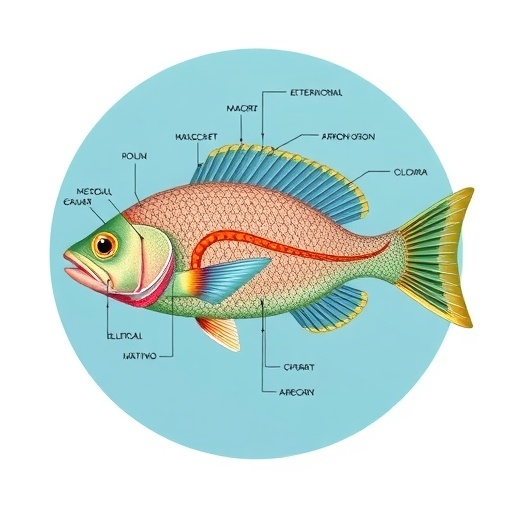
In an illuminating breakthrough from Osaka Metropolitan University, researchers have uncovered a sophisticated neural integration mechanism in zebrafish that blends visual cues from both the eyes and the pineal organ—a unique “third eye”—to finely control swimming behavior based on subtle differences in light wavelength. This discovery peels back layers of complexity in how aquatic animals navigate their environments by interpreting not just visible but ultraviolet light, with significant implications for understanding sensory processing and neural circuit function.
The aquatic environment presents an intricate light landscape that varies dynamically with depth, water clarity, and exposure to sunlight or shade. Unlike terrestrial animals that primarily rely on visible light, many aquatic species, including zebrafish, respond to a wider spectrum including ultraviolet wavelengths. The ability to decode these visual cues enables fish to make critical survival decisions, such as ascending or descending in the water column, evading predators, or seeking optimal feeding zones. Yet, the neural substrates and pathways allowing such nuanced multispectral perception remained elusive—until now.
Central to this mechanism is parapinopsin 1 (PP1), a light-sensitive opsin protein expressed in the pineal organ of zebrafish. Opsins traditionally serve as the foundation of photoreception in eyes, triggering responses to incident photons. The PP1 opsin is uniquely tuned to discriminate between ultraviolet and visible light, exhibiting opposing neural activation patterns in response to these wavelengths. The research group employed calcium imaging—a technique that captures neuronal activation through calcium ion flux visualization—to monitor neural responses in live transparent zebrafish larvae, a model that allowed unprecedented access to intact neural circuits in action.
By tracking calcium fluorescence, the team demonstrated that PP1-activated signals in pineal photoreceptor cells travel through specific ganglion cells to reach the midbrain’s tegmentum region. This critical tegmental area was identified as the neural hub where visual inputs from the paired eyes converge with the pineal organ’s chromatic information. This dual-source integration orchestrates behavioral decisions, specifically modulating the vertical position of the fish’s swim trajectory in response to the detected light spectrum. Such integration highlights the brain’s remarkable capacity to synthesize multisensory data streams for adaptive motor output.
Functional validation of this pathway was achieved by genetically modifying zebrafish to lack the PP1 gene. These knockout fish displayed a striking absence of typical behavioral responses to wavelength shifts, confirming the indispensability of PP1-mediated pineal photoreception in driving natural vertical swimming modulation. The rigor of these findings underscores the tegmentum’s role as a decision-making center that processes photic information beyond traditional ocular inputs, expanding the concept of vertebrate sensory integration.
The discovery that zebrafish leverage both ocular and extraocular photoreception for behavioral regulation broadens our understanding of evolutionary adaptations in sensory systems. This study compellingly reveals that pineal photoreception is not merely a circadian or hormonal modulator but actively informs movement strategies by encoding spectral light composition. Such insights may stimulate comparative analyses across vertebrates to explore conserved or divergent neural circuit architectures mediating multisource light detection.
Furthermore, the technical prowess demonstrated with in vivo calcium imaging in transparent zebrafish larvae sets a compelling precedent for dissecting neural circuits with precision. By visualizing activity within intact brains, researchers can pinpoint where and how sensory signals are integrated to produce behavioral outputs—a methodological leap forward that offers new dimensions to neuroethological investigations.
Beyond enhancing fundamental neuroscience, these findings hold translational promise, particularly in the burgeoning field of optogenetics. Given that PP1 acts as a naturally occurring light sensor with distinct spectral preferences, it presents an attractive candidate for engineering neural control tools. Such PP1-based optogenetic applications could enable targeted modulation of neural circuits with wavelength-specific light, potentially revolutionizing approaches to treating neurological disorders or restoring sensory functions.
This research also contributes to a broader narrative about how organisms interpret their environments through multisensory integration, offering a neurobiological lens on decision-making processes. The tegmentum’s integration of ocular and pineal inputs illustrates a sophisticated computation that balances diverse photic signals, guiding swim behaviors crucial for ecological success. It challenges existing models that prioritize eyes as sole photoreceptors, proving that non-ocular photoreception plays active roles in behavioral control.
As the scientific community delves deeper into the neural underpinnings of behavior, these findings from zebrafish serve as a compelling reminder of nature’s ingenious solutions to environmental challenges. The interplay of UV and visible light detection through distinct photoreceptors and their convergence in brain regions dedicated to decision-making exemplifies an elegant neurobiological design. Anticipated future studies may map downstream circuits from the tegmentum to motor centers, unraveling the complete sensorimotor pathways orchestrating vertical navigation.
In summary, the work by Professors Terakita, Koyanagi, and their colleagues at Osaka Metropolitan University unfolds a fascinating chapter in sensory neuroscience. It reveals how zebrafish integrate genomic, cellular, and circuit-level processes to decode complex light information, ultimately regulating essential survival behaviors. This nuanced orchestration between eye and pineal organ photoreception, translated through midbrain circuits, opens new frontiers in understanding vertebrate neuroethology and potential biomedical applications.
Subject of Research: Animals
Article Title: Neural circuits for decision making based on pineal photoreception in zebrafish
Web References: http://dx.doi.org/10.1073/pnas.2520290123
References: Terakita, A., Koyanagi, M., Wada, S., et al. Neural circuits for decision making based on pineal photoreception in zebrafish. Proceedings of the National Academy of Sciences. DOI:10.1073/pnas.2520290123
Image Credits: Osaka Metropolitan University
Keywords: zebrafish, pineal organ, parapinopsin 1, opsin, photoreception, ultraviolet light, visible light, tegmentum, neural circuit integration, calcium imaging, optogenetics, behavioral neuroscience
Tags: aquatic environment light dynamicsaquatic sensory processingfish swimming behavior controllight wavelength impact on fish behaviormultispectral visual cues in aquatic animalsneural circuits in underwater navigationopsin proteins in fishparapinopsin 1 functionpineal organ photoreceptionthird eye sensory mechanismsultraviolet light navigation in fishzebrafish neural integration