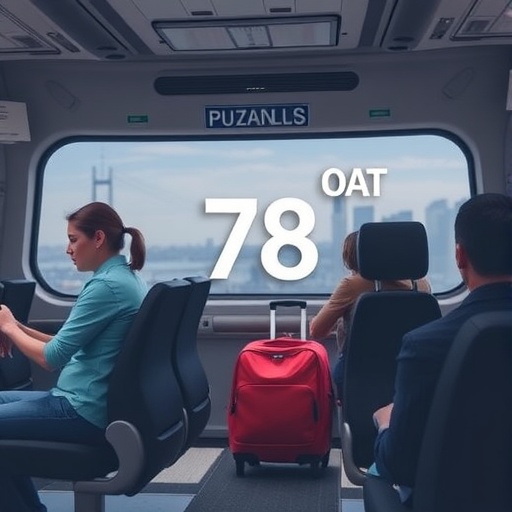
In an enlightening global study that stretches across 43 countries and encompasses over half of the world’s population, researchers from the Institute of Environmental Science and Technology at the Universitat Autònoma de Barcelona and McGill University in Canada have revealed a striking regularity in human travel behavior. Their findings show that irrespective of geographic location, economic status, or transport mode, people consistently spend about 1.3 hours, or 78 minutes, traveling each day. This steadfast temporal boundary holds a crucial key to understanding global energy consumption patterns and offers powerful insights on how urban planning and policy can mitigate future energy demands in transportation.
The phenomenon of convergent travel time is rooted in a complex interplay of psychological and practical factors. Psychologically, individuals seem to possess a deep-seated inclination to allocate roughly the same amount of time to travel daily, balancing their desire to explore their surroundings with the constraints imposed by the need for efficient living time allocation. Practically, physical and temporal limitations restrict the amount of time commuters can dedicate to transit, establishing a nearly uniform ceiling for travel durations globally. This balance remains largely unperturbed regardless of improvements in transportation speed or efficiency.
What emerges from the study is a profound counterintuitive insight: improving vehicle speed and fuel efficiency does not reduce the overall time people spend traveling but rather increases the distance they cover within that constant time frame. This behavioral adaptation drives energy use upwards because despite traveling more efficiently per kilometer, the total energy consumption rises as people exploit higher speeds to access destinations further afield. The research stresses that examining energy use on a per-hour basis rather than per-kilometer basis is far more critical in assessing the future trajectory of transport energy demands.
This reframing compels urban planners and policymakers to rethink strategies aiming to reduce transportation-related carbon footprints. The traditional focus on vehicle efficiency—such as improving fuel technologies and vehicle aerodynamics—while important, may have a limited effect on total energy consumption if people continue to travel the same amount of time and simply expand their travel distances. Hence, future policy must prioritize restructuring urban environments to facilitate low-energy travel modes that align with fixed travel time habits.
For example, the study’s authors illustrate the outsized impact of transport modes through a comparative lens: a city where public transit, like a light rail system, is the primary mode of travel still consumes approximately five times more energy than a city where movement is predominantly on foot. More starkly, urban areas heavily dependent on internal combustion engine vehicles could use up to 100 times more energy per person than pedestrian-oriented cities, making a compelling case for radical urban and transport planning reforms.
Addressing this energy efficiency paradox involves promoting and enabling shifts toward modes of transport that inherently consume less energy per hour of travel. Walking, cycling, and electric-powered public transportation are highlighted as the prime candidates to curtail energy demands without forcing people to reduce their travel time, which behavioral evidence shows to be impractical. Facilitating these modes demands integrated strategies encompassing infrastructure development, urban design conducive to non-motorized mobility, and incentives that realign individual travel habits with sustainable energy goals.
Moreover, the study provides a predictive framework for how societies might adapt to new technologies and policies. Since people maintain a relatively static amount of travel time, any changes in transport systems will primarily alter the distribution of that travel time across different modes, consequently impacting total energy use. This predictable behavioral consistency offers a valuable tool for modeling future scenarios and testing the efficacy of interventions before their large-scale implementation.
This nuanced understanding of travel behavior and energy consumption challenges the traditional assumptions underlying many transportation policies. Instead of focusing primarily on technological fixes, solutions must increasingly grapple with human behavior patterns and urban spatial organization. In doing so, they can create resilient and sustainable systems that harmonize energy efficiency with the innate human propensity for travel.
The implications of this research extend into broader discussions about climate change mitigation. Transportation remains a significant contributor to global greenhouse gas emissions, and understanding fundamental determinants of transport energy consumption is vital to formulating effective carbon reduction strategies. By recognizing that travel time per capita is a nearly fixed quantity, climate policies can better tailor interventions to promote sustainable travel modes selectively.
Urban studies and environmental policy experts will find this study’s conclusions particularly impactful in guiding future research and practice. Embedding these insights into city planning can lead to transformative changes—designing urban environments that reduce dependence on energy-intensive transport and encourage active modes of travel without sacrificing accessibility or convenience.
Finally, this research underscores an essential truth: the fight against climate change and unsustainable energy use in transport sectors is not solely a matter of innovation in vehicle technology but equally a matter of understanding human time-use behavior and crafting environments that amplify low-energy transport choices. Only by integrating these dimensions can future societies hope to bend the curve of rising energy consumption and achieve long-term sustainability in mobility.
Subject of Research:
Not applicable
Article Title:
Energy use per hour is key determinant of future transport energy consumption
News Publication Date:
24-Oct-2025
Web References:
http://dx.doi.org/10.1088/1748-9326/ae1246
Keywords:
Transportation, Energy, Climate change mitigation, Anthropogenic climate change, Environmental issues, Time management, Urban studies
Tags: commuting patterns across countriesconvergence of travel habits globallydaily commuting time statisticsefficiency in urban transit systemsenergy consumption in transportationglobal travel behavior patternsimpact of living standards on travelimplications of travel time on quality of lifeinternational travel time comparisonpsychological factors in travel behaviortime allocation in daily lifeurban planning and transportation policies