Credit: OIST
The Okinawa Institute of Science and Technology Graduate University (OIST) has signed a Memorandum of Understanding (MOU) with the Ministry of Environment and Energy (MEE) of the Republic of Maldives and Kokyo Tatemono Company Limited (Kokyo) of Tokyo, Japan, to embark on a wave energy project in the Maldives.
The project involves testing prototype Wave Energy Converter units (WEC-units) in the Maldives with the aim of supplying sustainable energy and reducing carbon emissions, in collaboration with MEE and the Government of the Maldives.
This experiment is to be principally conducted with invaluable assistance and cooperation of MEE, as well as Holiday Inn Resort Kandooma at South Male Atoll, Maldives.
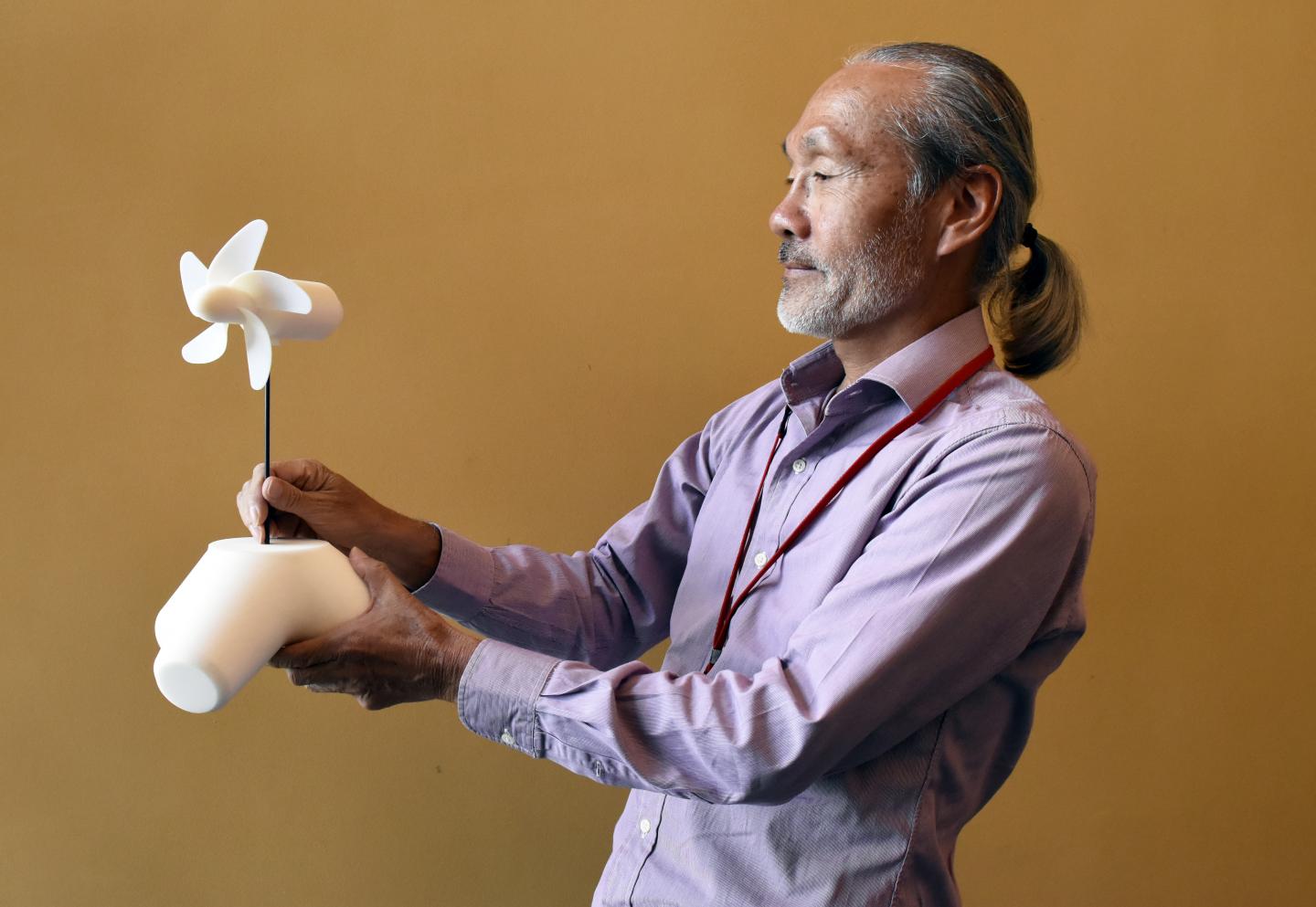
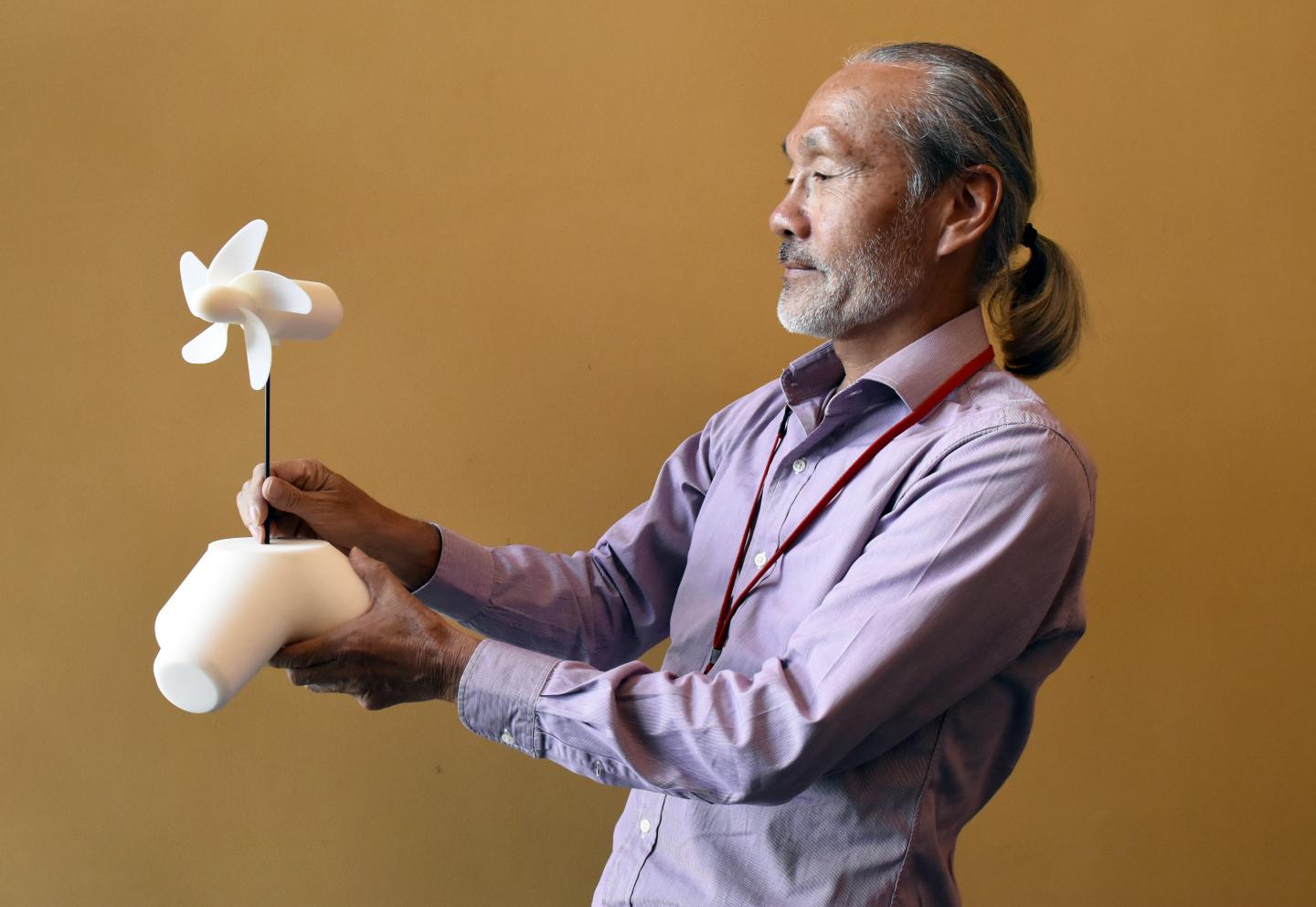
Professor Tsumoru Shintake, leader of the Quantum Wave Microscopy Unit, OIST, and his colleagues designed special WEC-units which can capture energy from surf waves along the shore-line and convert it into usable electricity, as part of the wave energy project which was launched in 2013.
Prof. Shintake's WEC-units have been carefully designed, taking inspiration from nature: the blade design and materials are inspired by dolphin fins and the flexible posts resemble flower stems. The units are built to withstand forces from breaking waves. They are also safe for sea-creatures, with the blades rotating at a carefully calculated speed that allows them to avoid the blades. One of the principal features of the WEC-units is that the generating turbines are designed to be located at the mean sea level to harness the wave energy most effectively.
The experiment in the Maldives will involve installing two half-scaled WEC prototypes, with 0.35-meter diameter turbines. For simplicity, the prototype blade is not yet a flexible design but is made from high-tension duralumin. The prototypes will be installed about 50 meters offshore along the shoreline of the Southeastern part of Kandooma Island. The location has been carefully selected for its low environmental and visual impact — it is shallow with no living coral and it is situated behind a hotel, away from surfers and divers.
"The Maldives is an ideal place to test our Wave Energy Converters for three reasons," says Prof. Shintake. Firstly, the Maldives needs new ways to generate electricity. Consisting of approximately 1,200 islands, there is no central power plant or way to transmit energy between islands. Currently, each inhabited island must generate its own energy supply, usually by burning fossil fuels.
Secondly, the Maldives has a vested interest in finding renewable energy sources and reducing carbon emissions. Since the Maldives is an archipelago nation made out of atolls, in which each and every island is elevated only a few meters above sea level, the islands might be possibly influenced by the current global warming environment, and are facing a certain geophysical impact, i.e. the gradual rising of the sea level.
"The Maldives is a symbol of global climate change," says Prof. Shintake.
Thirdly, the location of the Maldives makes it a suitable place to harness wave energy. The Maldives receives a constant stream of waves which have propagated across the Indian ocean from the South Pole. Unlike Okinawa, the Maldives is not a hurricane or typhoon region, so the WEC units are at low risk of damage from extreme weather conditions.
Wave energy is the most suitable form of renewable energy for the Maldives. The fact that wave power provides a continuous stream of energy gives it a major advantage over other types of renewable energy, such as solar panels which cannot generate electricity at night. This reduces the requirement for energy storage systems which can be large and expensive to develop. This is particularly important in a location like the Maldives that has many hotels and remote villages. In the hotels, facilities running throughout the night, such as laundry, desalination water plants, and air-conditioners, are one of the biggest sources of energy consumption.
The prototype WECs are currently being shipped to the Maldives and are scheduled to be installed in April 2018. The researchers will monitor the wave energy generation from the power house on the island, as well as remotely from Japan using web cameras.
This initial trial will be followed by two full-scaled prototype models with 0.7-meter diameter turbines which will be installed in September 2018. In the long term, the hope is to eventually diffuse full-scaled production models of wave energy convertor units throughout the Maldives.
From one island to another, this transfer of wave convertor technology is a step towards a greener future that embraces renewable energy.
###
Media Contact
Kaoru Natori
[email protected]
81-989-662-389
@oistedu
http://www.oist.jp/
Original Source
https://www.oist.jp/node/32536/