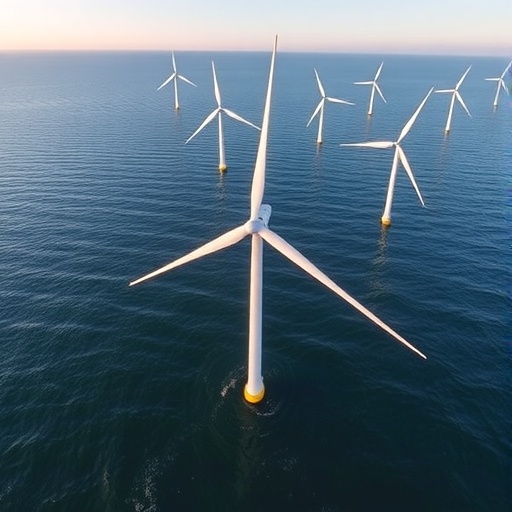
In a remarkable breakthrough poised to transform the renewable energy landscape, researchers led by Xie, Tian, and Gu have unveiled a pioneering approach to offshore wind farm integration that significantly enhances grid flexibility and renewable energy penetration. Centered on a real-world case study from Eastern China, this novel framework demonstrates how offshore wind farms can evolve from isolated power generators into dynamic, synergistic aggregators—effectively harnessing their potential to stabilize and strengthen electrical grid operations. This advancement marks a major leap toward the global imperative of maximizing renewable energy’s role while addressing the intermittency and variability challenges that have historically hindered large-scale green energy adoption.
At the heart of this transformation lies a comprehensive strategy that reimagines offshore wind infrastructure not just as energy producers but as integral grid assets with the capacity for multi-dimensional coordination. The study delineates a finely tuned aggregation model wherein multiple offshore wind farms operate collaboratively, sharing data, forecasting capabilities, and power dispatch strategies. This harmonized operation enables the smoothing of output fluctuations caused by erratic wind patterns, thereby facilitating a more predictable and manageable integration of renewable power into the broader electrical grid. The improved predictability is vital in maintaining grid stability, reducing reliance on fossil-fuel backup plants, and enabling higher renewable penetration rates without jeopardizing supply security.
Technically, the research incorporates advanced control algorithms and grid-responsive technologies to create an intelligent offshore wind aggregation platform. This platform employs machine learning models to analyze meteorological data and power output variability in real time, delivering precise short-term wind power forecasts. By embedding these predictive capabilities within the aggregation framework, operators can optimize energy dispatch schedules and dynamically adjust output according to grid demand and operational constraints. Such proactive management drastically reduces the risks of frequency deviation and voltage instability that often plague renewable-rich power systems. The Eastern China project exemplifies this approach, leveraging high-resolution atmospheric modeling combined with real-time data analytics to predict and respond to wind power variability on scales ranging from minutes to days.
Moreover, the integration model emphasizes the strategic coupling of offshore wind farms with grid-scale energy storage systems, including battery banks and pumped hydro storage, to buffer intermittent supply. This hybrid approach allows excess wind power generated during high-wind periods to be stored and subsequently dispatched during lulls in wind speed, thus leveling energy supply curves. This synergy between wind farms and energy storage enhances overall grid flexibility, enabling operators to adjust supply seamlessly to meet fluctuating demand profiles. The researchers highlight that, in the Eastern China context, this coupling has the potential to reduce curtailment—where excess wind energy is wasted—by up to 30%, significantly improving the economic viability of offshore wind investments.
Beyond technical refinements, the study addresses the socio-economic and regulatory frameworks necessary to unlock the full benefits of offshore wind aggregation. The authors advocate for adaptive market mechanisms that reward grid flexibility services rendered by aggregated wind farms. For instance, they propose novel tariff structures and incentives for wind farm operators who actively participate in grid balancing, frequency regulation, and reserve capacity provisioning. Such market reforms are critical to align commercial motivations with system-wide reliability objectives and to encourage technological innovations centered on grid-friendly renewable operation. The Eastern China example serves as a policy laboratory, where emerging regulatory experiments can be observed and adapted globally.
Crucially, the research underscores the scalability and replicability of the aggregation model beyond its initial geographic scope. While the pilot project focuses on the Eastern coastal seaboard—a region characterized by dense population centers, fast-growing electricity demand, and abundant offshore wind potential—the principles laid out are applicable to other global regions with substantial offshore wind resources, including Europe’s North Sea, the US Atlantic coast, and parts of Southeast Asia. The aggregation model’s modular architecture facilitates incremental deployment, allowing grids of various maturity levels to progressively incorporate the benefits of coordinated offshore wind operation without overhauling existing infrastructure.
From an environmental perspective, the transformation of offshore wind farms into synergistic aggregators aligns with worldwide efforts to reduce greenhouse gas emissions by maximizing renewable utility. By directly tackling grid integration challenges, this model promotes higher renewable energy shares and diminishes dependence on fossil fuel peaking plants that are carbon intensive and often inefficient. The study’s findings indicate that such advanced integration could help reduce carbon emissions by several million tons annually in regions adopting the framework at scale, contributing materially to international climate targets mandated by agreements such as the Paris Accord.
On the technical implementation side, the research also delves into the communication and cyber-physical systems underpinning the aggregator concept. Secure, high-bandwidth communication networks linking offshore wind farms enable real-time data exchange essential for synchronized operation. The authors detail the integration of edge computing architectures with cloud-based control centers, which collectively handle the vast data streams from sensors, weather stations, and grid monitors. This architecture ensures rapid decision-making cycles, minimizes latency, and enhances resilience against system faults or cyberattacks—factors critical in mission-critical energy infrastructure.
The interdisciplinary methodology employed by the research team combines expertise in power systems engineering, meteorology, control science, and economics. By converging these domains, the study offers a holistic perspective on offshore wind integration challenges and solutions, advancing beyond conventional siloed approaches. The comprehensive simulation platform developed for the Eastern China case integrates detailed aerodynamic modeling of wind turbines, grid power flow calculations, market behavior simulations, and climate impact assessments—an ambitious synthesis that sets a new benchmark for renewable energy research.
Importantly, this work opens stimulating avenues for future research in offshore renewable energy integration. For instance, extending the aggregation concept to hybrid offshore platforms incorporating floating solar photovoltaics, hydrogen electrolyzers, and marine energy converters could further diversify and stabilize renewable supply vectors. Additionally, artificial intelligence enhancements to grid forecasting and control systems promise to elevate the operational intelligence of offshore aggregators to unprecedented levels, potentially enabling autonomous grid services adapted in real-time to evolving conditions.
The Southeast Asian and Western Pacific regions stand to benefit substantially from such integrative offshore wind frameworks as they experience rapid energy demand growth coupled with strong wind resource availability offshore. International collaboration based on the Eastern China prototype could accelerate knowledge exchange, tech transfer, and joint investments necessary to realize resilient, scalable green power networks in these emerging markets.
While challenges remain—such as addressing uncertainties in extreme weather impacts on offshore assets, ensuring cybersecurity robustness, and managing environmental impacts on marine ecosystems—the demonstrated successes of the synergistic aggregator model in Eastern China offer a compelling roadmap. Energy stakeholders ranging from utilities and policymakers to technology developers are already taking notice, laying the ground for these concepts to transition from academic innovation to widespread commercial adoption.
The implications of transforming offshore wind farms into synergistic aggregators extend well beyond electricity markets. By enhancing grid flexibility, this integration supports broader societal electrification efforts, including electric vehicle charging infrastructure, green hydrogen production, desalination plants, and other emerging energy-dependent technologies. This multi-sector coupling underscores the strategic importance of advanced offshore renewable integration in powering resilient, sustainable economies of the future.
As offshore wind continues its rapid expansion worldwide, breakthroughs such as the one hailed from Eastern China illuminate pathways to greater system intelligence, operational synergy, and renewable energy integration. This research not only advances technical frontiers but also catalyzes a paradigm shift—envisioning offshore wind farms as proactive, coordinated entities that drive forward a cleaner, more stable, and economically viable energy future. The global renewable energy community eagerly awaits further developments arising from this seminal work, which promises to reshape the quest for carbon-neutral power systems.
Subject of Research: Integration and aggregation of offshore wind farms to enhance renewable energy penetration and grid flexibility.
Article Title: Transforming offshore wind farms into synergistic aggregators to enhance renewable integration and grid flexibility—an Eastern China example.
Article References:
Xie, D., Tian, Z., Gu, C. et al. Transforming offshore wind farms into synergistic aggregators to enhance renewable integration and grid flexibility—an Eastern China example. Commun Eng (2025). https://doi.org/10.1038/s44172-025-00563-7
Image Credits: AI Generated
Tags: collaborative offshore wind operationsdata sharing in energy managementEastern China renewable energy case studyelectrical grid stability enhancementsgreen energy adoption challengesgrid flexibility improvementmulti-dimensional coordination in energyoffshore wind farm integrationpower dispatch optimizationrenewable energy intermittency solutionsrenewable energy penetration strategiessynergistic energy aggregators