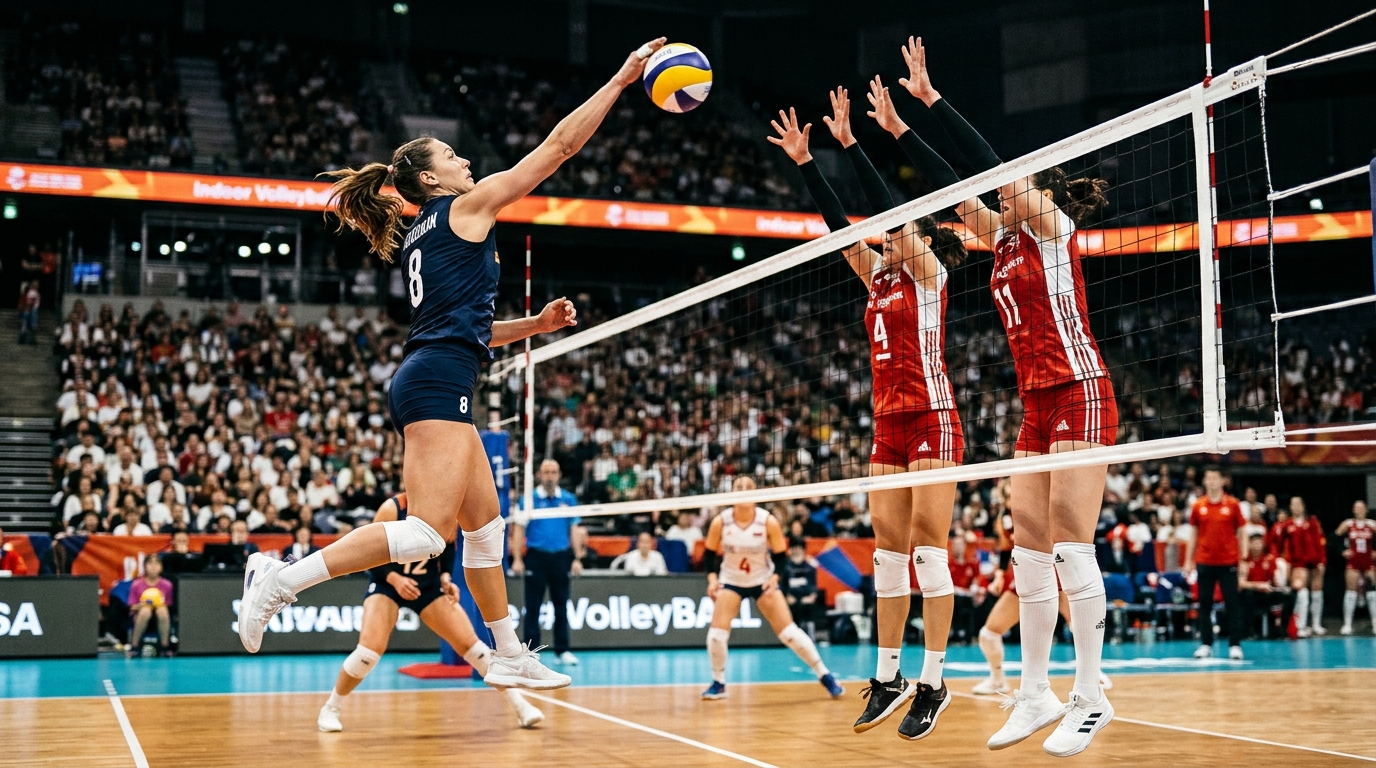
Analysis of 3,798 offensive sequences from five elite women’s volleyball national teams reveals that teams can be categorized into three distinct offensive-style clusters—offensive, defensive, and balanced. These offensive styles demonstrate significant variations in on-court match behaviors, while fast attack tempo and attack type consistently predict attack outcomes across each style.
The study, conducted by researchers Yuwei Shen and Qing Yang, was designed to identify offensive-style clusters among elite international squads and examine whether specific match behaviors and performance predictors diverge across those tactical classifications.
To classify the squads, the authors performed a hierarchical cluster analysis based on the proportions of three attack outcomes—scoring, error, and continuation—across all included offensive sequences. This procedure separated the teams into the offensive, defensive, and balanced clusters. Differences in offensive behaviors among these clusters were subsequently evaluated using chi-square tests with Bonferroni-adjusted post-hoc comparisons.
The comparative analysis revealed statistically significant differences among the three clusters across setting zone, attack tempo, attack zone, attack type, and opposing blocking formation. To explore how these behavioral variables influenced attacking success within each cluster, the researchers conducted multinomial logistic regression analyses to determine predictors of attack effect.
The regression models identified fast tempo and attack type as the most consistent predictors of attack effect across all styles. Fast tempo was associated with higher scoring odds in all three clusters, and diagonal and parallel attacks were linked to higher scoring odds than off-speed attacks. However, diagonal and parallel attacks were also associated with higher error odds in the offensive and balanced clusters, while offensive teams unexpectedly experienced lower scoring odds in no-block situations. The authors concluded that the findings underscore the importance of tempo control, attack-type selection, and context-specific decision-making under differing blocking conditions.
The peer-reviewed paper was published in BMC Sports Science, Medicine and Rehabilitation, with the authors noting that clinical trial registration was not applicable to the study.
Subject of Research: Offensive style clusters and match behaviors in elite women's volleyball
Article Title: Does offensive style engender distinct match behaviors? A case study of the top women’s volleyball national teams
Article References: Shen, Y., & Yang, Q. (2026). Does offensive style engender distinct match behaviors? A case study of the top women’s volleyball national teams. BMC Sports Science, Medicine and Rehabilitation. https://doi.org/10.1186/s13102-026-02216-4
Image Credits: AI Generated
DOI: 10.1186/s13102-026-02216-4
Keywords: women's volleyball, sports analytics, offensive tactics, hierarchical cluster analysis, attack tempo, multinomial logistic regression, performance analysis, Does, offensive, style, engender, distinct
News Source: Ophelia Keating. (November 6, 2026). Offensive-Style Clusters Differ in Match Behaviors in Elite Women’s Volleyball Teams. Scienmag.