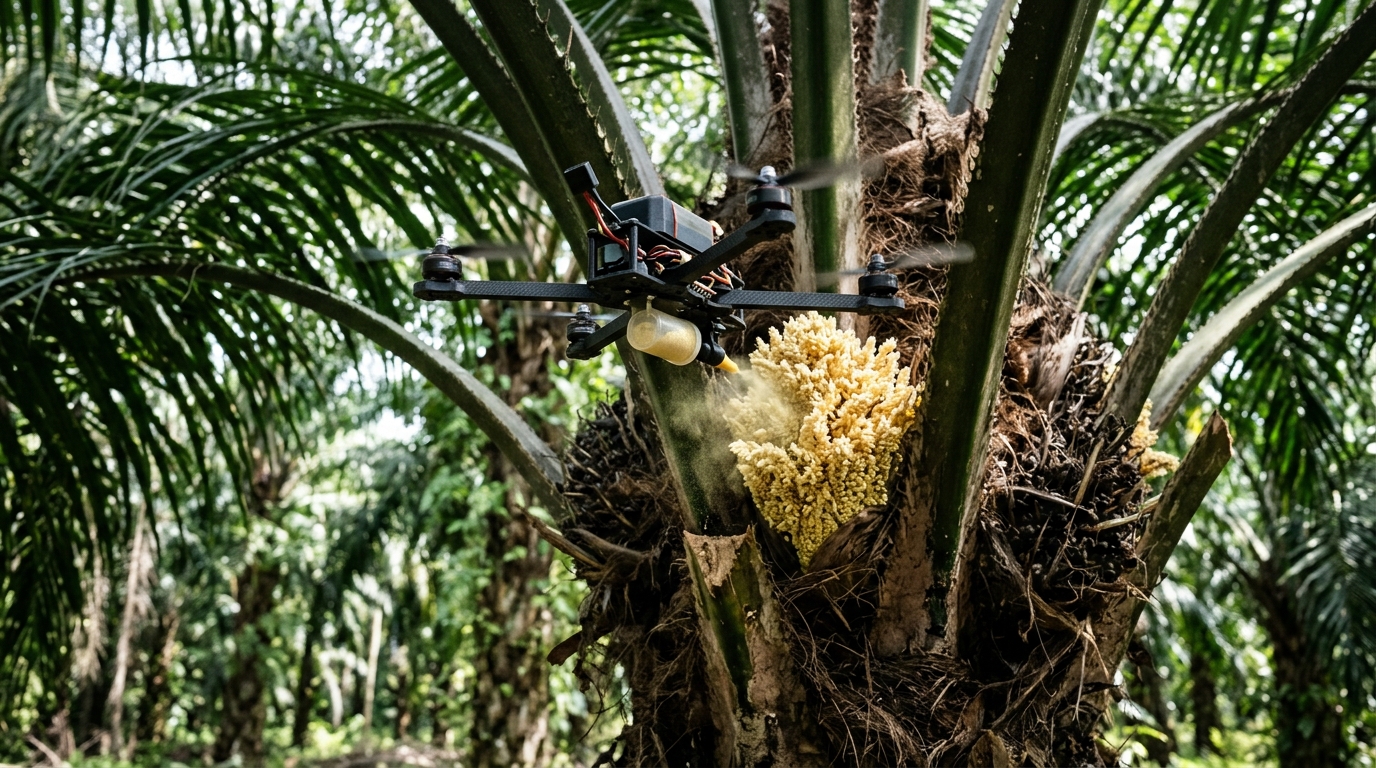
Agricultural engineers have developed an autonomous pollination support system that couples a compact unmanned aerial vehicle with an external artificial intelligence computing terminal, achieving an 88.23 percent normal fruit set during field evaluations in an oil palm plantation. Published in Smart Agricultural Technology, the investigation addresses a longstanding operational bottleneck in tropical agriculture, where commercial yields of oil palm heavily depend on the efficacy of pollination across extensive cultivation acreage. Conventional operations rely on natural insect pollinators such as the weevil Elaeidobius kamerunicus alongside extensive manual pollination crews. However, these traditional approaches remain vulnerable to adverse environmental conditions, fluctuations in insect populations, shortages in field labor, and inconsistent mechanical pollen application across vast and challenging agricultural terrains. By moving computationally demanding computer vision and mission decision algorithms off the aerial vehicle and housing them within an intelligent ground controller, the engineering team demonstrated that a lightweight 3.5-inch aerial platform can execute complex agricultural flight workflows without carrying expensive or power-hungry onboard computing units.
Autonomous flight underneath dense agricultural canopies introduces severe robotic challenges that standard aerial mapping and broadcast spraying systems rarely confront. In mature oil palm plantations, tree crowns form overlapping vegetative canopies that severely degrade global navigation satellite system reception through physical signal attenuation and multipath distortions, preventing reliance on global positioning coordinates for close-proximity navigation. Furthermore, commercial groves feature visually repetitive geometric patterns of tree trunks measuring between 1 and 5 meters in height and up to 152 centimeters in circumference, interspersed with drooping fronds that present immediate collision hazards. Standard positioning techniques cannot provide the sub-meter precision required to maneuver within reach of reproductive plant structures. To overcome these constraints, the researchers structured their robotic operational framework into seven distinct sequential stages: aerial tree geo-tagging, satellite-guided waypoint approach, vision-based obstacle avoidance, transitional switching from global navigation to visual servoing, close-range trunk-guided approach, circumferential orbiting inspection, and targeted pollen discharge.
To bypass the weight, heat, and power penalties associated with mounting advanced graphics processing hardware directly on the airframe, the platform utilizes an asymmetric computational partition. High-level image inference, coordinate transformations, mission logic, and navigation control operate within Robot Operating System 2 on a ground-based NVIDIA Jetson Nano P3450 embedded into an intelligent remote controller. The physical drone consists of a compact SpeedyBee 3.5-inch carbon frame equipped with four SB-2006 1950KV brushless motors, a Mateksys H743V4 flight controller running ArduPilot firmware, an MTF-01 optical-flow sensor for low-altitude stabilization, and a 6S 2100 milliampere-hour battery delivering approximately 15 minutes of operational endurance. High-definition digital video and flight telemetry generated by the aircraft are broadcast via a Walksnail Avatar first-person-view digital link. On the ground station, vision algorithms process incoming video frames, while an Arduino Nano microcontroller translates generated velocity commands into pulse-position modulation signals injected into a Radiomaster Pocket ExpressLRS radio transmitter. This architecture ensures that should a collision occur during canopy maneuvering, the costly computing hardware remains safe with the operator on the ground.
The system relies on a dual-scale visual perception strategy that alternates operational references according to flight altitude and operational scale. For plantation-level mapping, an aerial camera view captures tree canopies, which are processed by a single-class YOLOv11n convolutional neural network trained on 6,980 images to locate palm crowns. Once the drone descends into the sub-canopy environment, a second YOLOv11n network trained on 1,362 frontal images takes over, detecting tree trunks to guide fine-scale proximity maneuvering. Trunks provide an exceptionally reliable visual landmark because their rigid vertical structures remain unaffected by wind turbulence or seasonal foliage changes. When evaluated on independent test datasets, the frontal trunk detector achieved a precision of 0.861, a recall of 0.828, and a mean average precision at an intersection-over-union threshold of 0.50 of 0.925. The aerial crown detector registered a precision of 0.831, a recall of 0.677, and an intersection-over-union mean average precision of 0.698, a performance level sufficient for coarse target selection despite background canopy clutter.
Accurate tree geo-tagging requires integrating continuous telemetry directly from the video stream without adding excessive computational overhead to the ground station. Rather than deploying a heavy secondary neural network for optical character recognition, the researchers implemented a normalized cross-correlation template matching routine that monitors a fixed region of the on-screen display showing coordinates, altitude, and heading. This template matching technique achieved 100 percent character recognition accuracy while requiring an average processing latency of just 0.000416 seconds per frame, outperforming convolutional character recognizers that recorded 90.373 percent accuracy at 0.037564 seconds. Detected crown centers in normalized camera coordinates are subsequently transformed into local metric frames using calibrated intrinsic parameters, including an effective focal length of approximately 4.46 millimeters, alongside drone altitude and attitude matrices. To prevent duplicate entries when trees temporarily pass out of view, the system couples DeepSORT temporal tracking with spatial threshold reassociation, storing localized palms in a persistent database with unique global identifiers that track operational status from unvisited to visited.
During field localization experiments over an 868.21 square meter plantation plot traversed in 34 seconds at speeds up to 5.82 meters per second, the aerial mapping routine located candidate trees with a mean geolocation error of 3.551 meters. While this variance exceeds the tolerance required for direct physical pollen delivery, it provides an adequate coarse guidance coordinate for satellite-based transit. The navigation state machine selects the nearest unvisited target tree and executes global navigation waypoint guidance until the platform closes to within a four-meter transition threshold. Once within four meters of the target coordinate, the system automatically transitions from global satellite navigation to local visual servoing. Across eight dedicated flight trials testing this handoff under dense canopy conditions, the transition achieved a 100 percent success rate, seamlessly transferring flight control from satellite guidance to frontal trunk tracking.
Close-range maneuvering relies on continuous visual feedback, but raw neural network bounding boxes frequently suffer from jitter caused by aerodynamic buffeting, vibration, and shifting shadows. To stabilize tracking, the control layer channels horizontal image coordinates and bounding box widths through a constant-velocity Kalman filter before computing control inputs. In quantitative benchmarks evaluating 2,038 video frames, raw YOLO detections yielded 1,702 stable frames and 336 unstable frames, reflecting an 83.51 percent tracking stability rate. Integrating the Kalman filter increased stable detections to 1,987 frames and dropped unstable frames to 51, delivering a 97.50 percent stability rate and an 84.82 percent reduction in coordinate volatility. Horizontal alignment is governed by a proportional-integral-derivative controller that zeroes the difference between the filtered trunk center and the image midpoint, while forward separation is regulated through bounding box width errors. Although an inverse-power-law model calibrated across 4,084 field observations accurately reflected the physical distance trend between 1.8 and 4.2 meters, the forward pitch controller directly regulates pixel width error to avoid compounding regression errors.
During forward transit toward the target tree, the frontal vision stream actively safeguards the flight corridor against intermediate collisions. A defined rectangular region of interest projects the anticipated flight volume ahead of the vehicle. If an intervening tree trunk or frond enters this corridor, the decision layer initiates a lateral avoidance state, calculating evasive steering commands using either the nearest unobstructed horizontal clearance or the visual midpoint of an opening between dual obstacles. Lateral avoidance commands superimpose onto forward waypoint progress, allowing the drone to navigate around obstructions without dropping its global destination waypoint. In field verification trials, the obstacle avoidance controller executed three out of three trials with complete success, successfully bypassing intervening trees and returning to the target vector. Furthermore, eight out of eight independent close-range approach trials converged smoothly on the designated target tree from varied approach angles.
Upon reaching a stable interaction pose, defined by horizontal centering and width errors remaining within set thresholds for a predefined stabilization interval, the drone enters an orbiting inspection state. Using tuned proportional-integral-derivative gains, the controller commands a constant tangential velocity around the tree while yaw and pitch loops keep the trunk centered in the visual frame. Wrapped heading tracking monitors angular displacement relative to the initial approach angle, confirming orbit completion once heading returns within tolerance after an initial three-second delay. In experimental field trials, the system completed eight out of eight orbiting maneuvers around mature palms without losing visual tracking of the trunk. This circumferential inspection allows the platform to circumnavigate the trunk structure to align with receptive female inflorescences located on any side of the plant.
Targeted pollen application is executed by an onboard mechanical payload consisting of a pollen storage reservoir, an internal screw feeder, a brushed 8520 motor driving a centrifugal radial blower, and a discharge nozzle. The screw feeder meters dried pollen diluted with talcum powder in a 1:4 ratio, delivering a nominal discharge of approximately 0.32 grams per actuation. Laboratory and field testing evaluating nozzle lengths of 20, 30, and 75 centimeters demonstrated an identical stable projection distance of approximately 60 centimeters across all configurations. Fluid dynamic analysis based on the Darcy-Weisbach relation confirmed that frictional pressure losses along the nozzle lengths were negligible relative to the initial kinetic energy imparted by the radial blower. In field operational tests, the decoupled payload mechanism successfully discharged pollen on ten out of ten trials after the drone established the required stable hovering pose.
The biological efficacy of the robotic platform was evaluated through a randomized complete block design involving 120 mature palms organized into three blocks across four distinct treatments: untreated control, natural insect pollination via Elaeidobius kamerunicus, manual assisted pollination, and drone-assisted pollination. Receptive female inflorescences in developmental stages F0 and F1 were pollinated between 10:00 and 15:00 at an ambient temperature of approximately 35 degrees Celsius under rain-free conditions, after which flower bunches were covered with protective bags to prevent cross-contamination. Harvested 5.5 months later, fruit bunches from the drone-assisted treatment exhibited an 88.23 percent normal fruit formation rate and an 11.77 percent parthenocarpic fruit proportion. In contrast, control trees produced 27.62 percent normal fruit, insect pollination yielded 38.50 percent, and manual pollination achieved 80.76 percent. The drone treatment produced an oil extraction rate of 26.90 percent, closely mirroring the 27.40 percent rate obtained by intensive manual application.
Beyond operational performance across 37 successful individual functional trials and three complete end-to-end mission runs, the offboard architecture delivers substantial hardware savings. A component bill-of-materials analysis comparing the 3.5-inch platform with a standard 7-inch drone carrying an onboard NVIDIA Jetson computer revealed an aerial platform cost reduction from Rp10,300,928 to Rp5,399,678, representing a 47.58 percent decrease in capital expenditure. The authors note that while these findings demonstrate the feasibility of drone-assisted pollination support, current operations rely on the human operator to visually verify flower receptivity and trigger the blower actuation. Future iterations aim to integrate direct neural network detection of female inflorescences into the flight control loop, automate pollen discharge metering, and expand validation trials across multi-season weather variations and varied palm grove topographies.
Subject of Research: Offboard artificial intelligence architecture and autonomous drone navigation for oil palm pollination support
Article Title: An offboard AI-based low-cost UAV system architecture for oil palm pollination support
Article References: Mardiyanto, R., Diandra, A., Priambodo, A. S., Ikhsan, A. N., Cahyadi, M. N., Lisnawita, Saragih, W. S., & Mokhtar, N. B. (2026). An offboard AI-based low-cost UAV system architecture for oil palm pollination support. Smart Agricultural Technology, 15, Article 102761. https://doi.org/10.1016/j.atech.2026.102761
Image Credits: AI Generated
DOI: 10.1016/j.atech.2026.102761
Keywords: Precision agriculture, Oil palm pollination, Unmanned aerial vehicles, Offboard artificial intelligence, YOLOv11, Kalman filter, Visual servoing, ArduPilot, Robot Operating System 2, Agricultural robotics, Fruit set, Oil extraction rate, Obstacle avoidance, GNSS navigation, Computer vision, DeepSORT, Jetson Nano
News Source: Blake Davidson. (November 27, 2026). Offboard Artificial Intelligence Guides Low Cost Drone for Oil Palm Pollination. Scienmag.