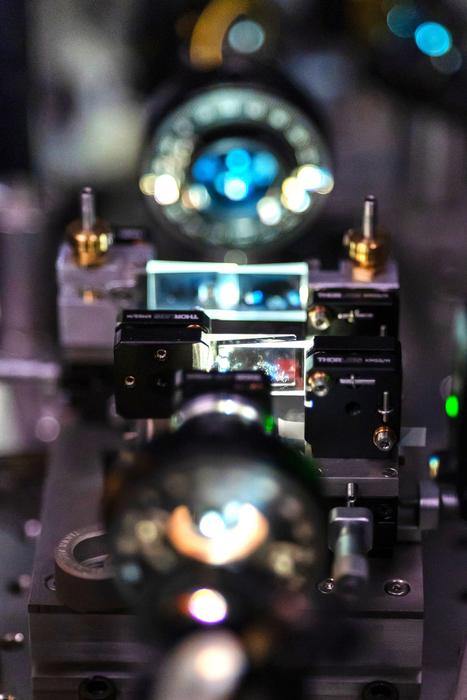

At the forefront of modern physics, the realm of ultrafast dynamics has opened up profound insights into the behavior of electrons within molecules and solids, especially during various critical processes such as chemical reactions and solar energy conversion. For years, researchers have struggled to visualize these phenomena directly due to the ultra-short timescales involved—often in the femtosecond range, equivalent to one quadrillionth of a second. However, thanks to the advent of two-dimensional electronic spectroscopy (2DES), scientists are finally gaining the means to observe these quantum mechanical events in real time.
Historically, two-dimensional electronic spectroscopy has been a complex and intricate technique, utilized primarily by a select group of experts around the world. This method harnesses a sequence of ultrafast laser pulses to excite materials and capture their subsequent dynamics. With its ability to probe the interactions and movements of electrons, 2DES has the potential to revolutionize our understanding of processes fundamental to chemistry, physics, and even emerging technologies such as quantum computing. In an exciting new development, a collaborative team of researchers from Italy and Germany, led by Professor Christoph Lienau from the University of Oldenburg, has uncovered ways to simplify the experimental setup for 2DES.
Lienau envisions a future where this sophisticated tool transitions from being an exclusive methodology for a few experts to a widely accessible technique for researchers everywhere. This journey began when two doctoral students, Daniel Timmer and Daniel Lünemann, made substantial contributions to refining the existing methods for conducting 2DES, culminating in their recent publication in the journal Optica.
In a typical 2DES experiment, researchers utilize a trio of extremely short laser pulses. The initial two pulses, which must replicate each other exactly, ignite the electronic transitions within the material being studied. For instance, in a semiconductor or dye, these excitation pulses can elevate electrons to higher energy states, dramatically altering the optical properties of the material. The third pulse, referred to as a probe pulse, interacts with this excited state to reveal crucial information about the system’s condition.
The intricacies of capturing the time evolution of these processes lie in how effectively researchers can manipulate the timing between each of these pulses. By systematically varying these intervals, scientists can collect a wealth of data about different stages of the electronic dynamics, effectively composing a timeline that visualizes the sequential evolution of these ultrafast processes. This capability is essential for targeting complicated phenomena such as energy transfer during photosynthesis.
Nonetheless, despite the exciting potentials presented by 2DES, implementing the technique poses significant challenges. Lienau notes that the precise control of timing between the initial excitation pulses is particularly problematic. Furthermore, maintaining particular wave shapes for these pulses complicates the experimental setup, creating significant barriers for researchers interested in applying this method to various systems.
In their groundbreaking work, Lienau and his team identified a promising solution to these challenges, building upon a concept known as TWINS—first described by Italian physicist Professor Giulio Cerullo several years earlier. Cerullo’s innovational design includes an interferometer equipped with birefringent crystals that produce two identical replicas of an input pulse, which are then employed for material excitation. While this approach markedly simplifies the emission process compared to existing methodologies, it has traditionally met limitations in achieving full functionality as a multidimensional electronic spectrometer.
The breakthrough moment occurred when Timmer and Lünemann conceptualized an elegant yet straightforward modification to Cerullo’s interferometer by incorporating an optical element known as a delay quarter wave plate. This addition introduces a delay to any light passing through it, allowing unprecedented control over the laser pulses utilized in their studies. The enhancement afforded by this optical adjustment significantly increases the precision with which researchers can manipulate the timing of the laser systems.
Following the successful implementation of their refined technique, the researchers took the opportunity to validate their findings through experiments investigating charge dynamics within an organic dye. Their pioneering method not only showed successful results but also offered a robust theoretical foundation that underpins their research.
As this fascinating field of ultrafast spectroscopy continues to evolve, the innovations introduced by Lienau and his team stand poised to democratize access to 2DES, thus catalyzing broader research applications. They have recently filed a patent for their novel interferometric method, marking a significant step toward making these advanced scientific tools available to a wider array of researchers.
The implications of such breakthroughs cannot be understated; as 2DES becomes more viable for broader use, it promises to pave the way for innovations across various scientific disciplines. Researchers could apply this methodology to better understand complex biochemical processes, optimize solar energy conversion technologies, and further unravel the elusive dynamics of quantum computing.
As we witness the emergence of these advanced methodologies, it becomes clear that the intersection of optics, material science, chemistry, and quantum mechanics will continue to yield insights that enhance our understanding of the universe at its most fundamental levels.
With collaborative efforts and continued innovation in ultrafast dynamics research, we can anticipate a future where methods like 2DES become staple tools for not just physicists but a multitude of scientists seeking to further unravel the intricate tapestry of natural phenomena. As barriers to the experimental implementation of sophisticated techniques diminish, the realm of research will expand, fostering a new generation of discoveries waiting just beyond the horizon.
Subject of Research:
Article Title:
News Publication Date:
Web References:
References:
Image Credits:
Keywords
Tags: advancements in quantum computingchemical reaction dynamicscollaborative research in physicselectron behavior in solidsfemtosecond timescales in physicsinsights into molecular interactionsreal-time observation of quantum eventssimplifying 2DES experimental setupssolar energy conversion processestwo-dimensional electronic spectroscopyultrafast electron dynamicsultrafast laser pulse techniques