• HOME
  • NEWS
  • EXPLORE
    • CAREER
      • Companies
      • Jobs
    • EVENTS
    • iGEM
      • News
      • Team
    • PHOTOS
    • VIDEO
    • WIKI
  • BLOG
  • COMMUNITY
    • FACEBOOK
    • INSTAGRAM
    • TWITTER
Friday, April 3, 2026
BIOENGINEER.ORG
No Result
View All Result
  • Login
  • HOME
  • NEWS
  • EXPLORE
    • CAREER
      • Companies
      • Jobs
        • Lecturer
        • PhD Studentship
        • Postdoc
        • Research Assistant
    • EVENTS
    • iGEM
      • News
      • Team
    • PHOTOS
    • VIDEO
    • WIKI
  • BLOG
  • COMMUNITY
    • FACEBOOK
    • INSTAGRAM
    • TWITTER
  • HOME
  • NEWS
  • EXPLORE
    • CAREER
      • Companies
      • Jobs
        • Lecturer
        • PhD Studentship
        • Postdoc
        • Research Assistant
    • EVENTS
    • iGEM
      • News
      • Team
    • PHOTOS
    • VIDEO
    • WIKI
  • BLOG
  • COMMUNITY
    • FACEBOOK
    • INSTAGRAM
    • TWITTER
No Result
View All Result
Bioengineer.org
No Result
View All Result
Home NEWS Science News Chemistry

Observing changes in the chirality of molecules in real time

Bioengineer by Bioengineer
November 14, 2019
in Chemistry
Reading Time: 3 mins read
0
IMAGE
Share on FacebookShare on TwitterShare on LinkedinShare on RedditShare on Telegram

IMAGE

Credit: ETH Zurich / Joachim Schnabl


Some molecules can exist in two mirror-image forms, similar to our hands. Although such so-called enantiomers have almost identical physical properties, they are not the same. The fact that they behave to each other like image and mirror image is called chirality (from the Greek cheiro for hand). In nature, however, often only one enantiomer exists, for example in amino acids, DNA or sugars. The enzymes that produce these molecules are themselves chiral and therefore only produce one type of enantiomer.

This preference of nature has far-reaching consequences. For example, enantiomers of drugs can have completely different modes of action, such as being toxic or the can be completely ineffective. The food and cosmetics industry are also interested in chirality because fragrances and flavors are perceived differently depending on the enantiomer. Chemists therefore often try to produce only one enantiomer or, if this is not possible, to separate mixtures of enantiomers.

To distinguish enantiomers from each other, chemists use polarized light because the enantiomers rotate the plane of polarized light in opposite directions. The breaking or formation of chemical bonds takes place on a very short time scale, namely within a few femtoseconds (quadrillionths of a second). With the existing measurements, it has not been possible to monitor chirality in such short periods of time and thus follow a chemical process.

Understanding the reactions of chiral molecules

Researchers led by Hans Jakob Wörner, Professor at the Department of Chemistry and Applied Biosciences, have now developed a new method for observing changes in chirality directly during a chemical reaction in real time. The researchers have generated femtosecond laser pulses, with tailor-made temporally varying polarization, which are themselves chiral. This new approach enabled them for the first time to simultaneously achieve the necessary sensitivity to chirality and time resolution.

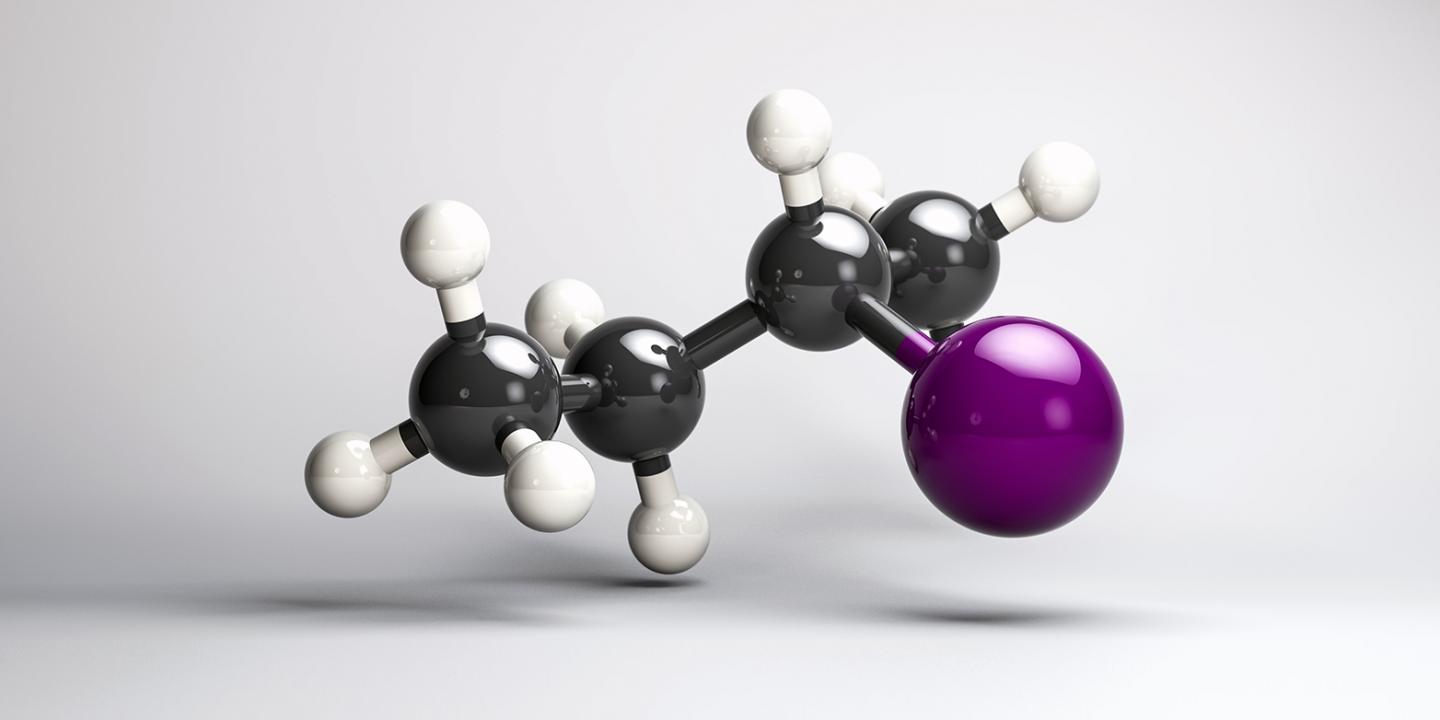
In their experiment, which the scientists reported on in the scientific journal PNAS, they excited the gaseous chiral molecule (R)-2-iodobutane with two ultra-short ultraviolet laser pulses. The excitation caused the bond between carbon and iodine to break. In this process, the 2-butyl radical is initially formed in a chiral conformation, which rapidly loses its chirality. With the help of the newly developed polarized laser pulses, they were then able to follow live how the chirality disappears after the bond break due to the cleavage of the iodine atom.

This new method can also be applied to the liquid or solid phase to observe the extremely rapid changes in molecular chirality, as the scientists say. The possibility of making chiral photochemical processes directly accessible on such short time scales now makes it possible to better understand the reactions of chiral molecules. This could facilitate the development of new or improved methods for the production of enantiomerically pure compounds.

###

Video: https://youtu.be/0HeyShXSuWE
Temporal evolution of molecular chirality during photodissociation of (R)-2-iodobutane. (Video: ETH Zurich / Joachim Schnabl)

Reference

Baykusheva D, Zindel D, Svoboda V, Bommeli E, Ochsner M, Tehlar A, Wörner HJ: Real-time probing of chirality during a chemical reaction, PNAS 2019, doi: 10.1073/pnas.1907189116 [http://dx.doi.org/10.1073/pnas.1907189116]

Media Contact
Prof. Dr. Hans Jakob Wörner
[email protected]
41-446-334-412

Original Source

https://ethz.ch/en/news-and-events/eth-news/news/2019/11/observing-changes-in-chirality-in-real-time.html

Related Journal Article

http://dx.doi.org/10.1073/pnas.1907189116

Tags: Chemistry/Physics/Materials Sciences
Share12Tweet8Share2ShareShareShare2

Related Posts

Engineered Biochar Harnesses Soil Chemistry to Degrade Antibiotic Pollution

Engineered Biochar Harnesses Soil Chemistry to Degrade Antibiotic Pollution

April 2, 2026
From Coffee Waste to Cutting-Edge Biodegradable Insulation: A Green Innovation

From Coffee Waste to Cutting-Edge Biodegradable Insulation: A Green Innovation

April 2, 2026

Study Uncovers Early Origins of Atypical Alterations in Dalí’s The Temptation of St. Anthony (1946), Highlighting Crucial Roles of Amber and Zinc White

April 2, 2026

Racetrack-Shaped Lasers Revolutionize Bright and Stable Frequency Combs

April 2, 2026
Please login to join discussion

POPULAR NEWS

  • blank

    Revolutionary AI Model Enhances Precision in Detecting Food Contamination

    96 shares
    Share 38 Tweet 24
  • Imagine a Social Media Feed That Challenges Your Views Instead of Reinforcing Them

    1007 shares
    Share 398 Tweet 249
  • Promising Outcomes from First Clinical Trials of Gene Regulation in Epilepsy

    51 shares
    Share 20 Tweet 13
  • Popular Anti-Aging Compound Linked to Damage in Corpus Callosum, Study Finds

    44 shares
    Share 18 Tweet 11

About

We bring you the latest biotechnology news from best research centers and universities around the world. Check our website.

Follow us

Recent News

Revolutionary Magnetic Biochar Gel Tackles Arsenic and Antimony Pollution in Rice Cultivation

Engineered Biochar Harnesses Soil Chemistry to Degrade Antibiotic Pollution

Leading Cancer Scientist Thales “PapaG” Papagiannakopoulos Joins Salk Institute

Subscribe to Blog via Email

Enter your email address to subscribe to this blog and receive notifications of new posts by email.

Join 78 other subscribers
  • Contact Us

Bioengineer.org © Copyright 2023 All Rights Reserved.

Welcome Back!

Login to your account below

Forgotten Password?

Retrieve your password

Please enter your username or email address to reset your password.

Log In
No Result
View All Result
  • Homepages
    • Home Page 1
    • Home Page 2
  • News
  • National
  • Business
  • Health
  • Lifestyle
  • Science

Bioengineer.org © Copyright 2023 All Rights Reserved.