Researchers from the National University of Singapore (NUS) share their recent progress in constructing numerical models for fluid mechanics simulations In new book
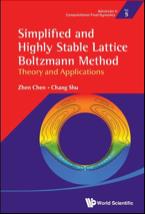
Credit: World Scientific
The lattice Boltzmann method (LBM) has been widely studied for decades. Its popularity in the fluid mechanics community originates from its various advantages such as kinetic nature, simplicity and explicitness. However, coexisting with these merits are some intrinsic limitations like the high cost in virtual memory, inconvenient implementation of physical boundary conditions, and poor numerical stability, which are difficult to be removed by using conventional ways.
Simplified and Highly Stable Lattice Boltzmann Method: Theory and Applications introduces a new methodology, namely the simplified and highly stable lattice Boltzmann method (SHSLBM), for constructing numerical schemes within the lattice Boltzmann framework for simulations of fluid mechanics problems. Through rigorous mathematical derivations and abundant numerical validations, SHSLBM is found to outperform the conventional LBM in terms of memory cost, boundary treatment and numerical stability.
“Many limitations of existing lattice Boltzmann methods stem from their conventional ways of evolution. Without fundamental modifications of the evolution strategy, these intrinsic limitations cannot be truly removed. In this book we introduce a new theory of constructing numerical schemes within the lattice Boltzmann framework, which, at least in the presented areas of applications, shows exciting advantages in memory cost, boundary treatment and numerical stability,” says the lead author Zhen Chen. “Of course, this theory is still on the trajectory of verifying applicability in even broader areas of fluid mechanics. Hopefully, this book could enlighten the readers to nurture lattice Boltzmann methods from an alternative perspective and thus stimulate research in this direction,” adds co-author Chang Shu.
This book spans from the theoretical part to the application of SHSLBM. It provides every necessary detail of the theory and sample codes for implementation. It will serve as a handbook to readers to learn, employ and further develop this novel numerical method.
Simplified and Highly Stable Lattice Boltzmann Method: Theory and Applications retails for US$98 / £85 (hardcover) and is also available in electronic formats. To order or know more about the book, visit http://www.
###
About the Authors
Dr Zhen Chen is a Research Scientist at Temasek Laboratories (T-Lab), National University of Singapore (NUS). He received his BEng and MEng degrees in Naval Architecture and Marine Engineering from Dalian University of Technology (DUT), China. He received his PhD in Mechanical Engineering from NUS and was granted the elite NUS President’s Graduate Fellowship. Dr Chen came to T-lab in 2018 and was jointly appointed as the Teaching Associate by NUS Department of Mechanical Engineering in 2020. Zhen’s research interests mainly lie in the development and refinement of novel numerical schemes as well as their applications in multiphase flows, free-surface flows, and multiscale problems.
Dr Chang Shu is a Professor at Department of Mechanical Engineering, National University of Singapore (NUS). He obtained his PhD degree at University of Glasgow in 1991, and received MEng and BEng degrees from Nanjing University of Aeronautics and Astronautics (NUAA), China, respectively in 1986 and 1983. Dr Shu has been working in the Computational Fluid Dynamics (CFD) for more than 35 years. His major interest is to develop efficient numerical methods to solve flow problems. He also made efforts to establish robust models for simulation of multiphase flows and flows around moving boundaries. So far, he has authored 4 monographs, published about 350 articles in the international referred journals (SCI indexed), and received more than 18000 citations in Google Scholar Profile. Currently, he is the Editor-in-Chief of Advances in Applied Mathematics and Mechanics (AAMM), and the Associate Editor of International Journal for Numerical Methods in Fluids.
About World Scientific Publishing Co.
World Scientific Publishing is a leading international independent publisher of books and journals for the scholarly, research and professional communities. World Scientific collaborates with prestigious organisations like the Nobel Foundation and US National Academies Press to bring high quality academic and professional content to researchers and academics worldwide. The company publishes about 600 books and over 140 journals in various fields annually. To find out more about World Scientific, please visit http://www.
For more information, contact Amanda at [email protected].
Media Contact
Amanda Yun
[email protected]
Original Source
https:/